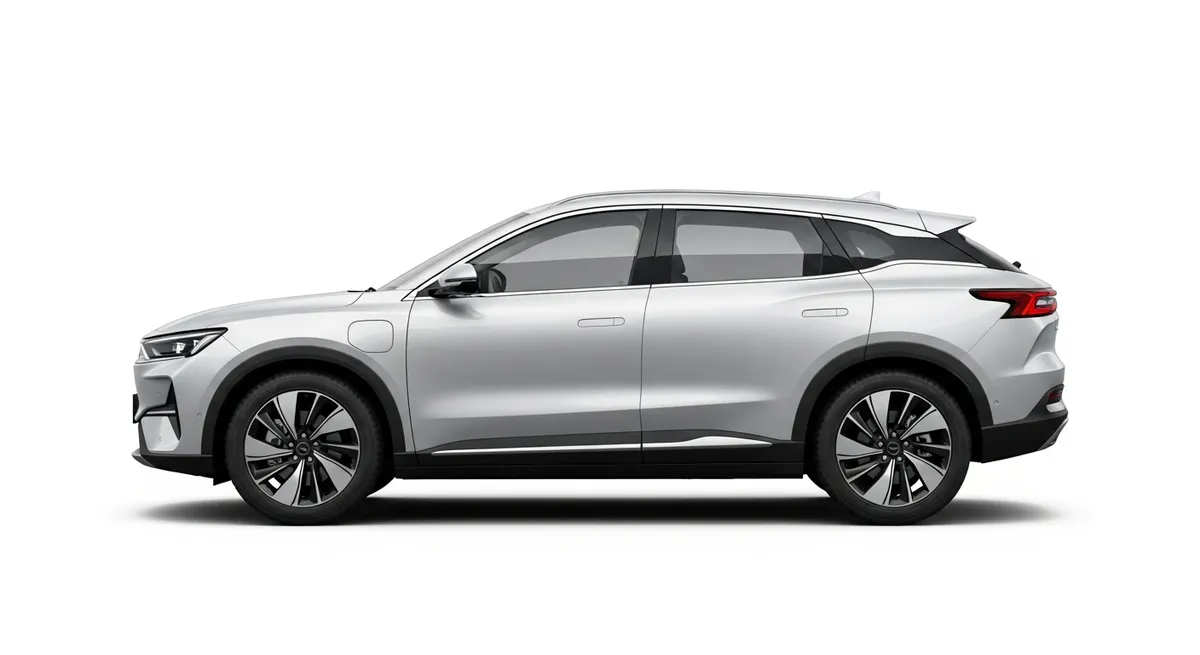

Chery has confirmed the South African lineup for iCAUR, its retro-futuristic EV brand, ahead of a May 2026 launch—and the timing couldn’t be sharper. The V23 all-electric SUV will land at 15 dealerships nationwide with indicative pricing around R550,000, just as diesel breaches R30 per litre and BYD begins rolling out 200–300 megawatt Flash charging stations across SA highways.
The announcement positions Chery to ride a structural shift in the local market. BYD sold 705 units in April 2026, ranking 21st among all carmakers—ahead of Honda and Mitsubishi—as fuel-price pain finally tips fleet operators and private buyers toward electric. iCAUR’s three-model lineup (V23 BEV, V27 range-extender hybrid, 03T electric SUV) brings what Chery calls “emotional design” and factory customisation hubs to a segment dominated by clinical appliances.
The government’s 150% tax deduction for EV manufacturing investments went live on 1 March 2026, Toyota is launching three battery-electric models this year, and charging infrastructure is expanding faster than at any point in SA’s EV history. iCAUR’s arrival is less about pioneering and more about catching a wave that’s already building.
What is iCAUR and why is it launching in South Africa?
iCAUR is Chery’s standalone EV brand, spun off to target younger, lifestyle-focused buyers who see cars as extensions of identity rather than appliances. The name blends “i” (intelligent), “CA” (car) and “UR” (you are), reflecting a philosophy of co-creation: buyers specify colours, wraps, roof racks and adventure gear at the dealership before the vehicle leaves the factory. Chery confirmed these “personalisation hubs” will be standard at all 15 SA outlets by launch.
Why South Africa? According to iCAUR’s brand statement, “South Africa is a country with a rich outdoor lifestyle, vibrant urban culture, and an increasingly energy-conscious mindset. These are the communities iCAUR is built for.” The brand’s retro-futuristic aesthetic—boxy silhouettes, circular LED headlamps, rugged cladding—is designed to evoke Land Rover Defender nostalgia while delivering LFP battery reliability and sub-25-minute fast charging.
The timing aligns with a structural shift in SA’s automotive market. BYD sold 705 units in April 2026, ranking 21st among all carmakers—ahead of Honda and Mitsubishi—as diesel climbed above R30 per litre. Fleet operators and private buyers are calculating total cost of ownership differently, and iCAUR’s 10–80% charge time of approximately 22 minutes (per Sowetan’s first-drive report) makes it practical for long-distance travel on SA’s improving charging network.
The South African lineup: V23, V27 and 03T specifications
iCAUR confirmed three models for the local market, each addressing a different buyer segment:
| Model | Powertrain | Battery (kWh) | Range (km) | Power (kW) | 0–100 km/h (sec) | Indicative Price (ZAR) |
|---|---|---|---|---|---|---|
| V23 2WD | BEV | 65.7 / 69.8 | 426 / 418 (NEDC) | 184 | — | ~R550,000 |
| V23 iWD | BEV | 65.7 / 69.8 | 426 / 418 (NEDC) | Dual-motor AWD | — | TBA |
| 03T (iCAR 03) | BEV | LFP (size TBA) | 501 (CLTC) | 184 | — | TBA |
| V27 REEV | Range Extender | 34.3 (+ 1.5L turbo) | 156 EV / 1,000+ total | 339 (dual-motor) | 5.0 | TBA |
The V23 is the volume play: a compact SUV (4,406 mm long, 2,715 mm wheelbase) with LFP chemistry for thermal stability in SA’s climate. YouTube reviewers have called it “loveable nonsense,” praising its 600 mm wading depth and off-road credentials while noting the boxy design won’t appeal to everyone. Indicative pricing around R550,000 positions it between the BYD Atto 3 and GWM Ora, though final pricing will be confirmed at launch.
The V27 flagship: range-extender for long-distance confidence
The V27 REEV is iCAUR’s answer to range anxiety. Its 34.3 kWh battery delivers 156 km of pure-electric range, then a 1.5-litre turbo engine (45.79% thermal efficiency) generates electricity to extend total range beyond 1,000 km. At 339 kW from a dual-motor setup, it hits 100 km/h in 5.0 seconds—faster than most diesel SUVs—while offering 6 kW of external power output for camping or emergency backup. The chassis was tuned by Prodrive, the motorsport engineering firm, and 76% of the body is high-strength steel. It earned five-star safety ratings in China and Europe.
The V27’s 5,000+ mm length and 2,900 mm wheelbase make it a direct rival to the Toyota Fortuner and Ford Everest, but with the ability to run on electricity alone for daily commutes. For SA buyers nervous about charging infrastructure gaps, the REEV formula offers a hedge: pure EV driving in cities, petrol backup on remote routes.
What this means for South African EV buyers
iCAUR’s launch arrives at an inflection point. Three forces are converging to make EVs viable for mainstream SA buyers:
1. Fuel-price pain: Diesel above R30/l is pushing fleet total-cost-of-ownership calculations in EVs’ favour. TechCentral reports that BYD’s April 2026 sales surge (705 units, 21st overall) reflects this shift. iCAUR’s V27 REEV hedges the bet: you get EV economics for 80% of your driving (the daily 50 km commute) without range anxiety on the annual Cape Town–Durban road trip.
2. Charging infrastructure acceleration: BYD’s 200–300 Flash charging stations (up to 1 MW) will blanket SA highways by end-2026, starting April/May 2026. Zero Carbon Charge is building two fully off-grid solar charging hubs on the N3 by June 2026, bypassing Eskom’s unreliable grid. GridCars operates over 450 public stations (650 chargers, 1,200+ connectors), and the Eastern Cape added 11 new sites (nine with DC fast charging) between January and February 2026. The V23’s 22-minute 10–80% charge time becomes practical when chargers are 150 km apart, not 400 km.
3. Government incentives: The 150% tax deduction for EV manufacturing investments went live 1 March 2026, designed to attract OEMs and protect SA’s export position as the EU and UK ban ICE sales by 2035. While iCAUR’s vehicles will initially be imported, Chery’s long-term SA presence (it already assembles ICE models locally) positions it to leverage this incentive if volumes justify local battery-pack assembly.
How iCAUR compares to the competition
iCAUR enters a crowded field. BYD dominates (705 April sales), Toyota is launching three BEVs in 2026 including the bZ4X, and Chery’s own Q EV will undercut the Geely E2 and BYD Dolphin Surf later in 2026 to become SA’s cheapest EV. iCAUR’s differentiator is emotional resonance: the brand targets buyers who want a vehicle that signals adventure and individuality, not just low running costs. The factory customisation hubs—where you spec a matte-green wrap, all-terrain tyres and a rooftop tent before delivery—are designed to make each iCAUR feel bespoke.
Charging costs remain higher than home rates: public DC charging averages R7.00–R7.35 per kWh (Rubicon and GridCars), versus R3.00–R4.00 per kWh at home. But the V23’s 65.7 kWh battery costs roughly R460 to charge at home (full empty-to-full), delivering 426 km—about R1.08 per km. A diesel SUV averaging 8 l/100 km at R30/l costs R2.40 per km. Over 20,000 km per year, that’s a R26,400 annual saving, even before factoring in lower maintenance (no oil changes, fewer brake replacements thanks to regenerative braking).
Stakeholder reactions: automakers, government and installers
Chery’s local statement frames iCAUR as a lifestyle play. “iCAUR brings a new energy to the market, combining striking design with advanced EV technology and a playful, user-centric spirit,” the company said in its Q1 2026 announcement. “We’re here to make electric motoring more personal, more joyful and, importantly, more accessible.”
The government’s 150% manufacturing incentive signals long-term commitment, but infrastructure gaps remain the biggest barrier. GridCars and Rubicon operate 560 public stations combined, but highway coverage is patchy outside Gauteng and the Western Cape. BYD’s megawatt network and CHARGE’s solar hubs address this, yet the rollout timelines (April–December 2026) mean early iCAUR buyers will still face range planning on routes like the N1 to Polokwane or the N2 Garden Route.
For EV charger installers like ChargePoint SA, iCAUR’s arrival expands the addressable market. The V23’s 11 kW onboard AC charger (inferred from 22-minute DC fast-charge spec) means a 7.4 kW home wallbox can fully charge the 65.7 kWh battery overnight in about 9 hours—practical for most households. The V27’s 6 kW external power output also creates demand for bidirectional chargers that can use the vehicle as a home backup during load-shedding, though vehicle-to-grid (V2G) regulation in SA remains unclear.
What’s next: timeline and what to watch
iCAUR’s May 2026 launch is imminent. Key milestones to watch:
- April 2026: BYD’s first Flash charging stations go live, setting the benchmark for charge speed and network density.
- May 2026: iCAUR V23 and 03T arrive at 15 dealerships; final pricing and finance offers confirmed.
- June 2026: CHARGE’s two N3 solar charging hubs open, demonstrating off-grid viability for long-distance EV travel.
- Q3 2026: V27 REEV launch; Chery Q EV pricing announced (expected to undercut R340,000).
- End-2026: BYD completes 200–300 station rollout; Toyota’s three BEVs hit the market.
The wildcard is load-shedding. If Eskom’s grid instability persists, off-grid solar charging (CHARGE’s model) and home battery-plus-solar-plus-EV ecosystems will accelerate. iCAUR’s V27, with its 6 kW external output, positions itself as a mobile generator—a hedge against both fuel prices and grid failures.
Ready to charge smarter?
If the iCAUR V23, V27 or any of 2026’s incoming EVs are on your radar, now is the time to future-proof your home. A 7.4 kW or 11 kW wallbox cuts charging time by 60% compared to a standard 3-pin plug, and a properly sized installation ensures you’re not tripping breakers or overloading your DB board during overnight top-ups.
ChargePoint SA designs and installs EV charging solutions nationwide—from single-phase home wallboxes to three-phase commercial setups. We’ll assess your electrical capacity, recommend the right charger for your vehicle and driving patterns, and handle the full installation with a COC. Get a free site assessment and quote today, and make sure your driveway is ready before your iCAUR arrives in May.
Image credits
Image: Chery / iCAUR (press kit, via finance.yahoo.com) · Image: Chery / iCAUR (press kit, via finance.yahoo.com) · Image: Chery / iCAUR (press kit, via finance.yahoo.com) · Image: Chery / iCAUR (press kit, via finance.yahoo.com)