
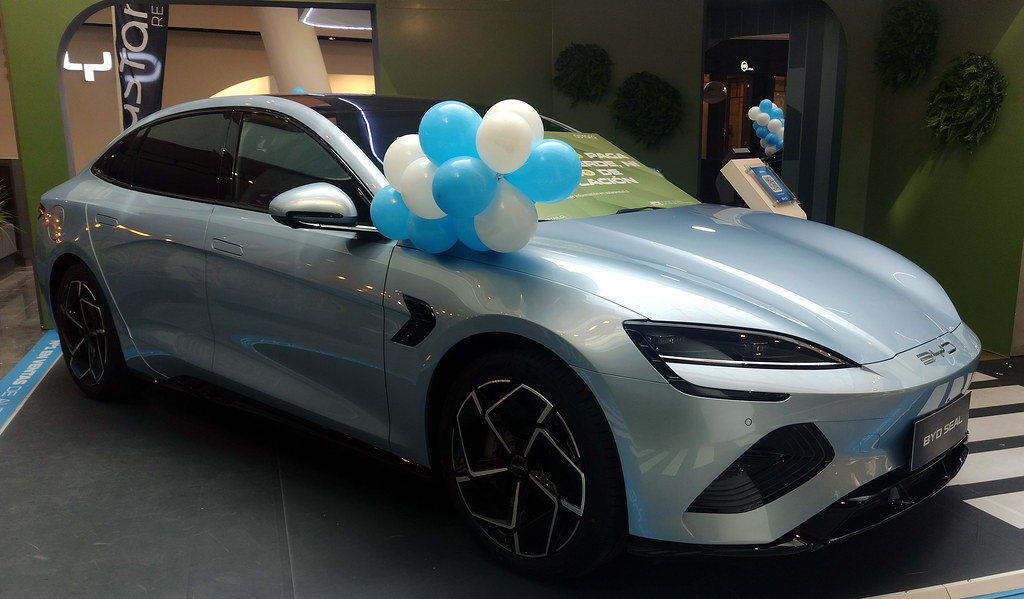
BYD Seal vs BMW 3 Series 320i: Which Should You Buy in 2025?
Considering switching to an EV? This comprehensive comparison between the BYD Seal and the BMW 3 Series 320i will help you make the right decision for your wallet and lifestyle in South Africa.
📊 Quick Comparison Overview
| Feature | BYD Seal | BMW 3 Series 320i |
|---|---|---|
| Purchase Price | R959,900 | R900,000 |
| 5-Year Fuel Cost | R55,905 | R112,125 |
| 5-Year Maintenance | R15,000 | R40,000 |
| Total Cost of Ownership | R1,030,805 | R1,052,125 |
| Winner | EV wins by R21,320! | |
Note: This TCO comparison includes purchase price, fuel, and basic maintenance only. Insurance, depreciation, and financing costs will vary by individual circumstances and should be factored into your personal decision.
💰 The Real Cost: 5-Year Ownership Analysis
Here’s where electric vehicles shine. While the BYD Seal costs R959,900 upfront compared to the BMW 3 Series 320i’s R900,000, the total cost of ownership tells a different story.
Fuel Costs Breakdown
- BYD Seal electricity cost: R11,181/year = R55,905 over 5 years
- BMW 3 Series 320i petrol cost: R22,425/year = R112,125 over 5 years
- Fuel savings with EV: R56,220 over 5 years
Maintenance Costs
- BYD Seal: R15,000 (minimal – no oil changes, less brake wear)
- BMW 3 Series 320i: R40,000 (regular servicing, oil, filters, etc.)
- Maintenance savings with EV: R25,000
🔋 Understanding Range and Daily Driving
The BYD Seal offers a 570km range on a single charge—more than enough for typical South African driving patterns. Most SA drivers cover less than 100km per day, meaning you’ll charge once or twice per week with normal use.
For context, a daily commute from Sandton to Pretoria and back (approximately 100km) uses less than 20% of the Seal’s battery. Weekend trips to the Cradle of Humankind or a day at Hartbeespoort Dam are easily manageable without charging stops.
When Range Becomes a Consideration
Long-distance travel requires planning with an EV. A Johannesburg-to-Durban trip (570km) would need a charging stop, whereas the BMW can refuel in five minutes at any petrol station along the N3. For most daily driving scenarios—commuting, school runs, shopping trips—the Seal’s range provides ample buffer. Even a full day of errands covering 150km leaves you with over 70% battery remaining.
Real-World Range Factors
Your actual range will vary based on driving style, weather, and terrain. Highway driving at 120km/h consumes more energy than city driving, where regenerative braking recovers power. Air conditioning in Gauteng’s summer heat or heater use in Cape Town’s winter can reduce range by 10-15%. Plan for 450-500km of usable range in mixed conditions to avoid range anxiety.
🎯 Who Should Buy the BYD Seal?
The BYD Seal is perfect for you if:
- 💰 Budget-conscious long-term: Save R355 per month on running costs
- 🏠 Home charging available: Wake up to a “full tank” every morning for just R932/month
- 🌆 City/suburban driving: Perfect for daily commutes and weekend trips within practical range
- 🔧 Low maintenance priority: No oil changes, no exhaust systems, minimal brake wear
- 🌍 Environmental responsibility: Zero tailpipe emissions in SA’s cities
- ⚡ Modern technology: Latest infotainment, over-the-air updates, advanced safety features
🎯 Who Should Buy the BMW 3 Series 320i?
The BMW 3 Series 320i makes sense if:
- 💵 Lower upfront cost needed: R59,900 cheaper to purchase
- ⛽ Long-distance flexibility: Refuel anywhere in 5 minutes with petrol stations everywhere
- 🚗 Heavy towing/off-road: 2.0L engine provides proven capability
- 📍 Rural/remote areas: No charging infrastructure concerns
- 🔋 No home charging option: Petrol stations remain more accessible for now
- 👴 Familiar technology: Comfortable with traditional vehicle ownership
💡 Key Decision Factors
Choose the BYD Seal if you:
- ✅ Typically drive less than 200km per day
- ✅ Have access to home charging or workplace charging
- ✅ Want to save R355 per month on running costs
- ✅ Prioritize lower maintenance and running costs
- ✅ Want zero tailpipe emissions
- ✅ Can manage the higher upfront cost
Choose the BMW 3 Series 320i if you:
- ✅ Need maximum flexibility for long-distance travel
- ✅ Don’t have reliable charging access
- ✅ Frequently drive routes longer than 400km without breaks
- ✅ Need to minimize upfront costs
- ✅ Prefer the familiarity of petrol stations
- ✅ Live in an area with limited charging infrastructure
🔋 Charging Infrastructure in South Africa
South Africa’s EV charging network is growing rapidly, with over 500 public charging points nationwide. Major cities like Johannesburg, Cape Town, Durban, and Pretoria have excellent coverage, while secondary routes are seeing steady expansion.
Home charging transforms the EV experience: Installing a home charger (R15,000-R30,000) gives you a “full tank” every morning at a fraction of petrol costs. You’ll never need to visit a petrol station for your daily driving. Most owners charge overnight during off-peak hours when electricity rates are lowest, typically adding 300-400km of range in 6-8 hours.
Public charging is available at shopping centres, hotels, and along major routes. Apps like ChargePoint’s live charging map help you locate stations and check availability in real-time. Fast-charging stations can add 200km of range in 30 minutes—perfect for a coffee break on longer trips.
Load-Shedding Considerations
Load-shedding affects both EVs and petrol stations (pumps need electricity). However, home charging during off-peak hours or with solar panels gives EV owners more control. Many ChargePoint customers pair their home chargers with battery storage for uninterrupted charging. Smart chargers can also schedule charging to avoid load-shedding windows automatically.
For apartment dwellers without dedicated parking, the equation changes. Public charging becomes your primary option, which adds time and planning to your routine. Some body corporates are installing shared charging facilities, but this infrastructure is still developing in South Africa.
📈 Long-Term Value and Ownership Costs
Over 5 years of ownership (15,000km/year):
- Total savings with BYD Seal: R21,320
- Monthly savings: R355
- Cost per kilometer – BYD Seal: R13.74
- Cost per kilometer – BMW 3 Series 320i: R14.03
Resale Value Outlook
EV resale values in South Africa are still establishing themselves. Early indicators suggest strong demand for used EVs as charging infrastructure expands, but the market is younger than the established petrol vehicle market. Factor this uncertainty into your decision if you plan to sell within 3-5 years. Battery degradation—typically 5-10% capacity loss over five years—also affects resale values, though modern batteries like the Seal’s BYD Blade battery show excellent longevity.
Warranty and Service Plans
The BYD Seal typically includes a 6-year/150,000km vehicle warranty and an 8-year battery warranty, providing peace of mind for long-term ownership. BMW offers a 2-year/unlimited km warranty with optional service plans. Extended warranties and maintenance plans should be factored into your total cost calculations, as they vary significantly between brands and can add R20,000-R50,000 to ownership costs.
🌍 Environmental Impact
By choosing the BYD Seal over the BMW 3 Series 320i, you’ll prevent approximately 11,261kg of CO₂ from entering the atmosphere over 5 years—equivalent to planting roughly 500 trees.
Even accounting for South Africa’s coal-heavy electricity grid, EVs produce significantly fewer emissions over their lifetime than petrol vehicles. As our grid incorporates more renewable energy, this advantage grows. If you charge with solar power at home, your carbon footprint drops even further, making the Seal nearly carbon-neutral for daily driving.
🚗 Performance and Driving Experience
Beyond costs, the driving experience differs substantially. The BYD Seal delivers instant torque from its electric motor, providing brisk acceleration that feels more responsive than the BMW’s 2.0L turbocharged engine in city traffic. The Seal’s lower centre of gravity (battery pack mounted in the floor) contributes to stable, planted handling through corners.
The BMW 3 Series 320i counters with refined engine note, proven dynamics, and the tactile feedback BMW is known for. For driving enthusiasts who value traditional sports sedan characteristics, the BMW’s steering feel and chassis balance may outweigh the Seal’s electric advantages. Test-driving both is essential—they represent fundamentally different philosophies.
🏁 The Verdict
It’s Close: Consider Your Priorities
The cost difference is relatively small—just R21,320 over 5 years (R355/month). Your decision should be based on lifestyle factors:
- Choose the BYD Seal if environmental impact, modern technology, and home charging convenience matter to you
- Choose the BMW 3 Series 320i if maximum flexibility, lower upfront cost, and established refuelling infrastructure are priorities
Both are solid choices at this price point. The Seal offers a glimpse of the future with lower running costs, while the BMW provides the proven flexibility of petrol power. Neither choice is wrong—it depends on your daily driving patterns, charging access, and whether you’re ready to embrace electric mobility.
💰 Calculate Your Own Savings
Want to see how much you could save based on your specific driving habits? Use our EV Cost Savings Calculator to input your exact annual kilometres, electricity rate, and more. The calculator accounts for your local Eskom tariffs and driving patterns to give you a personalized comparison.
🚗 Ready to Make the Switch?
Need help installing a home charger for your new EV? Get a free quote for professional EV charger installation anywhere in South Africa. Our certified installers handle everything from electrical compliance to smart charger setup, ensuring your home is ready for electric vehicle ownership.
Last updated: December 2024
Continue Reading
Deprecated: File Theme without comments.php is deprecated since version 3.0.0 with no alternative available. Please include a comments.php template in your theme. in /var/www/wordpress/wp-includes/functions.php on line 6085
Leave a Reply