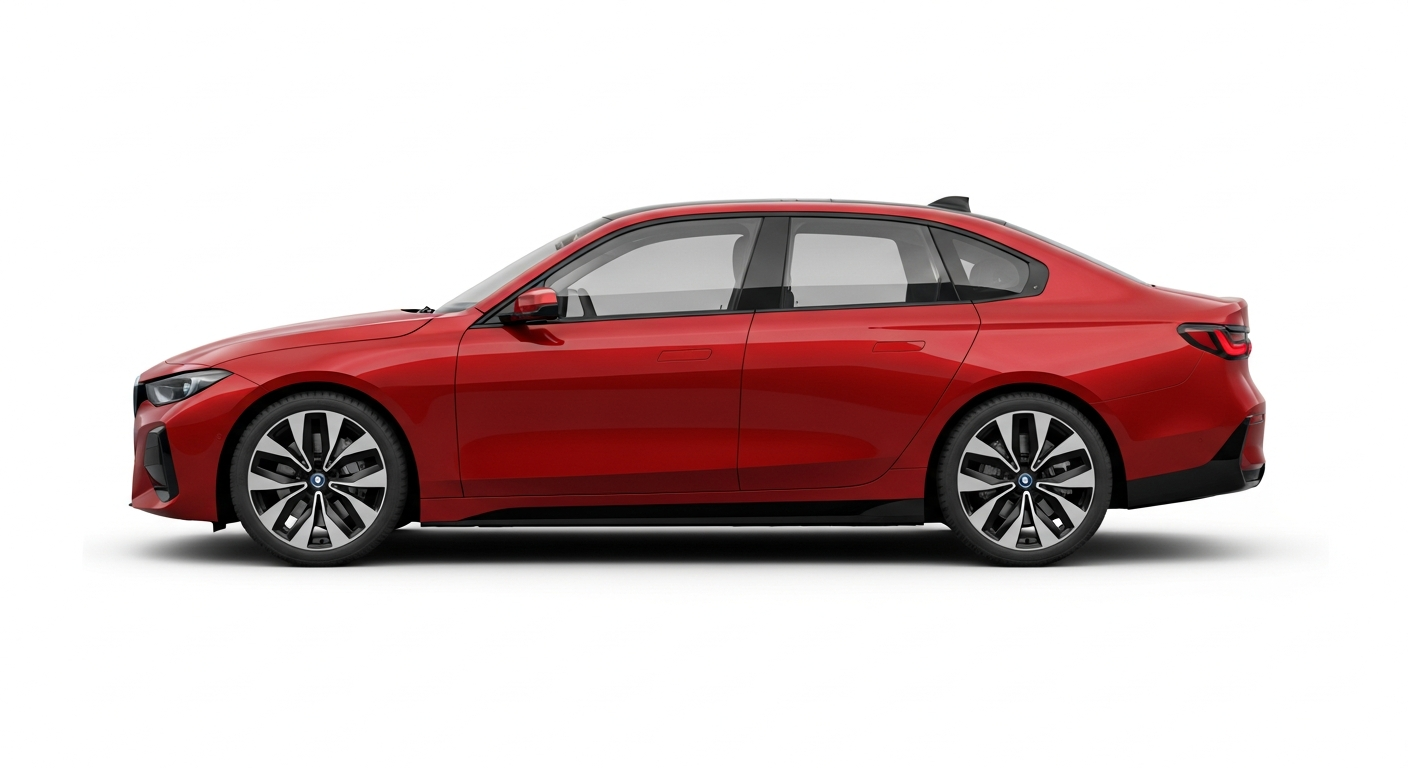
According to BMW’s official Neue Klasse announcement, the fully electric i3 Sedan will be available from Q1 2027, with a claimed range of up to 900 km on the WLTP cycle.
This is not a niche city car or an experimental SUV. This is the 3 Series — BMW’s most important model, the car that has defined what a driver’s sedan should be for half a century. And it’s going electric. Here, in South Africa, next year.
Unveiled in 50 xDrive guise, the BMW i3 employs a dual electric-motor powertrain producing a combined system output of 345 kW and 645 Nm of torque. BMW has yet to announce 0–100 km/h sprint times and top speed.
But here’s the thing:
it is capable of DC fast charging up to 400 kW, going from 10% to 80% in 21 minutes and adding 400 km of range in 10 minutes.
That second stat is arguably more important than any power figure.
Based on BMW’s global Neue Klasse rollout timeline, the fully electric i3 50 xDrive will arrive in South Africa in Q1 2027 as the first all-electric BMW 3 Series in the local market, built on the new Neue Klasse platform.
For premium EV buyers who’ve been waiting for something with actual BMW DNA rather than a badge slapped on borrowed tech — the wait is almost over.
What Is “Neue Klasse” and Why Should You Care?
The name “Neue Klasse” — German for “New Class” — is a deliberate nod to BMW’s iconic 1960s reinvention, when the brand pivoted away from bubble cars and luxury barges to define a new category of sporting saloon. That car saved BMW. This platform is meant to do the same thing for the electric era.
BMW’s Neue Klasse era is about to enter full swing with the i3 Sedan, built entirely on the new Neue Klasse platform — not a modified version of today’s G20 3 Series, but a clean-sheet electric architecture and design that will define BMW’s future lineup of sedans.
Powering the i3 lineup is BMW’s sixth-generation eDrive technology. At its core is a new cylindrical battery cell format, which replaces the previous prismatic and pouch cells with a more efficient and compact design. These Gen6 batteries offer a 20% increase in energy density, 30% faster charging, and up to 25% greater range.
That last number is the one that unlocks the 900 km claim.
Similar to other 800-volt EVs, the i3 is built on an 800-volt architecture. The i3 50 xDrive features a 108 kWh (usable) NMC lithium-ion battery offering up to 900 km of WLTP range. (Note: Some international materials reference a 710 km EPA estimate. EPA testing typically yields results 15–20% lower than WLTP due to different test cycles and conditions. The 900 km WLTP figure remains the binding standard for SA market claims and is consistent with the 108 kWh battery capacity and Gen6 eDrive efficiency gains.)
The 900 km Range Claim: What It Actually Means in South Africa
Let’s be honest with each other. WLTP figures are tested in laboratory conditions — controlled temperature, no aircon blasting, speeds that would have you overtaken on the N1 by a fully loaded Isuzu bakkie.
Since no binding WLTP values are currently available for the BMW i3 50 xDrive, these are provisional values. The actual values depend on various factors, such as load, driving style, route, weather, and auxiliary consumers including air conditioning.
Real-world estimate for SA conditions — 120 km/h highway cruising, aircon on, a passenger and luggage — is closer to 700–750 km. Still remarkable. Because here’s what 700 km actually means on a map: Cape Town to George (400 km) with zero charging. Johannesburg to Durban (570 km) on a single charge or none if you start full. Cape Town to Johannesburg (1,400 km) with ONE 10-minute stop. That is range anxiety solved. Not managed. Solved.
For context,
the Neue Klasse platform delivers 30% faster charging speeds and a 30% increase in range compared to current BMW EVs.
The current BMW i4 eDrive40 — the longest-range BMW on sale in SA today — claims 590 km WLTP, which translates to roughly 450 km in the real world. The i3 improves on that by over 50%.
Cape Town to Johannesburg on ONE 10-minute charging stop. That is range anxiety not managed, but eliminated.
If you’re currently weighing up EVs for a long-distance lifestyle, our EV cost and range calculator lets you model exactly how the i3 would perform against your actual driving routes and current fuel spend.

How Much Could You Save With an EV?
Use our free calculator to compare your current fuel costs with EV charging costs.
10-Minute Charging: The Spec That Changes Everything
The i3 incorporates an 800V electrical architecture and a battery that can be charged at up to 400 kW on DC power, which will allow up to 400 km of range to be added in a claimed 10 minutes, and at up to 22 kW on AC power.
To put that in perspective: current 400V EVs charging at 150 kW need 30+ minutes to add 200–300 km. The i3 is doing roughly three to four times more range per minute of charging.
The obvious SA question: do we have 400 kW chargers? Honestly, not yet at scale. GridCars’ network sits mostly at 50–150 kW today. But by Q1 2027, the trajectory is clear — according to GridCars’ public expansion roadmap, ultra-fast charging infrastructure is being rolled out with spacing of roughly 150 km, targeting 350 kW+ capability, with the N1, N2, and N3 corridors the priority. The infrastructure is racing to meet the cars, not the other way around.
And here’s the thing people miss: even on a 150 kW charger — the most common type available today — the i3’s 800V architecture charges more efficiently than current 400V cars. You’re still adding range faster per minute than in an i4 or a Model 3 Long Range on the same charger. The 400 kW figure is the ceiling; the 800V system raises the floor. Check our live charging map to see where ultra-fast chargers are already operating and where new ones are coming.
345 kW and V2H: Power in Both Directions
At launch the i3 will be offered as the i3 50 xDrive, featuring a dual-motor all-wheel drive setup producing 345 kW and 645 Nm, giving it performance that sits comfortably within the expectations of a modern BMW sedan.
To give that figure some context: the BMW M340i petrol makes 275 kW. The Mercedes-AMG C43 produces 300 kW. The i3 tops both — before you factor in the instant torque delivery that makes electric power feel so much more visceral off the line.
BMW hasn’t confirmed the 0–100 km/h time yet, but with 345 kW, 645 Nm, and AWD on tap, expect something in the 4.5–5 second region.
We reckon it should be well under 5 seconds.
That puts it firmly in sports sedan territory.
But the power story goes both ways.
The i3’s sixth-generation eDrive setup incorporates 800V technology allowing for vehicle-to-load (V2L), vehicle-to-home (V2H), and vehicle-to-grid (V2G) bi-directional charging. This means the i3’s battery can be used to power external devices (V2L), act as a power source for a house (V2H), and feed energy back into the power grid (V2G).
For South African buyers, V2H is the killer feature. Load-shedding has been absent for over 300 consecutive days as of April 2026 — but nobody has forgotten Stage 6. A 108 kWh battery is enough to power an average South African home for two to three days. That’s a Tesla Powerwall on wheels, included in the purchase price. You can braai, run the lights, keep the Wi-Fi alive, all from the car parked in the garage.
Design and Dimensions: Bigger, Bolder, Still a BMW
The i3 has dimensions of 4,760 mm in length, a wheelbase of 2,898 mm, height of 1,481 mm and width of 1,864 mm.
Compare that to the current G20 3 Series: the i3 is 64 mm longer, 38 mm wider, 40 mm taller, with a 46 mm longer wheelbase. More interior space in every direction — and crucially, no transmission tunnel eating into the rear footwell.
The i3’s front fascia is characterised by the most modern interpretation of BMW’s signature kidney grille. According to BMW Group press materials, the grille and twin headlamp array merge to form an innovative lighting signature. It’s a bold look that signals this is not merely an electrified 3 Series, but a distinct model with its own visual identity.
Called a 2.5-box design by BMW instead of a traditional three-box sedan, the i3 rides on 21-inch alloy wheels and debuts a new colour option called M Le Castellet Blue Metallic, named after the Le Castellet or Paul Ricard circuit in France.
That name is doing a lot of work. This is not a car BMW is embarrassed by.
BMW has loaded the 2027 i3 with the full Panoramic iDrive system: a windscreen projection running from A-pillar to A-pillar, a 17.9-inch central display, an optional 3D head-up display, and steering wheel controls that only illuminate when their functions are available.
The traditional instrument cluster is gone. In its place, the Panoramic Vision display projects critical information across the base of the windshield — speed, navigation, driver assists — in a full-width strip that keeps your eyes on the road rather than buried in a screen.
Ready to Install a Home Charger?
Get a free, no-obligation quote for professional EV charger installation in South Africa.
How It Stacks Up: i3 vs the Competition in South Africa
The i3 lands in an increasingly competitive segment. Here’s where it stands against the cars it will face in SA showrooms:
| Model | Est. SA Price | Range (WLTP) | Power | Charging |
|---|---|---|---|---|
| BMW i3 50 xDrive | R1.2–1.5M (est.) | 900 km | 345 kW | 400 kW DC / 800V |
| Tesla Model 3 Long Range | ~R1.05M | 629 km | 346 kW | 250 kW DC / 400V |
| BMW i4 eDrive40 | R1.2–1.4M | 590 km | 250 kW | 205 kW DC / 400V |
| Mercedes-Benz EQE 350+ | R1.6–2.2M | 654 km | 215 kW | 170 kW DC / 400V |
| BMW 330i petrol | R900K–R1M | N/A | 190 kW | Petrol only |
The Tesla Model 3 Long Range is the closest rival on performance and price, but the i3 extends its range advantage by 270 km and brings 800V fast charging to a segment where nothing else offers it. The i4 eDrive40 — BMW’s current electric sedan — is effectively retired by this car. Gen5, 400V, 590 km WLTP. It’s old tech now. The i3 is the future.
The EQE is more luxurious but significantly more expensive and noticeably less powerful. And if you’re comparing to the Porsche Taycan, you’re looking at R600K more for 343–416 km less range. The i3 makes that conversation very uncomfortable for Stuttgart.
The Real Cost of Ownership: Petrol vs Electric
Let’s talk money, because this is where the argument for waiting gets compelling. A BMW 330i costs around R950,000. At R23.84 per litre of petrol (April 2026 inland 95 octane pump price) and an optimistic 15 km per litre, you’re paying R1.59 per kilometre in fuel alone. Over 15,000 km per year, that’s R23,850 in fuel annually. Over five years: R119,250 — just in petrol.
The i3, charged at home on off-peak rates in Cape Town (approximately R1.89/kWh), consumes around 18 kWh per 100 km, which works out to R0.34 per kilometre. That same 15,000 km per year costs R5,100 in “fuel.” Over five years: R25,500 total. The five-year fuel saving versus the 330i: R93,750. If petrol creeps toward R28/litre by late 2026 — well within forecasted range — that saving stretches past R114,000 over five years.
Yes, the i3 will cost more to buy — estimate R1.2–1.5 million versus R950,000 for a 330i. But when you add fuel and servicing over five years, the total cost of ownership gap narrows to roughly R3,100 per month. For 345 kW, 900 km of range, and a car that future-proofs your garage against whatever the fuel price does next — that’s a premium most buyers in this bracket will accept with a clear conscience. Calculate your own fuel savings here using your actual annual mileage and current fuel spend.
Find Charging Stations Near You
Explore our live map of EV charging stations across South Africa — updated in real time.
Home Charging: What You’ll Need
The i3 supports AC home charging at up to 22 kW, though most SA installations will deliver either 11 kW (three-phase) or 7.4 kW (single-phase). At 11 kW, a full charge from empty takes roughly nine to ten hours — overnight, done. At 7.4 kW, expect thirteen to fourteen hours. Either way, you wake up to a full “tank” every morning.
A three-phase 11 kW wallbox installation typically costs R12,000–R22,000 in South Africa, including wiring, the wallbox unit, and your Certificate of Compliance. Single-phase 7.4 kW sits at R8,000–R15,000. If you’re in a complex or an estate, check your body corporate rules early — that conversation is worth having six months before your car arrives rather than the week before delivery.
Planning ahead for a BMW i3? Get a free home charger installation quote and we’ll spec the right solution for your property — whether that’s a single-phase setup for a flat or a full three-phase 11 kW installation for a freestanding home.
The M Performance Version: Coming 2028
If 345 kW isn’t enough for you — and honestly, it should be — BMW has something considerably more alarming in development.
A full-fat M model is in the works and will be introduced in the near future. The halo all-electric 3 Series will be equipped with four electric motors, each driving an individual wheel. Reports have suggested it will produce around 1,000 kW — supercar territory, acceleration that would have seemed impossible for a four-door sedan just a few years ago.
The quad-motor setup also allows for torque vectoring at each wheel, potentially offering handling characteristics that no mechanical all-wheel-drive system can match.
Sub-3-second 0–100 km/h is expected. Price? Likely R2.5–R3 million. But then, you’d be buying a four-door supercar. Stranger things have happened.
FAQ
When exactly can I buy the BMW i3 in South Africa?
The fully electric BMW i3 Sedan will be available from Q1 2027
— that’s January to March 2027.
Despite BMW’s expansive local production, the i3 50 xDrive will be built in Germany, specifically in the Milbertshofen plant. Production starts from August 2026, but South African buyers will have to wait until the first quarter of 2027 before cars land on our shores.
Expect pre-orders to open in late 2026.
How much will the BMW i3 cost in South Africa?
BMW South Africa has not yet announced pricing. Based on global positioning — above the current i4 (R1.2–1.4M) but below the EQE (R1.6M+) — expect the i3 50 xDrive to open somewhere between R1.2 million and R1.5 million. The launch model is the dual-motor AWD 50 xDrive; more affordable single-motor variants may follow in 2028. Watch this space — pricing typically drops six to eight weeks before order books open.
Can the BMW i3 really do 900 km on one charge in South Africa?
All data is provisional. Since no binding WLTP values are currently available for the BMW i3 50 xDrive, these are preliminary values. The actual values depend on various factors such as load, driving style, route, weather, and auxiliary consumers including air conditioning.
Real-world SA estimate: 700–750 km at highway speeds with aircon running. Still enough to drive Cape Town to George with zero charging, or Johannesburg to Durban on a single charge. Range anxiety is solved at these numbers, not just managed.
Where will I charge a BMW i3 on a road trip in South Africa?
By Q1 2027, expect 350–400 kW DC fast chargers on major routes including the N1, N2, and N3. GridCars already has roughly 400 chargers nationally, mostly at 50–150 kW. According to GridCars’ public expansion plans, ultra-fast charging infrastructure is being rolled out at approximately 150 km spacing.
The i3’s 900 km range and rapid charging capability reduce dependence on public chargers for most daily use.
Even on today’s 150 kW chargers, the i3’s 800V architecture delivers faster real-world charging than current 400V EVs on the same hardware. Check the live charging map to plan your routes now.
Should I wait for the BMW i3 or buy a Tesla Model 3 or BMW i4 now?
If you need a premium electric sedan today, the Tesla Model 3 Long Range (~R1.05M, 629 km WLTP, established Supercharger network) remains the benchmark. The BMW i4 eDrive40 is still a fine car — but it’s now Gen5 technology with 400V charging, and it will feel dated the moment the i3 arrives. If you can wait 8–10 months: the i3 offers 270 km more range than the Model 3, 800V ultra-fast charging, bidirectional V2H capability, and the full Neue Klasse technology suite. Wait if you can. It’s worth it.
Continue Reading