

BMW South Africa will land the all-new Neue Klasse iX3 50 xDrive in September 2026 at R1.3 million — R350,000 more than the Audi Q5 40 TFSI quattro’s R950,000 sticker. That premium buys you 805 km WLTP range (560–640 km real-world), 800 V architecture, and monthly running costs of R1,850 versus the Q5’s R4,115 at 1,500 km. Over five years the iX3 still costs you R110,720 more when you factor in finance and depreciation, but the fuel saving alone is R144,780. The break-even point sits around 13 years if you’re doing 1,500 km a month — sooner if you drive more, or if you’ve already installed solar panels.
This comparison strips away the marketing and lays out the numbers: purchase price, running costs, five-year total cost of ownership, charging realities, and the honest trade-offs you’ll live with every day. We’re using OEM specs, real Eskom tariffs post the April 2026 increase, and current petrol prices. By the end, you’ll know whether the iX3’s electric drivetrain justifies the premium — or whether the Q5’s petrol engine still makes more sense in 2026 South Africa.
Price, spec, and what you’re actually comparing
The Audi Q5 40 TFSI quattro retails at R950,000 for the base specification. The Q5 Black Edition variant launched in mid-2024 at R1,215,600, but we’re comparing against the standard 40 TFSI trim at R950k to match the iX3’s positioning. BMW South Africa has indicated the all-new Neue Klasse iX3 will arrive in Q3 2026 with pricing expected around R1.3 million — a R350,000 premium for going electric, before any running-cost savings.

What does that extra money buy you? The iX3 50 xDrive uses BMW’s sixth-generation 800 V eDrive technology and delivers a WLTP range of up to 805 km — that’s the official test-cycle figure for the new Neue Klasse generation. Real-world SA highway driving (accounting for air-con, speed, and battery conditioning) typically delivers 70–80% of WLTP, so expect 560–640 km between charges in daily use. Energy consumption sits at 18.5 kWh/100 km (a conservative middle figure accounting for SA driving conditions, slightly higher than BMW’s official 17.9–15.1 kWh/100 km WLTP range). Peak DC charging capability reaches high levels on the new 800 V architecture, though you’ll be limited by South Africa’s current 150 kW public infrastructure until BYD’s promised 1 MW chargers go live in April or May 2026.
The Q5 40 TFSI counters with a 2.0-litre turbocharged four-cylinder producing 150 kW, mated to quattro all-wheel drive. Real-world highway driving typically delivers around 9.5 l/100 km. With a 75-litre tank, that’s roughly 790 km between fill-ups — longer legs than the previous-generation iX3, though the new Neue Klasse model now matches or exceeds this in optimal conditions.
| Specification | BMW iX3 50 xDrive | Audi Q5 40 TFSI quattro |
|---|---|---|
| Price (ZAR, Q3 2026) | R1,300,000 | R950,000 |
| Range (WLTP / real-world, km) | 805 / 560–640 | 790 |
| Energy / fuel consumption | 18.5 kWh/100 km | 9.5 l/100 km |
| Refuel / recharge time | 10–80% in ~30 min (150 kW DC) | 5 minutes |
| Drive configuration | AWD (xDrive) | AWD (quattro) |
| Service interval | 24 months / 30,000 km | 12 months / 15,000 km |
Running costs: the monthly bill at 1,500 km
This is where the iX3 starts clawing back that R350,000 purchase premium. We’ll model a typical month: 1,500 km of mixed driving (70% home charging, 30% public DC fast-charging), versus the same distance in the Q5.
BMW iX3 electricity cost
At 18.5 kWh/100 km, 1,500 km requires 277.5 kWh. Assume 70% of that (194.25 kWh) comes from your home wallbox and 30% (83.25 kWh) from public DC chargers. NERSA approved an 8.76% Eskom tariff increase effective 1 April 2026; the average Homelight 20 tariff now sits around R2.10/kWh (inclusive of all levies). Public DC charging via GridCars or Rubicon runs R7.00–7.35/kWh.
- Home charging: 194.25 kWh × R2.10 = R408
- Public DC: 83.25 kWh × R7.20 = R599
- Total monthly electricity: R1,007
Add R70/month for tyre wear (EVs are heavier, though regenerative braking helps), R150 for screenwash and cabin filters, and R623 amortised service cost (R7,500 every 24 months). Monthly iX3 running cost: ~R1,850.
Audi Q5 40 TFSI petrol cost
At 9.5 l/100 km, 1,500 km burns 142.5 litres. Coastal 95 octane sits in the R22–25/litre range as of mid-2026; we’ll use R24/litre for this model. That’s R3,420 in fuel alone. Service intervals are twice as frequent (every 15,000 km vs 30,000 km), and each one costs more: oil, filters, spark plugs, and labour run R4,500–6,000. Amortise R5,250 over 15,000 km and you’re adding R525/month. Tyres wear similarly, call it R70. Screenwash and filters: R100.
- Petrol: R3,420
- Service (amortised): R525
- Consumables: R170
- Total monthly Q5 running cost: ~R4,115
Monthly saving with the iX3: R2,265. Over a year, that’s R27,180. The R350,000 purchase premium pays for itself in 155 months — just under 13 years — if you’re doing 1,500 km/month consistently.
.jpg)
Five-year total cost of ownership
We’ll extend the model to 90,000 km over five years (1,500 km/month). We’ll include depreciation (both lose ~50% in five years on the used market, though EV residuals are still firming up), insurance (R2,600/month for the iX3, R2,200 for the Q5), finance interest at 11.75% over 72 months with a 10% deposit, tyres every 50,000 km (R12,000/set), and one battery service for the iX3 (coolant flush, R3,500) versus timing-belt and DSG service for the Q5 (R18,000 combined).
| Cost component (5 years / 90,000 km) | BMW iX3 | Audi Q5 40 TFSI |
|---|---|---|
| Purchase price | R1,300,000 | R950,000 |
| Finance interest (72 mo, 11.75%, 10% deposit) | R296,800 | R216,800 |
| Fuel / electricity (90,000 km) | R60,420 | R205,200 |
| Servicing (scheduled) | R22,500 | R31,500 |
| Tyres (2 sets) | R24,000 | R24,000 |
| Insurance (60 months) | R156,000 | R132,000 |
| Major service (battery coolant / timing belt + DSG) | R3,500 | R18,000 |
| Total 5-year cost | R1,863,220 | R1,577,500 |
| Resale value (50% depreciation, est.) | -R650,000 | -R475,000 |
| Net 5-year ownership cost | R1,213,220 | R1,102,500 |
The iX3 costs you R110,720 more over five years when you account for the higher purchase price and finance costs. The fuel saving (R144,780) is substantial, but it takes longer to offset the R350,000 upfront premium. If petrol climbs faster than electricity tariffs — a safe bet given global oil volatility and South Africa’s renewable-energy ramp-up — the gap narrows. At higher monthly mileage (2,500+ km), the iX3 pulls ahead sooner.
Charging at home: 7.4 kW vs 11 kW vs 22 kW
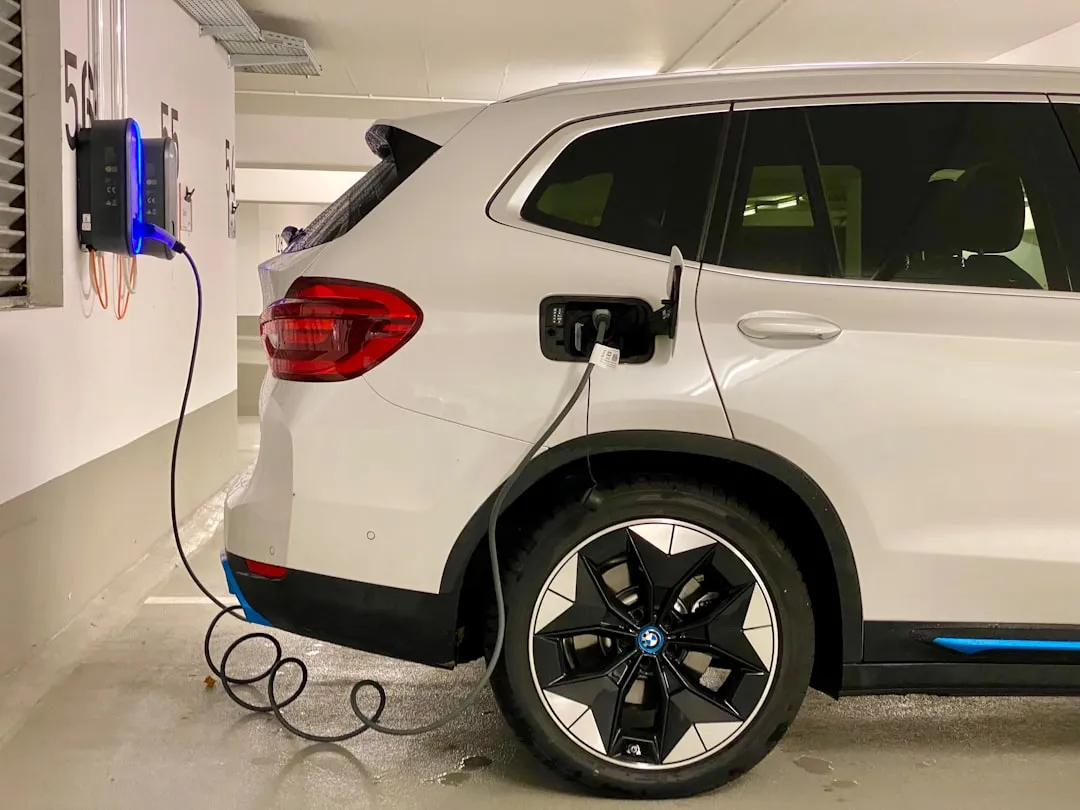
The iX3’s onboard AC charger accepts up to 11 kW single-phase. That’s the sweet spot for most SA homes: you can pull 11 kW from a dedicated 60 A circuit breaker without rewiring your distribution board for three-phase. A professionally installed 11 kW wallbox costs R18,000–25,000 including a type-2 tethered cable and surge protection.
Charging-speed comparison
| Charger power | km added per hour | 0–100% time (iX3, ~80 kWh usable) | Overnight top-up (8 hours) |
|---|---|---|---|
| 3.7 kW (standard 16 A plug) | 20 km/h | ~22 hours | 160 km |
| 7.4 kW wallbox | 40 km/h | ~11 hours | 320 km |
| 11 kW wallbox | 59 km/h | ~7.3 hours | 472 km |
| 22 kW (three-phase, iX3 limited to 11 kW) | 59 km/h | ~7.3 hours | 472 km |
For most drivers doing 50–80 km a day, a 7.4 kW unit is adequate: plug in at 18:00, wake up at 06:00 with 320 km added. But if you’re regularly clocking 100+ km days or want the flexibility to top up quickly between trips, the 11 kW unit future-proofs your setup and costs only R3,000–4,000 more installed. A 22 kW three-phase charger won’t help — the iX3 can’t accept more than 11 kW AC.
On the road, today’s GridCars and Rubicon 150 kW stations can push the battery from 10–80% in under 30 minutes — enough time for a coffee and a leg-stretch on a Cape Town–Johannesburg run.
South Africa–specific realities: load-shedding, solar, and service networks
Load-shedding and backup power
Load-shedding remains a wildcard. If you’re on a municipal supply with Stage 4+ cuts and no battery backup, home charging becomes a logistical puzzle: you’ll need to charge during the 2–4 hour windows between outages, or rely more heavily on public DC stations (which erodes your cost advantage). A 5 kWh home battery (R60,000–80,000 installed) can bridge a two-hour outage and keep your wallbox running, but that’s another upfront cost.
The Q5, meanwhile, doesn’t care about Eskom’s timetable. As long as the petrol station’s generator is running (and most are), you’re mobile.
Solar pairing
If you’ve already installed rooftop solar — and many SA households did during 2024–2025’s energy crisis — the iX3’s economics improve dramatically. A 5 kW array generating 25 kWh/day can cover 90% of your home charging (194 kWh/month) if you charge during daylight or store excess in a battery. Your effective electricity cost drops to zero for the home-charging portion, slashing monthly running costs to ~R600 (public DC only). The Q5 can’t burn sunshine.
Service and parts networks
BMW has 23 dealers nationwide; Audi has 19. Both offer mobile service in major metros. EV-specific training is still ramping up — not every BMW technician is Gen6 eDrive–certified yet — but the iX3’s 24-month / 30,000 km intervals mean you’ll visit less often. Audi’s 12-month / 15,000 km schedule is more traditional (and more frequent). Parts availability slightly favours Audi for wear items (brake pads, suspension bushes), though the iX3’s regenerative braking means you’ll replace pads far less often.
.jpg)
The honest verdict: who should buy which
Buy the BMW iX3 if you…
- Drive predictable routes under 250 km/day and can charge at home overnight
- Have solar panels or a home battery system (or plan to install one)
- Value lower running costs and longer service intervals, and can absorb the higher upfront price
- Live in Gauteng, Western Cape, or KZN where public charging infrastructure is densest
- Want the latest tech (800 V architecture, 805 km range, advanced driver assistance) and don’t mind the R350k premium
Stick with the Audi Q5 40 TFSI if you…
- Regularly drive 400+ km days (farm visits, client meetings across provinces, weekend getaways to remote lodges)
- Rent or live in a complex where installing a wallbox is bureaucratically or electrically impossible
- Depend on municipal electricity with frequent Stage 4+ load-shedding and no backup power
- Prefer the known quantity of a petrol SUV with 790 km range and a five-minute refuel
- Want to save R350,000 upfront, even if running costs are R27,000/year higher
Neither choice is “wrong.” The iX3 is the smarter pick for high-mileage drivers with charging infrastructure and solar; the Q5 is the pragmatic choice for those whose driving patterns or living situations don’t yet align with EV ownership, or who prioritise lower purchase price. The gap is closing fast — BYD’s 200–300 station rollout and CHARGE’s solar-powered N3 corridor sites will both go live by year-end 2026 — but today, in April 2026, your driveway and your daily route are the deciding factors.
Ready to charge smarter?
If the iX3’s numbers stack up for your situation, the next step is confirming your home can support an 11 kW wallbox without a distribution-board upgrade. ChargePoint SA offers free site assessments across Gauteng, Western Cape, and KZN — a qualified electrician will check your existing supply, measure your available capacity, and quote you a fixed-price installation (typically R18,000–25,000 all-in for an 11 kW unit with surge protection and a 5 m tethered cable). No obligation, and you’ll have a concrete answer within 48 hours.
Book your free assessment today and take the guesswork out of going electric.
Image credits
“IMGP7363” by mattbuck4950 (CC BY-SA 2.0, via flickr)