
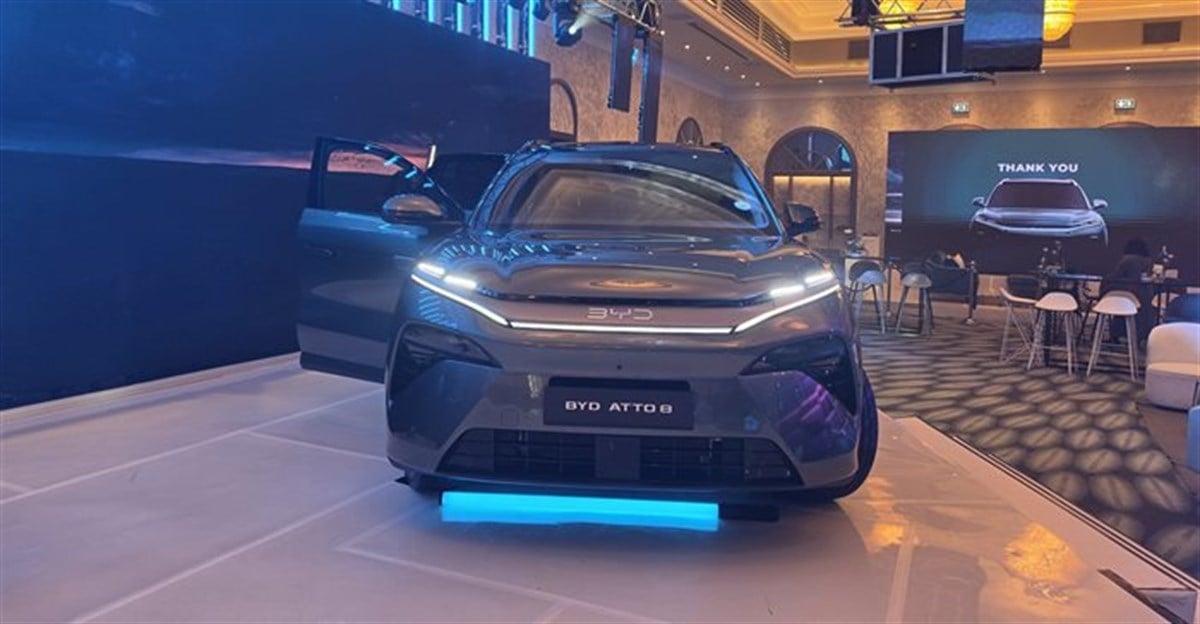
BYD ATTO 8 Launched in South Africa at R1 Million: Is This 7-Seater Electric SUV Worth It?
BYD has launched the ATTO 8 in South Africa at R1,000,000 — R300,000 less than the Kia EV9 and the first seven-seat electric SUV to undercut the R1.3 million mark locally. The 89.8 kWh Blade Battery delivers 480 km WLTP range, 360 kW dual-motor AWD, and a 0–100 km/h sprint in 4.9 seconds. For families covering 20,000 km annually, home charging at Johannesburg tariffs costs R55 per 100 km versus R232.75 for a diesel Fortuner — a R35,550 annual saving before maintenance. The question is whether a seven-figure price tag and the need for an 11 kW home wallbox make sense in a market still cautious about battery-electric vehicles.
To answer that properly, you need to understand both the vehicle itself and the thinking behind BYD’s broader strategy in South Africa — because the two are inseparable.
What Exactly Is the BYD ATTO 8?
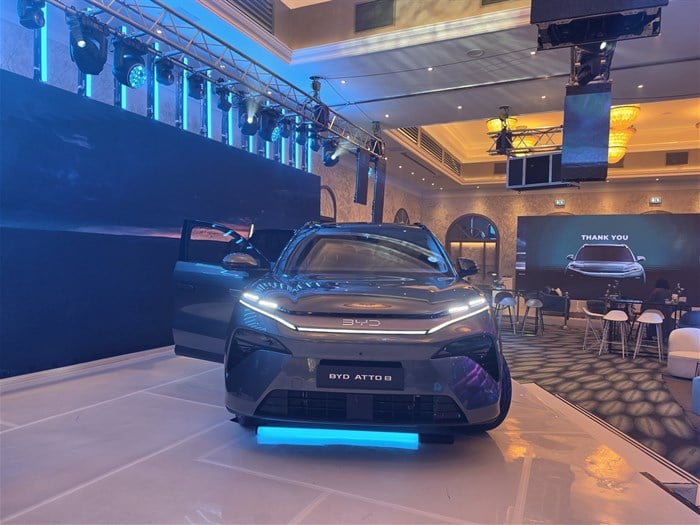
The ATTO 8 sits at the top of BYD’s local SUV hierarchy — a three-row, seven-seat electric crossover that competes directly with the likes of the Kia EV9 and, in terms of buyer consideration at least, the premium end of the diesel SUV segment. It is built on BYD’s e-Platform 3.0 architecture and features the company’s proprietary Blade Battery technology, which prioritises thermal stability and longevity over raw energy density.
In terms of hard numbers, the ATTO 8 is offered in South Africa with an 89.8 kWh Blade Battery pack, delivering a claimed range of approximately 480 kilometres on the WLTP cycle. Power comes from a dual-motor all-wheel-drive setup producing a combined output of 360 kW and 680 Nm of torque — enough to dispatch the 0–100 km/h sprint in around 4.9 seconds, which is genuinely brisk for a vehicle of this size and purpose. The ATTO 8 supports DC fast charging at up to 150 kW, meaning a ten to eighty percent charge can be achieved in roughly 35 to 40 minutes on a compatible fast charger. AC charging is handled by an onboard charger rated at 11 kW maximum — this is an important specification that limits how quickly the vehicle can accept charge from any AC wallbox, regardless of the wallbox’s own rating.
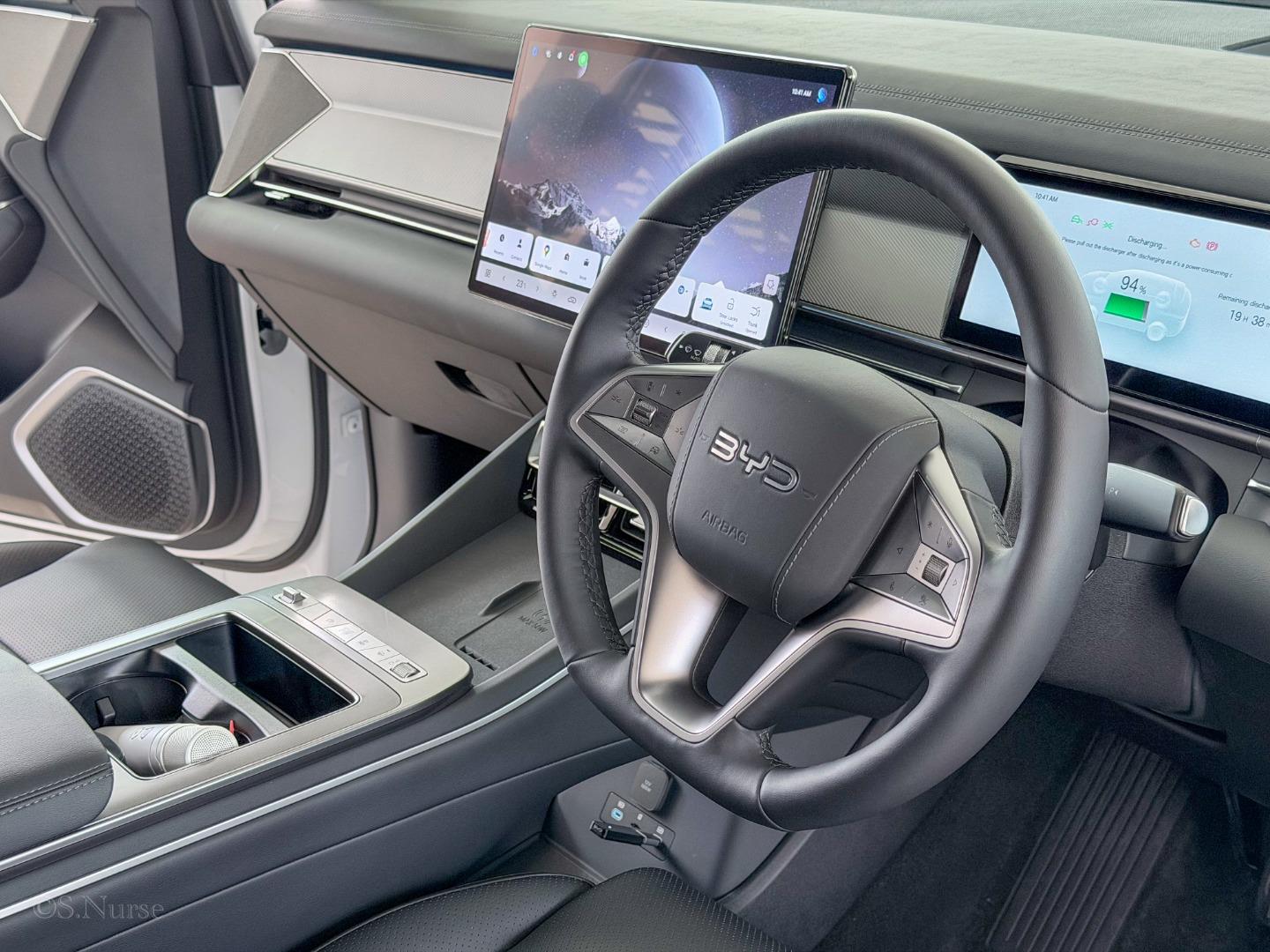
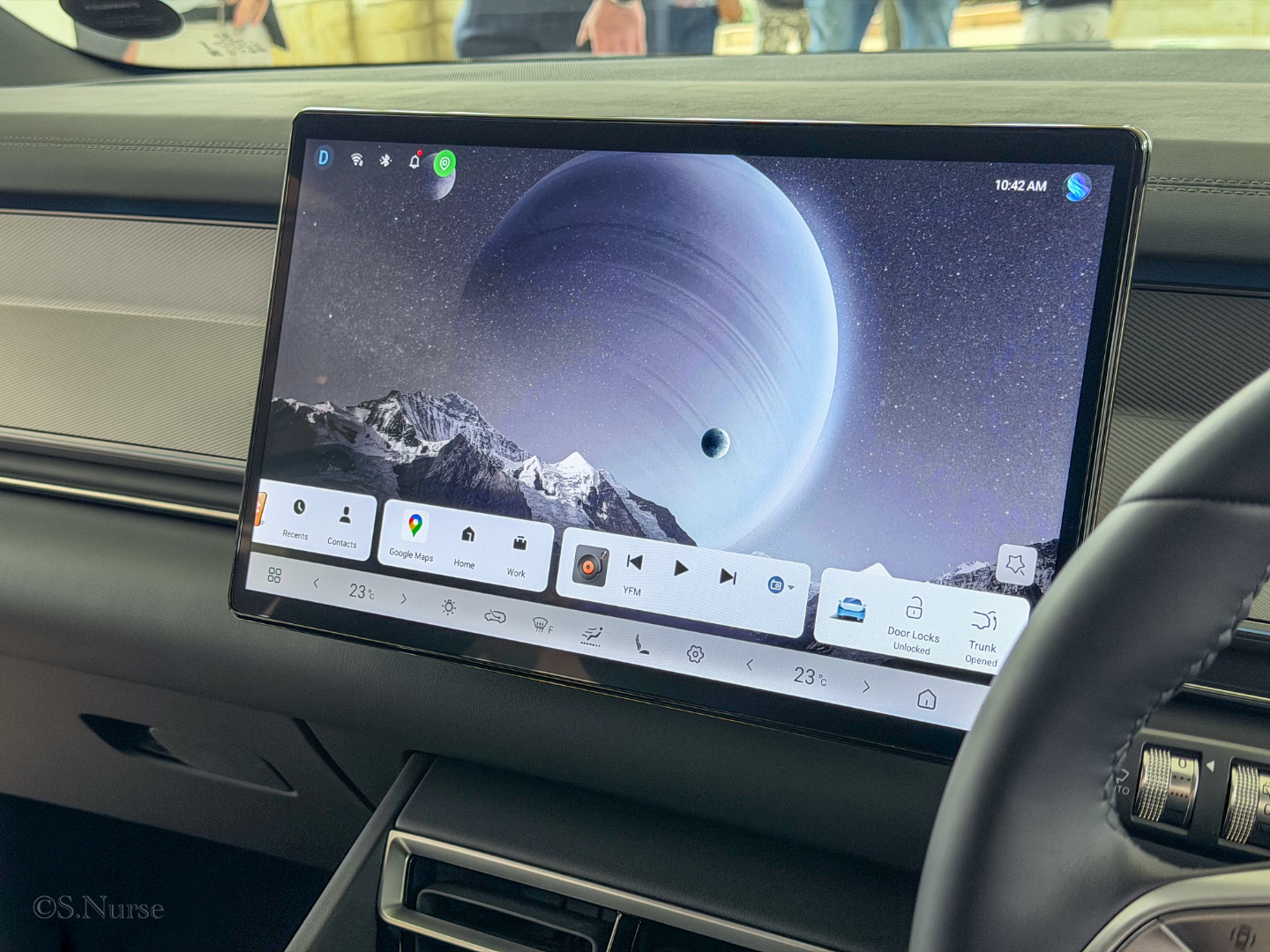
Inside, the cabin is wide, airy, and finished to a standard that does not embarrass the asking price. The second row features captain’s chairs in certain configurations, while the third row is genuinely usable for adults on shorter journeys rather than the token fold-flat bench you find in many ostensibly seven-seat vehicles. A 15.6-inch rotating infotainment screen dominates the dashboard, and the suite of driver-assistance systems is thorough — including adaptive cruise control, blind-spot monitoring, and a 360-degree camera system that proves its worth in urban parking situations.
What Would the ATTO 8 Cost to Charge?
Use our free calculator to see monthly charging costs for the BYD ATTO 8 based on your city’s electricity tariffs.
How Does It Fit Into BYD’s South African Range?
The ATTO 8 does not arrive in isolation. BYD has been methodically building its South African presence across multiple segments, and the model range now tells a coherent story from affordable hatchback to flagship SUV.
The entry point into BYD ownership locally is the Dolphin Surf, a compact urban hatchback that targets budget-conscious EV adopters. Above that sits the Atto 3, a compact SUV that has quietly become one of the better-selling electric vehicles in the country and demonstrated that South African buyers are willing to consider BYD on its merits. The Seal is the brand’s four-door electric sedan, pitched at buyers who want Tesla Model 3 performance credentials with a more accessible price point. The Sealion 5 bridges the gap between the Atto 3 and the ATTO 8, offering a mid-size SUV option for those who need more space but are not yet ready to commit to a seven-figure spend.
The ATTO 8, therefore, serves as both a range-topper and a statement of intent — proof that BYD can play in the premium segment and compete with established Korean and European offerings on specification, refinement, and technology.
The Price: How Does It Stack Up Against the Competition?
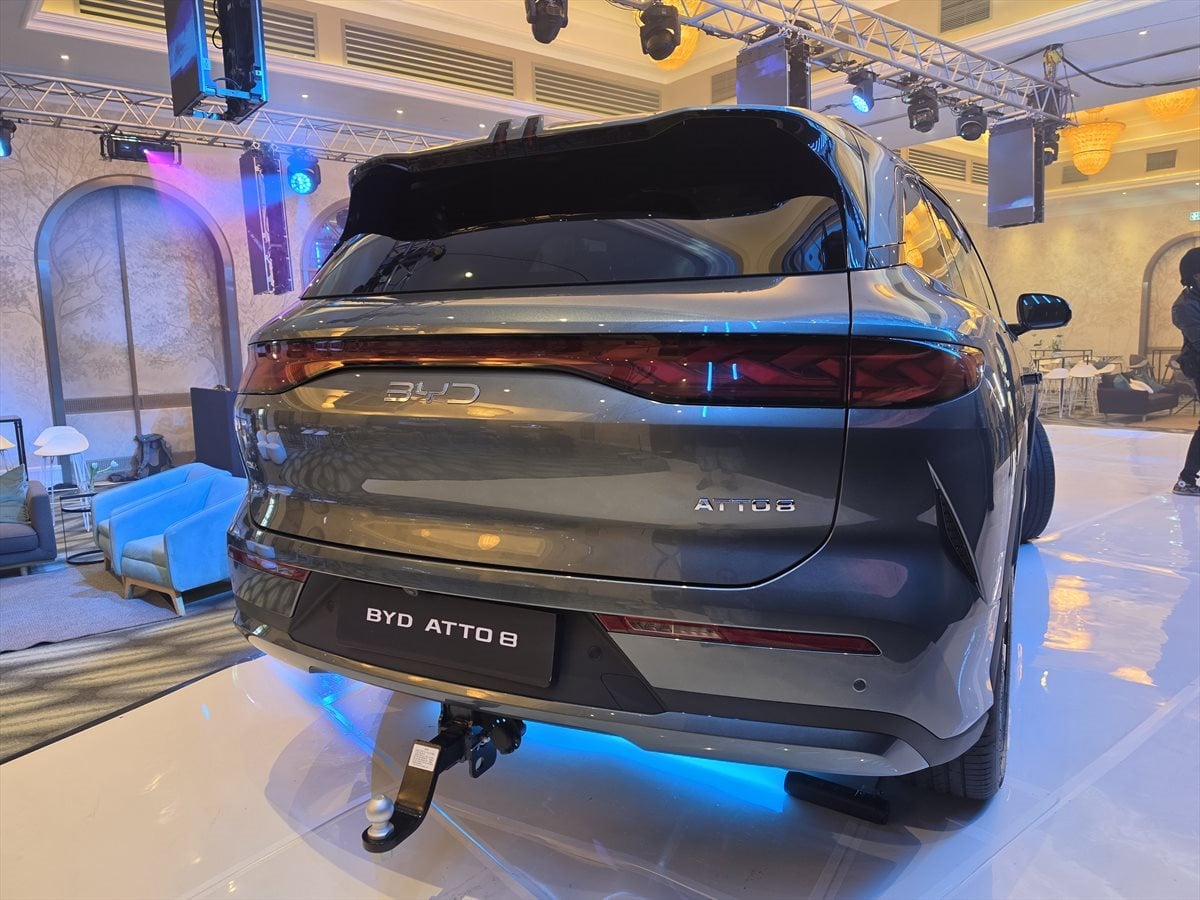
At just over R1 million, the ATTO 8 occupies an interesting space in the market. It is significantly more expensive than a top-spec Toyota Fortuner, which tops out at around R750,000 to R800,000 depending on variant and specification. However, it is broadly competitive with the Hyundai Palisade, which in well-specced diesel AWD guise sits in the R900,000 to R1,050,000 range. The most direct electric competitor, the Kia EV9, launches from approximately R1.3 million in South Africa — making the ATTO 8 meaningfully more accessible in the pure electric seven-seat space.
| Model | Approximate Price | Powertrain | Seating | Range / Tank |
|---|---|---|---|---|
| BYD ATTO 8 | From R1,000,000 | Dual-motor electric (360 kW) | 7 seats | 480 km (WLTP) |
| Kia EV9 | From R1,300,000 | Dual-motor electric (283 kW) | 7 seats | 505 km (WLTP) |
| Hyundai Palisade | From R950,000 | 2.2 diesel AWD (147 kW) | 7–8 seats | Approx. 700 km |
| Toyota Fortuner | From R550,000 | 2.8 diesel 4×4 (150 kW) | 7 seats | Approx. 750 km |
It is worth noting that comparing the ATTO 8 to a Fortuner is not entirely fair to either vehicle. The Fortuner is a body-on-frame workhorse built for gravel roads and towing, whereas the ATTO 8 is a monocoque crossover oriented towards comfort, technology, and urban-to-suburban family use. Nevertheless, the Fortuner remains the dominant reference point in South African family SUV conversations, so the comparison is unavoidable — and commercially relevant for BYD’s sales team.
What Does It Actually Cost to Run?
This is where the electric proposition becomes genuinely compelling, and it is a conversation that every prospective ATTO 8 buyer should have in full before dismissing the price premium.
Consider fuel costs first. A Toyota Fortuner 2.8 GD-6 consumes approximately 9.5 litres of diesel per 100 kilometres under mixed driving conditions. At the current South African pump price of approximately R24.50 per litre, that equates to a fuel cost of roughly R232.75 per 100 kilometres. Over 20,000 kilometres annually — a modest but representative annual mileage — you are spending close to R46,550 purely on diesel.
Now compare that to charging the ATTO 8’s 89.8 kWh battery. If you are charging at home in Johannesburg, where Eskom-linked municipal tariffs sit at approximately R2.95 per kWh, a full charge from near-empty costs around R265. That delivers up to 480 kilometres of range, translating to an energy cost of approximately R55 per 100 kilometres — a saving of over R177 per 100 kilometres compared to the Fortuner. Over 20,000 kilometres, that is a saving of roughly R35,400 per year on energy alone, before accounting for the reduced maintenance costs inherent in an electric drivetrain.
Cape Town residents face slightly higher municipal electricity rates, with tariffs sitting around R3.18 per kWh, which nudges a full charge to approximately R285 and raises the per-100-km cost to around R59. The saving over diesel is still substantial.
| Cost Factor | BYD ATTO 8 (Jhb tariff) | BYD ATTO 8 (CT tariff) | Toyota Fortuner 2.8 Diesel |
|---|---|---|---|
| Energy cost per 100 km | R55 | R59 | R232.75 |
| Annual energy cost (20,000 km) | R11,000 | R11,800 | R46,550 |
| Annual saving vs diesel | R35,550 | R34,750 | — |
| Estimated annual service cost | Lower (fewer moving parts) | Lower (fewer moving parts) | R6,000–R10,000 typical |
These figures do not account for public charging, which carries a premium over home tariffs. Charging networks in South Africa typically charge between R4.50 and R7.00 per kWh depending on the provider and speed of the charger — which erodes but does not eliminate the cost advantage over diesel. For buyers who can charge primarily at home, the economics are compelling.
Need a Home Charger for Your ATTO 8?
The ATTO 8’s large battery needs a proper home charging setup. ChargePoint SA installs 7.4kW, 11kW, and 22kW chargers with load management.
Home Charging: What ATTO 8 Owners Need to Know
Given the ATTO 8’s 89.8 kWh battery, home charging infrastructure deserves serious attention before purchase. A standard 2.3 kW single-phase plug — the kind of outlet you might use for a smaller EV or to top up overnight — would take in excess of 40 hours to fully charge this vehicle from empty. That is simply not practical for a primary family vehicle.
The minimum sensible home charging solution for the ATTO 8 is an 11 kW three-phase wallbox charger, which would deliver a full charge from empty in approximately eight to nine hours — workable if you charge overnight. Many buyers will consider a 22 kW three-phase installation for future-proofing or household fleet compatibility. However, it is critical to understand that the ATTO 8’s onboard AC charger is rated at 11 kW maximum — this is the vehicle’s own internal charging limit. What this means in practice is that even if you install a 22 kW wallbox at home, the ATTO 8 itself will only accept charge at up to 11 kW, so your practical overnight charging time remains in the eight-to-nine-hour range regardless of whether your wallbox is rated at 11 kW or 22 kW.
The value of installing a 22 kW unit despite this limitation lies in future-proofing: if you later add a second EV to your household that can accept 22 kW AC charging, or if BYD releases future models with higher AC charging rates, your infrastructure will already support it. For the ATTO 8 alone, an 11 kW wallbox is entirely sufficient.
Either way, prospective buyers should budget R15,000 to R30,000 for a professional 11 kW or 22 kW wallbox installation, inclusive of the charger unit, cabling, and any necessary electrical upgrades to the distribution board. This is not optional for a vehicle of this battery capacity — it is part of the total cost of ownership and should be factored into the purchase decision accordingly.
BYD’s Brand Strategy: Why They Are Not Playing the Discount Game
Perhaps the most telling comment at the ATTO 8 launch came from BYD South Africa’s Managing Director, who stated plainly that the brand is “not chasing numbers, not yet.” That is a strategically loaded phrase, and it signals an approach that is quite different from the conventional volume-at-all-costs playbook often associated with Chinese automotive entrants into new markets.
BYD is, by most measures, the world’s largest electric vehicle manufacturer by sales volume. It does not need to buy market share in South Africa with aggressive discounting. Instead, the brand appears to be taking a premium positioning approach — establishing itself through product quality, dealer experience, and long-term reliability before competing on price. It is a strategy more reminiscent of how Hyundai and Kia built credibility in South Africa over two decades than the rapid low-cost penetration approach.
There is a calculated risk here. South African consumers are acutely price sensitive, and the R1 million mark is psychologically significant. BYD is betting that buyers in this segment — who are already spending north of R800,000 on a Palisade or approaching R1 million on various premium SUV options — will be willing to consider an electric alternative if the product credentials stack up. The ATTO 8 needs to earn its price through the quality of the driving experience, the reliability of the battery technology, and the strength of the after-sales network.
On the first two counts, early impressions are genuinely positive. The Blade Battery technology has demonstrated strong real-world longevity in other markets, and BYD’s engineering pedigree — the company manufactures its own batteries, motors, power electronics, and increasingly its own semiconductors — gives it a vertical integration advantage that few competitors can match. The after-sales network remains the variable to watch as the brand scales its South African presence.
Plan Your Road Trip
Check charger availability across South Africa before you hit the road in your ATTO 8.
Real-World Considerations for South African Buyers
No review of an electric vehicle sold in South Africa would be complete without addressing load-shedding — or, more encouragingly, its recent easing. While the worst periods of rolling blackouts have subsided, the underlying grid fragility has not disappeared, and buyers of large-battery EVs need a contingency plan. A 89.8 kWh battery is, in fact, a significant energy buffer: some ATTO 8 owners will likely explore vehicle-to-load (V2L) functionality, though it is important to verify whether the South African specification supports bidirectional charging.
Range anxiety on longer inter-city routes also remains a legitimate consideration. The claimed 480 km WLTP range is measured under controlled conditions; real-world range in South Africa, factoring in highway speeds, air conditioning use, and the occasional Highveld gradient, will be somewhat lower — realistically in the 380 to 420 km range under typical conditions. The Johannesburg-to-Cape Town route requires careful planning, but the rapid expansion of DC fast charging infrastructure along major national routes has made such journeys increasingly viable. A 150 kW fast-charging capability means that a meaningful top-up can be achieved in the time it takes to stop for coffee and a comfort break.
Verdict: Is the BYD ATTO 8 Worth R1 Million?
The honest answer is: for the right buyer, yes — and the profile of that buyer is fairly specific. You are looking at a household that spends significant time in urban and suburban environments, covers at least 15,000 to 20,000 kilometres per year, has the ability to install a proper home charging solution, and needs genuine seven-seat capability without wanting to compromise on technology or refinement.
For that buyer, the ATTO 8 makes a strong case. The running cost savings over diesel are real and meaningful, the specification is genuinely premium, and the electric drivetrain delivers a quality of effortless, silent performance that reshapes how you think about family motoring. Against the Kia EV9 specifically, it undercuts by a meaningful margin while offering comparable electric range and more power.
Against the Fortuner, the comparison is harder to make on a pure value-per-rand basis — the Fortuner remains a more versatile, more affordable, and more infrastructure-independent choice for buyers who regularly leave the tar. But the ATTO 8 is not chasing Fortuner buyers. It is targeting a more specific, urban-leaning, tech-forward customer who has decided that electric is the direction they are heading and wants to do so without downsizing their family vehicle.
BYD’s refusal to chase volume through discounting tells you something about their confidence in the product. Whether the South African market is ready to reward that confidence at scale remains to be seen — but the ATTO 8 itself is a more convincing argument for electric family motoring than anything this segment has offered at this price point before. The real test will come not in the first six months of sales, but in the second and third year of ownership, when the after-sales experience, battery longevity, and resale values become the true measure of whether this R1 million investment was justified.
Frequently Asked Questions
What is the official price of the BYD ATTO 8 in South Africa?
The BYD ATTO 8 is priced from just over R1 million in South Africa. Specific variant pricing may vary, and prospective buyers should contact their nearest BYD dealership for confirmed on-the-road pricing inclusive of registration and delivery fees.
What is the real-world range of the BYD ATTO 8?
The ATTO 8 has a claimed WLTP range of approximately 480 km from its 89.8 kWh Blade Battery. Under typical South African driving conditions — including highway speeds and air conditioning — a realistic real-world range of 380 to 420 km is a reasonable expectation.
How long does it take to charge the BYD ATTO 8?
On a DC fast charger at up to 150 kW, the ATTO 8 can charge from ten to eighty percent in approximately 35 to 40 minutes. On an 11 kW home wallbox, a full charge from near-empty takes roughly eight to nine hours, making overnight charging the practical approach for most owners.
What home charging setup do I need for the BYD ATTO 8?
Given the 89.8 kWh battery size, a minimum 11 kW three-phase wallbox charger is strongly recommended. A 22 kW installation offers future-proofing benefits, though the vehicle’s onboard charger is rated at 11 kW AC, so actual charging speed will not exceed that rate. Budget R15,000 to R30,000 for a professional installation.
How does the BYD ATTO 8 compare to the Kia EV9?
Both are seven-seat electric SUVs with comparable WLTP ranges of around 480 to 505 km. The ATTO 8 offers more power at 360 kW versus 283 kW for the EV9, and is priced from approximately R300,000 less than the entry-level EV9 in South Africa, making it the more accessible option in the pure electric seven-seat segment.
Is the BYD ATTO 8 practical for South African load-shedding conditions?
The large 89.8 kWh battery means the ATTO 8 typically carries substantial energy reserves, which buffers against the need to charge during load-shedding periods. Buyers should ensure they have a reliable charging window — overnight charging during available supply is the standard approach — and should discuss V2L (vehicle-to-load) capability directly with their BYD dealer to confirm the South African specification’s bidirectional functionality.
What other BYD models are available in South Africa?
BYD’s South African lineup currently includes the Dolphin Surf (compact hatchback), the Atto 3 (compact SUV), the Seal (electric sedan), the Sealion 5 (mid-size SUV), and now the ATTO 8 as the flagship seven-seat SUV. The range covers a broad spectrum of price points and use cases within the electric vehicle segment.
Continue Reading
Deprecated: File Theme without comments.php is deprecated since version 3.0.0 with no alternative available. Please include a comments.php template in your theme. in /var/www/wordpress/wp-includes/functions.php on line 6085
Leave a Reply