
Yes, You Can Charge at Home — Here’s Exactly How
The short answer: Yes, 95% of South African EV owners successfully charge at home. It’s the most convenient and cost-effective way to own an EV — wake up every morning to a full “tank” without ever visiting a petrol station.
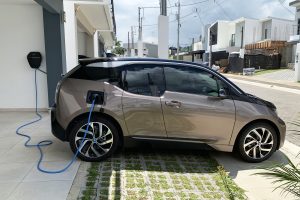
Home charging isn’t just possible in South Africa — it’s the primary charging method for the vast majority of EV owners. Whether you live in a house, townhouse, or complex with dedicated parking, installing a home charger transforms EV ownership from a daily chore into a seamless routine.
Home Charging Requirements (2026)
- Electricity supply: Any home with standard municipal/Eskom connection
- Installation space: Covered garage or carport (weatherproof mounting required)
- Circuit capacity: Dedicated 32A circuit installed by electrician
- Certificate of Compliance: Required by law (R500–R1,500)
- Total installed cost: R12,000–R25,000
The installation process typically takes 4–6 hours. A certified electrician assesses your distribution board capacity, runs dedicated cabling to your parking area, mounts the wall charger, and issues the mandatory Certificate of Compliance. Most installations are completed in a single day.
Monthly Charging Costs by City (2026)
Based on 1,500 km/month average driving and 16 kWh/100 km consumption (typical for models like the BYD Atto 3 and Volvo EX30):
| City | Rate | Monthly Cost | vs Petrol |
|---|---|---|---|
| Cape Town | R5.15/kWh | R687/month | Save R1,338 |
| Johannesburg | R3.85/kWh | R514/month | Save R1,511 |
| Durban | R4.50/kWh | R601/month | Save R1,424 |
| Port Elizabeth | R4.50/kWh | R601/month | Save R1,424 |
| Petrol (comparison) | R22.50/L | R2,025/month | Baseline |
Calculation: 1,500 km ÷ 100 km × 16 kWh = 240 kWh/month. Cape Town: 240 kWh × R5.15 = R1,236, but off-peak charging (typically 56% of total charging) at R2.87/kWh reduces blended cost to R687/month. Petrol comparison assumes 9 L/100 km at R22.50/L.
Annual Savings: R16,056–R18,132 vs equivalent petrol vehicle!
Use our EV Cost Calculator to see personalised monthly charging costs based on your exact driving patterns, electricity tariff, and vehicle model.
Load-Shedding and Home Charging
Load-shedding remains a concern for many prospective EV owners, but home charging adapts surprisingly well. Most EVs charge overnight during off-peak hours (23:00–06:00), when load-shedding schedules are least frequent. A typical 7.4 kW wall charger adds 50 km of range per hour — even a 4-hour window between load-shedding slots provides 200 km of range.
For complete peace of mind, pairing your home charger with a battery backup system (such as a 5 kWh home battery) ensures uninterrupted charging regardless of grid stability. Many installers now offer integrated solar + battery + EV charger packages starting from R85,000.
Apartment and Complex Installations
Sectional title and rental properties require additional steps but are entirely feasible. You’ll need written permission from your body corporate or landlord, and the installation must comply with building regulations. Many modern complexes are proactively installing EV-ready infrastructure — check with your trustees or managing agent.
If your complex doesn’t have existing EV charging, you can propose a pilot installation. Present the business case: EV chargers increase property values, attract environmentally conscious tenants, and future-proof the development. Offer to cover installation costs in exchange for exclusive use of the charger during your tenancy.
Financing Your Home Charger Installation
Don’t have R12,000–R25,000 upfront? While no formal financing programmes are currently available from major banks or charger manufacturers, several options exist for spreading the cost:
- Personal loans: Most banks offer unsecured personal loans at 11–14% APR for home improvement projects
- Credit card instalments: Many installers accept credit card payment, allowing you to use existing instalment plans
- Home equity: If you have equity in your property, access bond facilities at prime + 1–2%
- Retailer financing: Some EV dealerships bundle charger installation into vehicle finance packages
Industry sources indicate that dedicated EV charger financing products are under development by several financial institutions for potential launch in late 2026 or early 2027, but no specific programmes have been announced. Check our Live EV Charging Map for updates on financing options as they become available.
Reducing Upfront Costs
If financing isn’t viable, consider these cost-reduction strategies:
- Start with Level 1 charging: Use the standard 3-pin cable included with your EV while saving for a Level 2 wall charger (slow but functional for low daily mileage)
- Portable chargers: Mobile 7.4 kW units (R8,500–R12,000) plug into existing 32A outlets, avoiding permanent installation costs
- Workplace charging: If your employer offers free charging, delay home installation until necessary
- Group installations: Coordinate with neighbours to negotiate bulk installation discounts (10–15% savings typical)
Visit our Charger Installation page for quotes from certified installers across South Africa. Compare pricing, warranties, and installation timelines from multiple providers.
Frequently Asked Questions
Can anyone charge an EV at home in South Africa?
Yes, if you have: (1) Standard municipal/Eskom electricity, (2) Safe mounting space (garage/carport), (3) Landlord approval if renting. A certified electrician assesses and installs a dedicated circuit. Total cost: R12,000–R25,000.
How much does it cost to charge at home per month?
For 1,500 km/month at 16 kWh/100 km consumption: Cape Town R687 (R5.15/kWh blended rate with off-peak charging), Johannesburg R514 (R3.85/kWh), Durban/PE R601. Saves R16,000–R18,000/year vs petrol at R22.50/L.
How long does home charging take?
Level 2 wall chargers (7.4 kW) fully charge most EVs in 8 hours overnight. BYD Atto 3 (60 kWh) takes ~8 hours empty to full. Charge while sleeping, wake to 100% battery daily.
Can I charge without a special charger?
Technically yes using 3-pin plug (Level 1), but extremely slow (26 hours for 60 kWh). Not recommended as primary charging. Level 2 wall chargers essential for practical daily EV ownership.
Do I need municipal permission for a home charger?
No municipal permission needed, but installation MUST be by registered electrician who issues Certificate of Compliance. Legally required, ensures safety meeting SANS electrical codes.
What happens during load-shedding?
Charge during off-peak hours (23:00–06:00) when load-shedding is less frequent. Even with interruptions, 4 hours of charging provides 200 km range. Battery backup systems (from R85,000) eliminate load-shedding impact entirely.
Can I install a charger in a rental property?
Yes, with written landlord permission. Installation must be removable and leave no permanent damage. Many tenants negotiate cost-sharing: tenant pays installation, landlord reduces rent or agrees to purchase charger at lease end. Portable chargers (R8,500–R12,000) are ideal for rental situations.
Continue Reading

Deprecated: File Theme without comments.php is deprecated since version 3.0.0 with no alternative available. Please include a comments.php template in your theme. in /var/www/wordpress/wp-includes/functions.php on line 6085
Leave a Reply