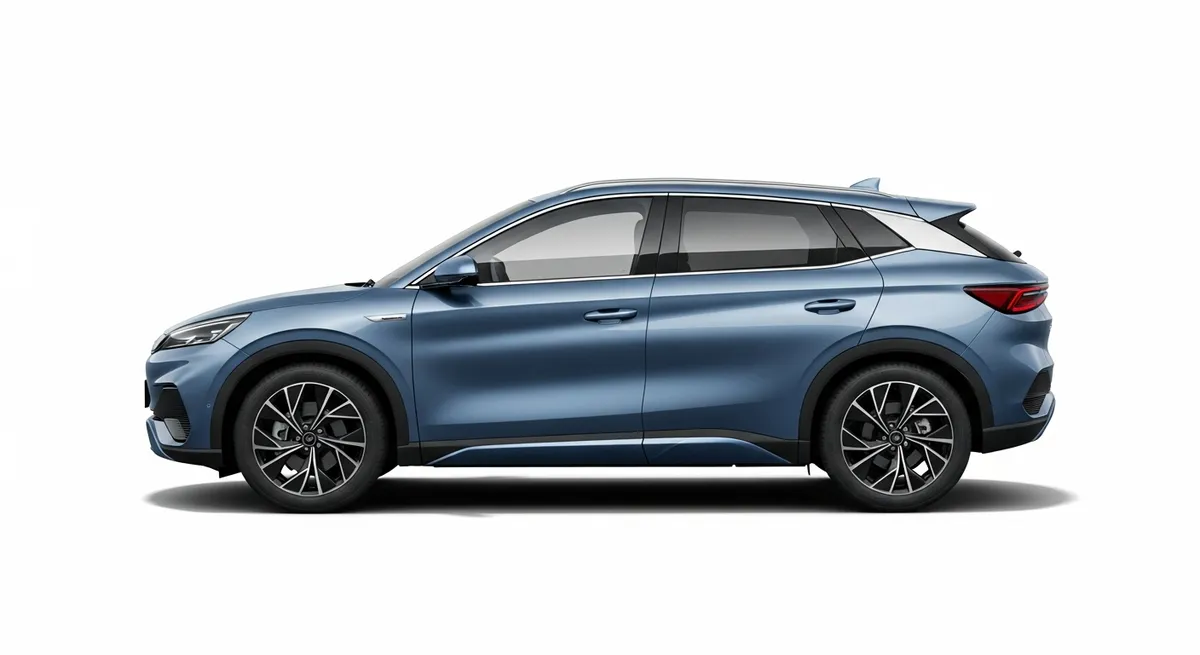

The BYD Atto 3 Extended Range costs R783,900 and delivers 420 km WLTP range — yet over five years it undercuts the R730,000 Kia Sportage 1.6T GDi by roughly R25,000 in total ownership cost, thanks to monthly fuel savings of R1,514. That’s the spreadsheet. The real question is whether you have off-street parking, a 7.4 kW wall-box, and a daily commute under 300 km — because if you do, the EV wins on every metric that matters.
As u/Uerwol put it on r/electricvehicles: “I actually own an EV (BYD Atto 3) and have been driving it for a while now and honestly I couldn’t be happier. My running costs are a fraction of what I was paying with petrol. I’m talking genuinely significantly less and the car drives better, requires less maintenance and I wake up every morning with a full charge.”
That’s the promise. But does it hold up when you compare a BYD Atto 3 against South Africa’s best-selling compact crossover, the Kia Sportage? We’ve pulled OEM specs, naamsa sales data, Eskom tariffs, and real owner testimony to answer that question with numbers you can trust.

Purchase price and warranty: the upfront gap
Let’s start with the sticker. According to BYD South Africa, the Atto 3 Standard Range (50.1 kWh) retails at R699,900, while the Extended Range (60.48 kWh, 420 km WLTP) sits at R783,900. The Kia Sportage 1.6T GDi range spans R662,995 to R823,995, with the mid-spec EX sitting around R730,000.
For a like-for-like comparison—both mid-spec, both automatic—you’re looking at roughly R783,900 for the Atto 3 Extended Range versus R730,000 for the Sportage 1.6T GDi EX. That’s a R53,900 premium for the EV, though the gap narrows if you opt for the Atto 3 Standard Range at R699,900.
| Model | Price (ZAR) | Warranty | Service plan |
|---|---|---|---|
| BYD Atto 3 Standard Range (50.1 kWh) | R699,900 | 5 years / 100,000 km | Not included |
| BYD Atto 3 Extended Range (60.48 kWh) | R783,900 | 5 years / 100,000 km | Not included |
| Kia Sportage 1.6T GDi (from) | R662,995 | 5 years / unlimited km | 6 years / 90,000 km |
| Kia Sportage 1.6T GDi (to) | R823,995 | 5 years / unlimited km | 6 years / 90,000 km |
Kia’s 5-year unlimited-kilometre warranty and 6-year/90,000 km service plan are hard to beat. BYD offers 5 years / 100,000 km on the vehicle and 8 years on the battery, but no bundled service plan. If you’re a high-mileage driver who values peace of mind, the Sportage’s unlimited warranty is a tangible advantage.

Range, efficiency, and real-world practicality
How far can you actually go?
The BYD Atto 3 Extended Range claims 420 km on the WLTP cycle with its 60.48 kWh battery. Real-world range—accounting for highway driving, climate control, and the occasional burst of acceleration—typically lands around 350–380 km. The Standard Range (50.1 kWh) delivers roughly 320 km WLTP, or 280–300 km in mixed conditions.
The Kia Sportage 1.6T GDi has a 54-litre tank and averages 6.5 L/100 km, giving it a theoretical range of 830 km per fill-up. In practice, you’ll see 700–750 km before the low-fuel light blinks. That’s nearly double the Atto 3’s range, and refuelling takes five minutes versus 30–60 minutes for a DC fast-charge (10–80%).
| Metric | BYD Atto 3 Extended Range | Kia Sportage 1.6T GDi |
|---|---|---|
| Battery / tank capacity | 60.48 kWh | 54 L |
| WLTP / claimed range | 420 km | 830 km |
| Real-world range (estimate) | 350–380 km | 700–750 km |
| Efficiency | ~16 kWh/100 km | 6.5 L/100 km |
| Refuel / recharge time (10–80%) | 29 min (DC fast-charge) | ~5 min |
Does range anxiety hold up?
As u/Uerwol noted: “The ’50km range’ take is so outdated its embarrassing… Even a standard mid-range pure EV is sitting at 400 to 480km of real world range. The average Australian drives something like 38km a day. Most people will literally never come close to running out of charge.” South African drivers average similar daily distances—figures vary by province, but 40–60 km/day is typical for urban commuters.
If you charge at home overnight, the Atto 3’s 350 km real-world range covers a week of commuting without touching a public charger. The Sportage still wins for long-haul road trips (Cape Town to Johannesburg without refuelling stress), but for daily use, the EV’s range is more than adequate.
Running costs: where the Atto 3 pulls ahead
Monthly fuel vs electricity at 1,500 km
This is where the spreadsheet starts favouring electrons over hydrocarbons. Let’s assume you drive 1,500 km per month—a realistic figure for a family crossover doing school runs, weekend trips, and the occasional longer journey.
BYD Atto 3 (Extended Range): At 16 kWh/100 km (real-world average) and R3.50/kWh (post-April 2026 Eskom tariff for residential users, per NERSA’s 8.76% increase), you’ll use 240 kWh per month. That’s R840/month if you charge exclusively at home. Add 10% for charging losses (inverter, cable resistance), and you’re at roughly R924/month.
Kia Sportage 1.6T GDi: At 6.5 L/100 km and R25/L (coastal petrol price as of mid-2026), you’ll burn 97.5 litres per month. That’s R2,438/month.
Monthly saving with the Atto 3: R1,514. Over a year, that’s R18,168 in your pocket—or your solar-panel fund.

Five-year total cost of ownership
Let’s stretch the horizon to five years (90,000 km total, or 18,000 km/year—slightly above the 1,500 km/month baseline to account for holiday trips).
| Cost category | BYD Atto 3 Extended Range | Kia Sportage 1.6T GDi |
|---|---|---|
| Purchase price | R783,900 | R730,000 |
| Fuel / electricity (90,000 km) | R55,440 (14,400 kWh + 10% losses @ R3.50) | R146,250 (5,850 L @ R25) |
| Service & maintenance (5 years) | ~R15,000 (tyres, brakes, cabin filter) | R0 (covered by service plan) + ~R8,000 (tyres, extras) |
| Insurance (estimated, 5 years) | R90,000 | R85,000 |
| Total 5-year cost | R944,340 | R969,250 |
The Atto 3 ends up roughly R25,000 cheaper over five years, even after its higher purchase price. Extend the timeline to seven or ten years, and the gap widens—EVs have fewer consumables (no oil, no exhaust, regenerative braking saves brake pads), so post-warranty service costs remain low.
Caveat: if petrol prices drop or electricity tariffs spike, the math shifts. But the trend since 2022 has been rising fuel costs and stabilising grid tariffs (post-load-shedding), so the EV’s advantage is likely to grow.
Charging at home: 7.4 kW, 11 kW, or 22 kW?
The BYD Atto 3’s onboard AC charger accepts up to 7 kW single-phase. That means:
- 7.4 kW wall-box (32 A, single-phase): Full charge (60.48 kWh) in ~8.5 hours. Perfect for overnight charging—plug in at 22:00, wake up at 06:30 with 100%.
- 11 kW or 22 kW wall-box: The Atto 3 can’t use the extra power. You’ll still charge at 7 kW max. Save your money unless you plan to own a three-phase-compatible EV in future (e.g., BMW iX, Mercedes EQE).
For DC fast-charging on road trips, the Atto 3 peaks at 88 kW. That’s 10–80% in 29 minutes on a capable charger—GridCars and Rubicon both offer 50+ kW DC chargers along major routes.
Bottom line: A 7.4 kW wall-box is the sweet spot for the Atto 3. ChargePoint SA can assess your electrical setup and confirm compatibility—book a free site visit to get a fixed-price quote.
South Africa-specific realities: load-shedding, solar, and service networks
Load-shedding and home charging
As of mid-2026, Eskom has maintained Stage 0 for several consecutive months—the longest reprieve since 2019. But no one’s betting the farm on uninterrupted supply. If you charge overnight (off-peak, 22:00–06:00), you’ll miss most Stage 2–4 windows, which typically hit during evening peak (17:00–22:00). A 10 kWh home battery (e.g., Sunsynk, Deye) can bridge a two-hour outage and keep your EV charging, though that’s an extra R80,000–R120,000 upfront.
The Sportage, of course, doesn’t care about load-shedding—petrol stations have generators. Advantage: petrol, if grid reliability is your top concern.
Pairing with solar
If you have a 5 kW rooftop solar array (common in Cape Town and Gauteng suburbs), you can generate roughly 20–25 kWh per day in summer. That’s enough to cover 125–150 km of EV driving plus household consumption. Charge the Atto 3 during the day (solar hours), and your marginal electricity cost drops to near-zero. The Sportage can’t sip sunshine.
Solar + EV is the long-term play that turns the total-cost-of-ownership math heavily in favour of electrons. Initial outlay is steep (R150,000–R200,000 for a decent solar + battery setup), but payback period is 4–6 years if you’re offsetting both home and transport energy.
Service and parts availability
Kia has 90+ dealers across South Africa—you’re never more than 100 km from a workshop. BYD, as of early 2026, operates through a smaller network concentrated in Gauteng, Western Cape, and KZN. If you live in Polokwane or East London, the nearest BYD service centre might be a 200 km round trip.
That said, EVs need less frequent servicing (no oil changes, no timing belts, no exhaust). The Atto 3’s service intervals are every 10,000 km or 12 months. Kia’s petrol Sportage requires service every 15,000 km, but each visit involves more consumables. Over five years, you’ll visit the Kia dealer six times; the BYD dealer five times. The inconvenience gap is real but narrow.
Performance, practicality, and the intangibles
The BYD Atto 3 delivers 150 kW and 310 Nm from its single front motor, hitting 100 km/h in 7.3 seconds. The Kia Sportage 1.6T GDi makes 132 kW and 265 Nm, reaching 100 km/h in 8.8 seconds. The EV is quicker off the line—electric torque is instant—but the Sportage has a higher top speed (201 km/h vs the Atto 3’s electronically limited ~160 km/h).
Boot space: the Sportage offers 590 litres with the rear seats up, expanding to 1,800 litres with them folded. The Atto 3’s boot is slightly smaller (figures vary by market—consult the official spec sheet), but both are practical family haulers.
One owner concern worth noting: u/Shivamyoo reported on r/electricvehicles that in a front-right collision, the Atto 3’s curtain airbags deployed but the driver front airbag did not. The poster walked away safe, but it raises questions about crash-sensor calibration. BYD South Africa has not issued a recall, and the Atto 3 has passed Euro NCAP testing—still, if you’re risk-averse, the Sportage’s longer safety track record (and Kia’s reputation for build quality) might weigh in its favour.
The honest verdict: who should buy which?
Buy the BYD Atto 3 if you…
- Have secure off-street parking and can install a 7.4 kW wall-box.
- Drive less than 300 km per day (i.e., most people).
- Want to slash running costs and never visit a petrol station again.
- Already have solar panels or plan to install them—this is the killer combo.
- Live in Gauteng, Western Cape, or KZN, where BYD’s service network is densest.
- Value instant torque, quiet cabins, and the smug satisfaction of zero tailpipe emissions.
Buy the Kia Sportage 1.6T GDi if you…
- Don’t have reliable off-street parking or can’t install a charger (apartment dwellers, street parking).
- Regularly drive 500+ km in a day (sales reps, long-distance commuters).
- Live in a smaller town where BYD service is scarce.
- Want the peace of mind of Kia’s unlimited-km warranty and 6-year service plan.
- Need to tow a trailer or caravan—towing specifications not available in current sources; consult Kia SA for official figures.
- Prefer a known quantity with a decade-long track record in South Africa.
Ready to charge smarter?
The BYD Atto 3 isn’t for everyone—yet. But if your daily routine fits its range envelope, and you have the infrastructure to charge at home, the five-year savings are real and the driving experience is genuinely better (instant torque, near-silent operation, fewer trips to the workshop). The Kia Sportage remains the sensible default for high-mileage drivers and those without secure parking, but its running costs will bleed you dry over the long haul.
Thinking about making the switch? Book a free site assessment with ChargePoint SA—we’ll confirm your electrical capacity, recommend the right wall-box, and give you a fixed-price quote with no surprises. Whether you go electric today or in two years, knowing your options costs nothing.
Image credits
“BYD Atto 3” by Rutger van der Maar (CC BY 2.0, via flickr) ·