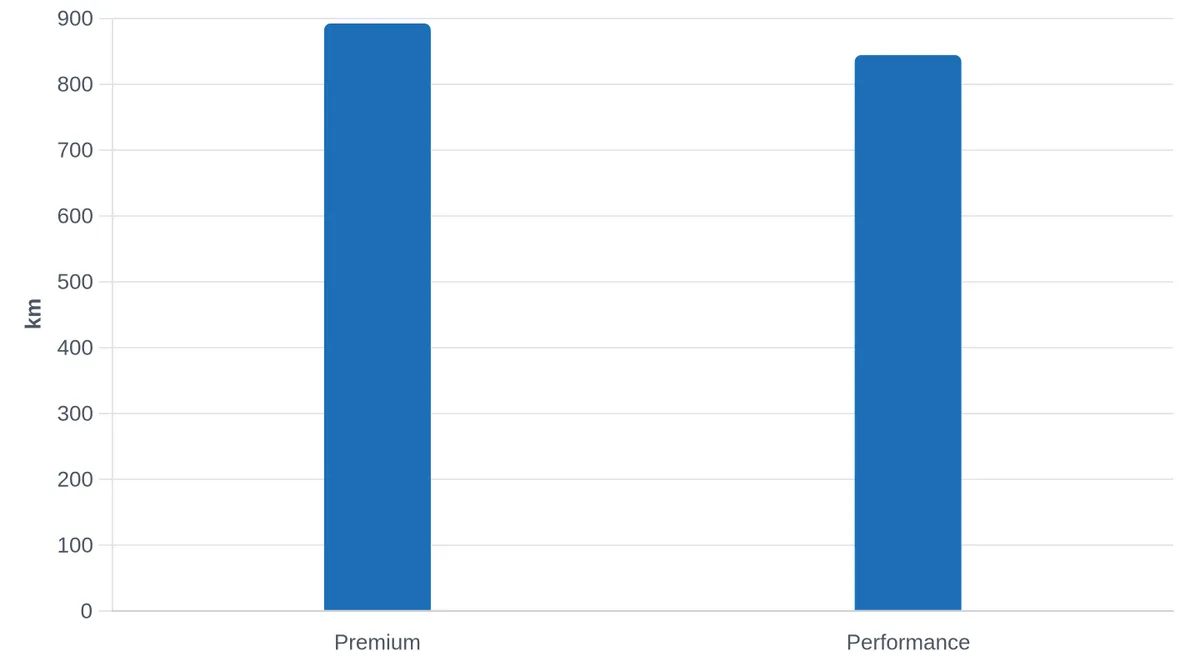
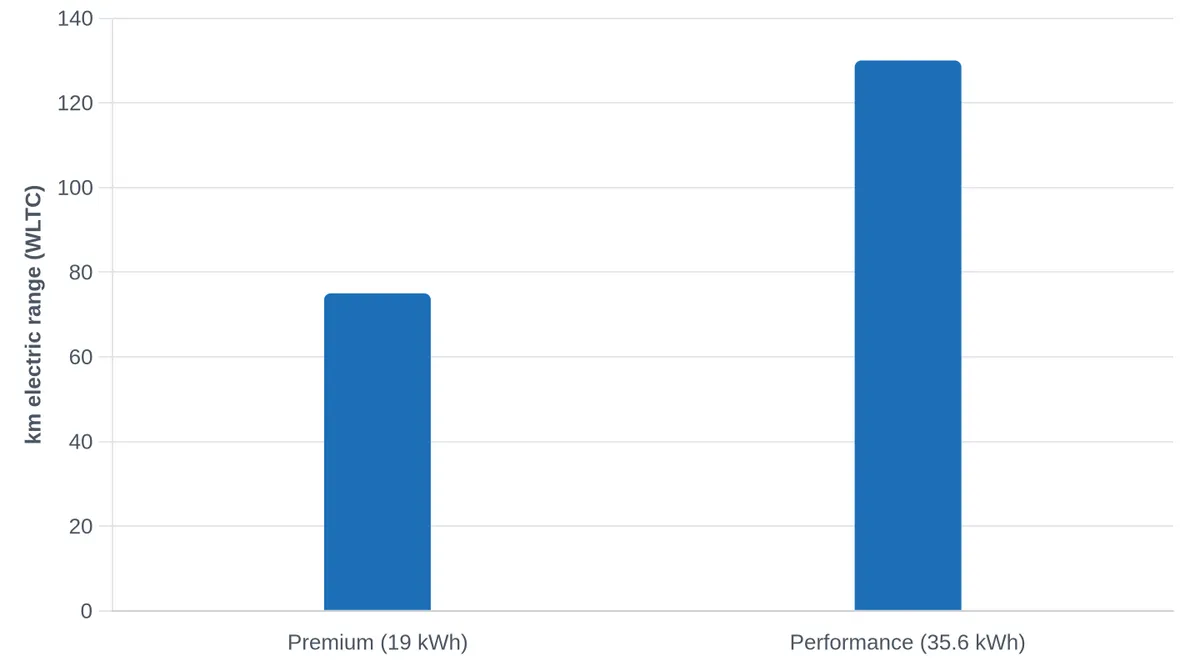
- BYD Atto 8 Premium PHEV: R1,059,900 (19 kWh battery, 75 km EV range, 892 km combined). Performance AWD: R1,259,900 (35.6 kWh, 130 km EV range, 844 km combined). Both launched 15 April 2026.
- Both variants include a 5-year/100,000 km maintenance plan at zero additional cost and an 8-year/200,000 km battery warranty.
- The Atto 8 accepts up to 11 kW AC charging. Most South African homes are single-phase, which means a 7 kW wallbox is the practical sweet spot without an expensive three-phase upgrade.
- If you charge the Premium every night on a 7 kW wallbox, a full battery costs roughly R66 to R98 at current municipal rates, enough for 75 km of petrol-free driving.
- A ChargePoint SA five-year TCO analysis puts the Atto 8 Premium R188,600 to R223,600 ahead of a Toyota Fortuner 2.8 GD-6 in fuel and maintenance savings, despite a higher purchase price.
- The PHEV case is strongest when you can charge at home daily. If you rely mostly on public DC fast charging, a pure EV with a home charger often wins on running cost.
- BYD’s dealer and service network remains concentrated in Gauteng, the Western Cape, and KwaZulu-Natal, a real practical consideration before you sign.
What the BYD Atto 8 PHEV is, and why it matters in South Africa right now
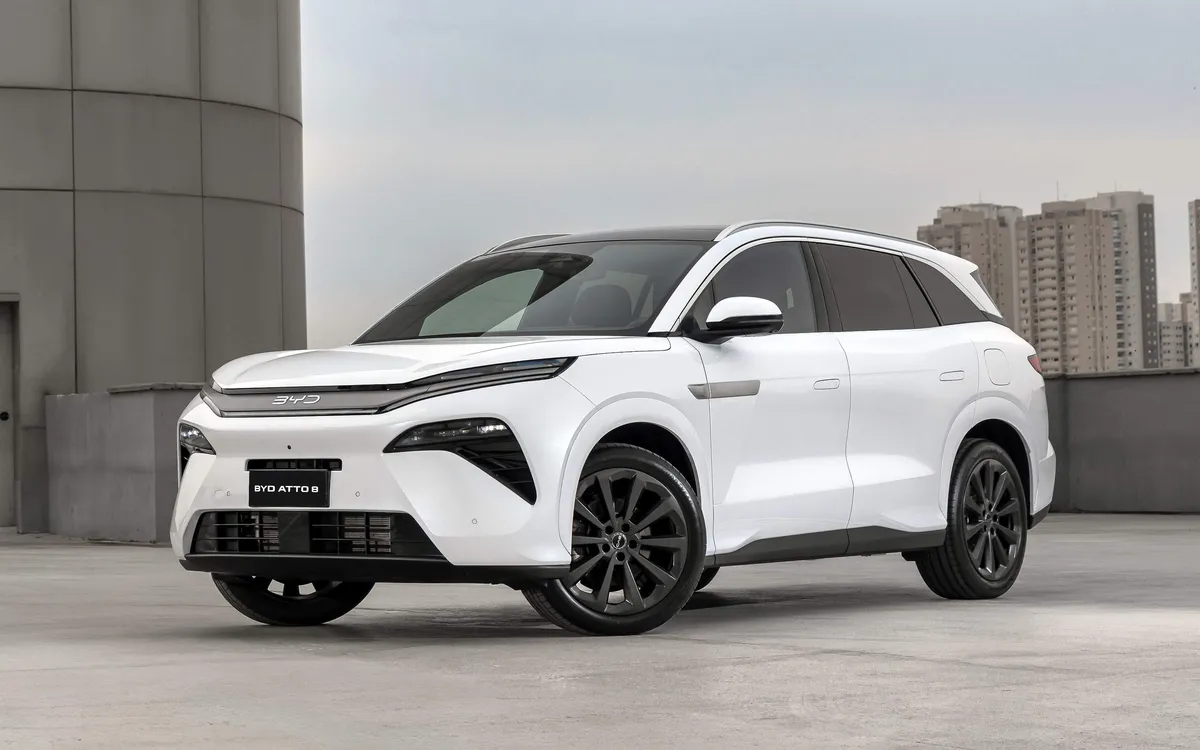
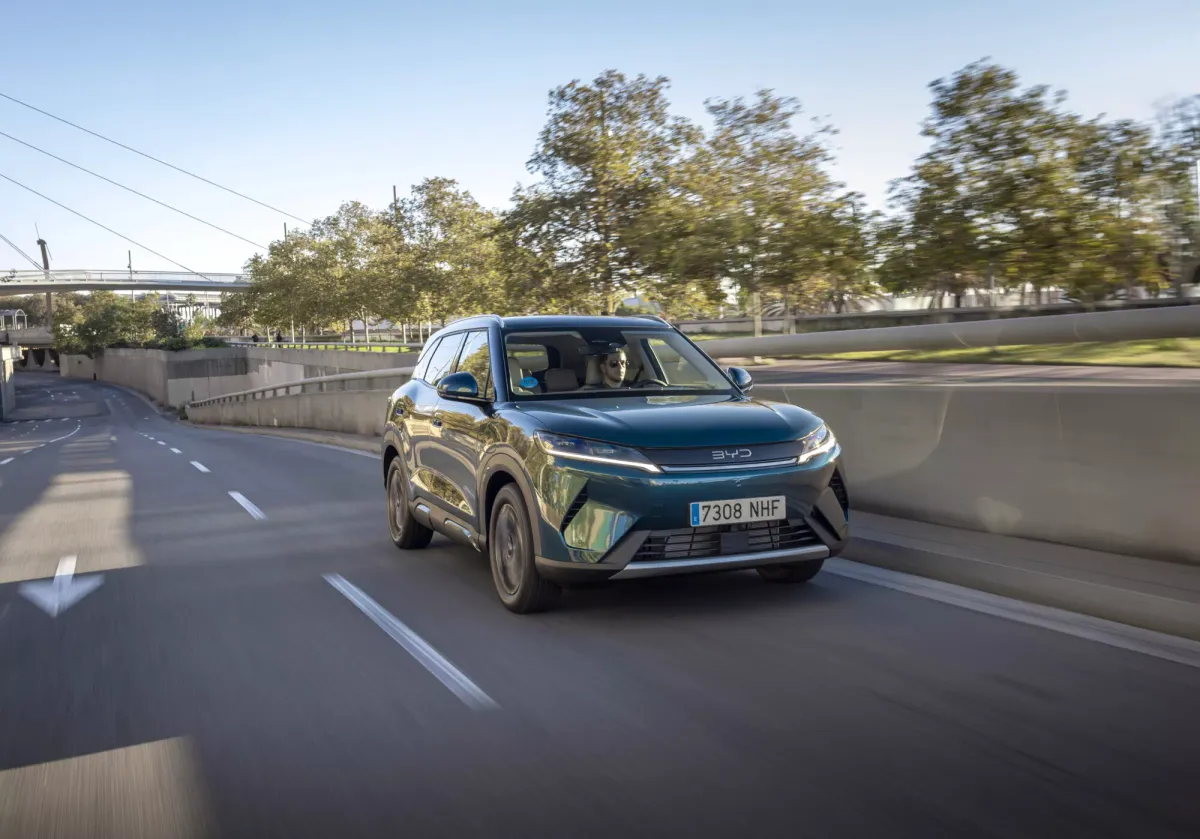
South Africa’s seven-seat SUV market has long been dominated by diesel workhorses. The BYD Atto 8 PHEV is a direct challenge to that convention: a full-size, 5,040 mm long plug-in hybrid SUV with a 1.5-litre turbocharged petrol engine, one or two electric motors depending on variant, and a battery large enough to cover most urban commutes without burning a drop of fuel.
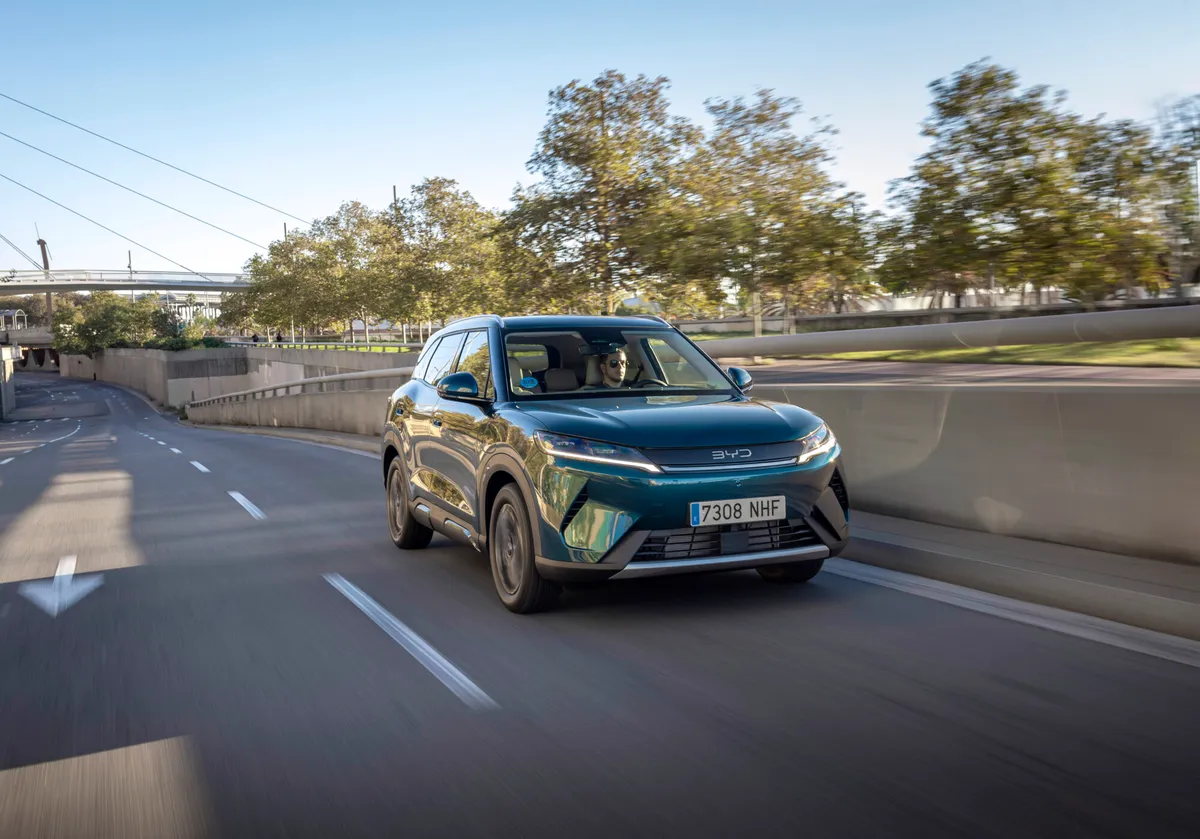
The Premium variant uses a single front-mounted 200 kW electric motor paired with the 1.5T petrol engine (110 kW/220 Nm) for a combined 205 kW and 315 Nm, sprinting to 100 km/h in 8.6 seconds (claimed, per AutoTrader). The Performance AWD adds a second rear motor, lifting combined output to 359 kW and 675 Nm, with a claimed 0-100 km/h time of 4.9 seconds, numbers that put it firmly in sports-SUV territory despite a 2,580 kg kerb weight.
At R1,059,900 and R1,259,900 respectively (TopAuto, Cars.co.za, CAR Magazine), both variants sit in a price bracket where buyers are weighing them directly against diesel SUVs, large-battery full EVs, and established hybrid alternatives. The question this article answers is straightforward: what do you actually pay over five years, and does the PHEV powertrain make sense for your specific situation?
“For daily commutes that fall within the quoted 75km electric range, the car could cost nothing in fuel bills. The Atto 8 will get nearly 900km to a tank, so there are no range anxiety issues as with a full EV.”
Business Day road test (7.7 L/100 km average, mixed urban and freeway driving)
Specifications at a glance
| Spec | Atto 8 Premium | Atto 8 Performance AWD |
|---|---|---|
| Price (VAT incl.) | R1,059,900 | R1,259,900 |
| Battery capacity | 19.0 kWh | 35.6 kWh |
| EV range (WLTC claimed) | 75 km | 130 km |
| Combined range (claimed) | 892 km | 844 km |
| WLTC fuel use (charged battery) | 2.9 L/100 km | 2.2 L/100 km |
| WLTC fuel use (combined) | 6.9 L/100 km | 7.8 L/100 km |
| Real-world fuel use (press tests) | 7.7 L/100 km (Business Day) | 9.0 L/100 km (The Citizen) |
| System power / torque | 205 kW / 315 Nm | 359 kW / 675 Nm |
| 0-100 km/h (claimed) | 8.6 s | 4.9 s |
| AC onboard charger | 11 kW max (single-phase) | 11 kW max (single-phase) |
| Fuel tank | 60 litres | 60 litres |
| Seating / length | 7 seats / 5,040 mm | 7 seats / 5,040 mm |
| Kerb weight | 2,315 kg | 2,580 kg |
| Vehicle warranty | 5 yr / 100,000 km | 5 yr / 100,000 km |
| Battery warranty | 8 yr / 200,000 km | 8 yr / 200,000 km |
| Maintenance plan | 5 yr / 100,000 km (zero cost) | 5 yr / 100,000 km (zero cost) |
Home charging: what your house can actually deliver

Understanding the Atto 8’s charging capability in the context of South Africa’s grid is critical, because it directly determines how much of your driving you can do on cheap electricity rather than petrol.
The Atto 8’s onboard AC charger accepts up to 11 kW regardless of variant (BYD Official Specification Sheet). That is a three-phase charging rate. Here is the practical implication: approximately 70% of South African residential properties are on a single-phase supply of 60-80 A, which caps you at a 7.4 kW home wallbox without a costly infrastructure upgrade. Upgrading from single-phase to three-phase involves a municipality application, meter replacement, DB board modification, labour, and a Certificate of Compliance, which cars.co.za describes as running into tens of thousands of rands.
For most Atto 8 buyers, then, the realistic home charging scenario is a 7 kW single-phase wallbox.
Charge times on a 7 kW wallbox:
- Premium (19 kWh): approximately 2.7 hours empty to full (Zecar.com / Plan EV Charge)
- Performance (35.6 kWh): approximately 5.1 hours empty to full (Plan EV Charge)
Charge times on an 11 kW three-phase wallbox (where available):
- Premium (19 kWh): approximately 1.7 hours empty to full
- Performance (35.6 kWh): approximately 3.2 hours empty to full
If you have three-phase supply at your property, the Caro Pro (CP-AC22) from ChargePoint SA delivers 22 kW, but the Atto 8 will draw only 11 kW, the car’s onboard charger is the limiting factor, not the wallbox. The benefit of installing a 22 kW unit is future-proofing: if you later own a vehicle that accepts 22 kW, your wallbox is already in place. For a household whose only EV is the Atto 8, the ChargePoint SA Caro Plus (CP-AC7), a 7 kW single-phase wallbox from ~R8,900 per unit (indicative) plus installation quoted per site, is the practical and cost-effective pick, with IP65 weatherproofing, Type A plus 6 mA DC earth-leakage protection, OCPP 1.6/2.0.1, Wi-Fi/Bluetooth, optional dynamic load balancing, and full SANS 10142-1 compliance including an electrical CoC. Installation of a standard single-phase 7 kW wallbox runs R13,000-R15,000 all-in, according to ChargePoint SA’s own supply and installation figures.
One note of caution: do not rely on a standard 3-pin domestic socket for regular overnight charging. South African socket outlets are rated for intermittent 10 A loads, not the continuous 8-plus-hour draw that daily PHEV charging demands. ChargePoint SA classes daily socket charging as a genuine fire and electrical compliance risk.
“The Sealion 8 positioned as a three-row plug-in hybrid SUV makes the home-charging bit rather more than a brochure garnish, although DC charging can be used.”
An owner and reviewer of the Sealion 8 (the Atto 8’s international variant), Gay Car Boys
What it costs per kilometre to run
The PHEV proposition only stacks up financially if you charge regularly. Here is the honest arithmetic.
Running entirely on electricity (home-charged): The Sowetan’s test recorded real-world electric consumption of 1.4 kWh per 100 km for the Performance variant in EV mode. Using that figure and a representative Johannesburg City Power flat rate of approximately R3.80 per kWh, 100 km of pure electric driving costs around R5.32. At a Tshwane off-peak overnight rate of R1.70 per kWh, the same 100 km costs approximately R2.38. Even at an average South African municipal rate of R3.40-R4.20 per kWh (ChargePoint SA, 2025/26), you are looking at R4.76-R5.88 per 100 km in EV mode.
Running on petrol with an uncharged battery: The Citizen recorded 9.0 L/100 km for the Performance in real-world driving. At the April 2026 inland petrol price of R23.36 per litre (ChargePoint SA), that is R210.24 per 100 km. The Business Day’s 7.7 L/100 km figure for the Premium translates to R179.87 per 100 km. WLTC figures with a charged battery (2.9 L/100 km Premium; 2.2 L/100 km Performance) are genuinely achievable for urban drivers who plug in every night, but they are laboratory conditions and should not be used for budgeting without adjustment.
The key planning insight: South Africa’s average one-way commute is 22 km (BusinessTech). A 44 km daily round trip falls comfortably within the Premium’s 75 km WLTC EV range, meaning a Gauteng commuter who charges overnight could genuinely cover most weekday driving on electricity alone. The Performance’s 130 km EV range covers virtually all daily urban use cases without touching the petrol tank.
“We averaged around 9L/100km during a week in the SUV, which is a very decent number for a performance car. The electric range is 130km. This should mean few visits to the petrol pumps if you charge the PHEV at home every night.”
The Citizen, real-world road test of the BYD Atto 8 Performance AWD
Five-year total cost of ownership: the full picture
Purchase price tells you very little about what you will spend. The table below compares the Atto 8 Premium against the Toyota RAV4 HEV, Haval H6 PHEV, and BYD Yuan Plus EV as a full-EV benchmark, across the costs that actually accumulate over five years and 100,000 km.
| Cost item | Atto 8 Premium PHEV | RAV4 HEV (GX, E-Four) | Haval H6 PHEV (2WD) | BYD Yuan Plus EV |
|---|---|---|---|---|
| Purchase price | R1,059,900 | R770,500 | R699,900 | R660,000 |
| 5-yr maintenance | R0 (included) | R45,000 est. (6-svc plan included; post-plan costs extra) | R0 (7-yr/75k plan included) | ~R12,000 est. |
| Fuel / electricity (20,000 km/yr, mostly home-charged PHEV) | ~R35,000-R55,000 (50% EV mode est.) | ~R94,000 (est. 4.7 L/100 km at R23.36/L) | ~R40,000-R60,000 (106 km EV range NEDC; depends on charge habits) | ~R10,000-R15,000 (home-charged) |
| Home charger install | R13,000-R15,000 (7 kW wallbox) | Not applicable (no plug) | R13,000-R15,000 (7 kW wallbox) | R13,000-R15,000 (7 kW wallbox) |
| Vehicle warranty | 5 yr / 100,000 km | 3 yr / 100,000 km | 7 yr / 200,000 km | 5 yr / 100,000 km |
| Battery warranty | 8 yr / 200,000 km | 8 yr / 160,000 km | 8 yr / 150,000 km | 8 yr / 200,000 km (est.) |
ChargePoint SA’s detailed TCO analysis comparing the Atto 8 to the Toyota Fortuner 2.8 GD-6 diesel found that the Atto 8 Premium produces R188,600 to R223,600 in fuel and maintenance savings over five years, despite a higher purchase price. The Fortuner’s service costs are estimated at R50,000-R70,000 over five years (R10,000-R14,000 per service, roughly every 10,000 km), while the Atto 8 Premium’s maintenance cost over the same period is R0, covered entirely by the included maintenance plan.
“The five-year ownership maths is firmly in the ATTO 8’s favour at any diesel price above R30/L, and we are already there.”
ChargePoint SA TCO analysis
One critical caveat on the Haval H6 PHEV comparison: the H6 PHEV’s 106 km EV range is quoted on the NEDC cycle, not WLTC. NEDC figures are typically 15-25% more optimistic than real-world results. The Atto 8’s 75 km EV range is WLTC-derived, making the two figures not directly comparable without adjusting for the test protocol difference.
The RAV4 HEV does not plug in at all: it is a self-charging hybrid only. Its fuel economy is genuine and reliable, but you cannot reduce running costs by plugging it in overnight, and Toyota’s 3-year/100,000 km vehicle warranty is the shortest in this comparison.
When the PHEV beats a pure EV, and when it does not
This is the honest heart of the article. The PHEV case depends entirely on your charging behaviour.
The PHEV wins when:
- You charge at home every night, covering 75-130 km of daily driving on electricity and using petrol only for longer trips.
- You frequently make trips beyond 400-500 km, where a full EV would require a public fast-charging stop on South Africa’s still-developing network.
- You live in an area with unreliable public charging infrastructure, where the petrol engine removes range anxiety entirely.
- You cannot yet install a home charger (body corporate rules, rented property) but still want fuel cost reduction on a portion of your driving.
The pure EV wins when:
- Your daily driving is consistently under 250-300 km, making the BYD Yuan Plus at R660,000 (Motowheeler ZA) or a BYD Atto 3 at R627,900 a significantly cheaper purchase with lower running costs.
- You have reliable home charging and rarely do long intercity trips, in this scenario, 95% of your charging happens at home (ChargePoint SA / EVASA), where residential rates of R1.70-R3.80 per kWh mean running costs of R37-R60 per 100 km versus R179-R210 per 100 km for the Atto 8 on petrol.
- You want to minimise service contact points, a full EV has no oil, no spark plugs, no exhaust, and no gearbox, producing maintenance costs approximately 30% lower than a petrol equivalent (BMW South Africa) and 60-70% lower than a diesel over five years (ChargePoint SA).
The PHEV penalty for owners who rarely or never charge is real. Without regular home charging, the petrol engine carries the full load of the heavy 2,315-2,580 kg vehicle, and real-world consumption climbs well beyond the WLTC combined figure. The Business Day’s 7.7 L/100 km Premium average and The Citizen’s 9.0 L/100 km Performance average are honest press-test benchmarks, but both journalists were almost certainly charging between stints. Owners who charge infrequently should model their fuel costs at 8-10 L/100 km minimum.
“The ATTO 8 is not perfect, BYD’s dealer and service network is still maturing in SA, and the PHEV’s real-world EV range needs honest testing on SA roads. But as a value proposition in a diesel crisis? It is genuinely compelling.”
ChargePoint SA, five-year TCO analysis comparing the BYD Atto 8 to the Toyota Fortuner 2.8 GD-6
Size the right wallbox for your Atto 8 PHEV
A stale fuel risk most brochures do not mention
Buyers drawn to the Performance’s 130 km EV range should be aware of a practical consequence that owners of the BYD Sealion 6 PHEV in South Africa have already flagged. When a large-battery PHEV covers most daily driving electrically, the petrol tank can sit untouched for months.
“With 100km+ of pure electric range, many owners are going 3-6 months between fill-ups. The Problem: Petrol degrades over time. Modern fuel contains ethanol (E10 in SA), which absorbs moisture and breaks down after 3-4 months.”
ChargePoint SA BYD Owners Survival Guide, discussing Sealion 6 PHEV owner experience
The solution is straightforward: schedule a monthly or bi-monthly longer drive in hybrid mode to cycle through the fuel tank, and keep the tank at least 25% full. It is a small discipline, but one worth knowing before you sign.
Grid compatibility and Eskom tariff context
South Africa’s electricity tariff structure has direct implications for your Atto 8 charging cost. Eskom implemented an 8.76% increase for direct customers from 1 April 2026, followed by a 9.01% increase for municipal customers from 1 July 2026 (Eskom 2026/27 tariff schedule). Charging costs will continue to rise in line with these increases.
The most cost-effective strategy is overnight off-peak charging. Tshwane residents with direct Eskom supply can access rates as low as R1.70 per kWh from 22:00-06:00. A full charge of the 19 kWh Premium battery at that rate costs approximately R32.30, delivering 75 km of electric range for the price of roughly 1.4 litres of petrol. Cape Town’s Home Power Plus TOU off-peak rate is approximately R2.10 per kWh, giving a full Premium charge for around R39.90. Johannesburg City Power’s flat rate of approximately R3.80 per kWh produces a full Premium charge cost of approximately R72.20.
On the Eskom Homeflex TOU tariff, which is available to Eskom-direct properties, peak rates reach R5.50-R6.50 per kWh during morning and evening peaks. Avoid charging during peak hours: set your wallbox to schedule charging for the overnight window.
If your home has a solar plus battery inverter system, the ChargePoint SA Caro Plus integrates with Sunsynk, Deye, and Victron inverters to maintain charging during load-shedding and to divert solar surplus into the car during the day, a particularly useful feature for Gauteng properties with south-facing roof space.
The service network question: be honest with yourself
The Atto 8 is a genuinely compelling product. The after-sales picture requires more candour. BYD’s service network in South Africa remains concentrated in Gauteng, the Western Cape, and KwaZulu-Natal, with gaps in Limpopo, Mpumalanga, the Eastern Cape, the Free State, and the Northern Cape (Top Chinese Car Brands). Warranty service is handled through Stallion Group and CFAO Motors.
Experience from BYD’s rapid expansion in Australia, a market approximately two years ahead of South Africa in BYD adoption, provides a useful preview. BYD Australia’s Chief Operating Officer acknowledged the challenge directly:
“Even in the early days of BYD [in Australia] there wasn’t a lot of experience in the country for EV repairs, right? So even if we had the parts, did the shop have the training? Did they have the right tools? I don’t think anyone expected us to grow as fast as we did, so we’re just bursting at the seams just running to catch up with the parts and service and training and all those things.”
Stephen Collins, BYD Australia Chief Operating Officer (March 2026)
This is not unique to BYD, and it does not make the Atto 8 a bad purchase. But if your nearest BYD dealership is more than 200 km away, factor in the logistics of a warranty claim or service booking before committing. BYD’s 8-year/200,000 km battery warranty and 5-year/100,000 km vehicle warranty are among the strongest in the segment, they only deliver value if you can access the service network.
How the Atto 8 Premium compares to a full EV over five years: a worked example
Buyer scenario: Pretoria household, 20,000 km per year, home on Eskom Homeflex TOU, charging overnight at R1.70 per kWh, petrol at R23.36 per litre inland.
BYD Atto 8 Premium PHEV (assuming 60% EV / 40% petrol split, realistic for a daily commuter who charges nightly):
- Electric kilometres (12,000 km/yr): 12,000 km at 1.4 kWh/100 km (Sowetan test) = 168 kWh per year, times R1.70 = R285.60 per year
- Petrol kilometres (8,000 km/yr at 7.7 L/100 km): 616 litres times R23.36 = R14,389.76 per year
- Combined annual running cost: approximately R14,675
- Over five years (fuel only): approximately R73,375
- Plus home charger install: R14,000 (one-off)
- Maintenance over five years: R0 (included plan)
- Five-year running cost total (fuel + charger + maintenance): approximately R87,375
BYD Yuan Plus EV (same household, same 20,000 km/yr, fully home-charged):
- Electric running cost: 20,000 km at 15 kWh/100 km (ChargePoint SA benchmark) at R1.70/kWh = R5,100 per year
- Over five years: R25,500
- Home charger install: R14,000
- Maintenance: approximately R12,000 over five years (ChargePoint SA, BYD Atto 3 proxy)
- Five-year running cost total: approximately R51,500
On running costs alone, the Yuan Plus saves approximately R35,875 over five years compared to the Atto 8 Premium under these conditions. The Atto 8 Premium’s purchase price is R399,900 higher. So the total five-year cost advantage sits firmly with the Yuan Plus if you are a consistent home charger with predictable urban driving needs.
Where the Atto 8 PHEV recovers ground: if you regularly drive 600+ km in a day, the petrol tank removes any charging stop overhead entirely. For families who combine urban commuting with quarterly long-distance travel, the hybrid flexibility has genuine value that does not appear in a pure cost-per-kilometre model.
ChargePoint SA’s own analysis, framing the Atto 8 against the Toyota Fortuner diesel, found R188,600-R223,600 in savings over five years in the PHEV’s favour despite the higher purchase price, but that comparison is against a thirsty diesel, not against an efficient full EV.
“Could this be the first Chinese car sold in SA with a genuinely upmarket feel beyond the surface materials? And could this be one of the first Chinese models sold in the country with a genuinely unique identity?”
Sowetan, road test of the BYD Atto 8 Performance, July 2026
Competitor snapshot: what else is in this price bracket
For buyers at the R1,059,900-R1,259,900 price point who want seven seats and are weighing the Atto 8 against other options:
- Toyota RAV4 2.5 HEV E-Four (R770,500-R941,800): A proven, self-charging hybrid with no plug. Cheaper purchase price, 3-year vehicle warranty (versus the Atto 8’s 5 years), solid dealer network, but cannot be charged at home to reduce running costs.
- Toyota RAV4 2.5 PHEV E-Four (R1,043,900): The plug-in RAV4 offers a 25.4 kWh battery and 142 km zero-emission range (TechCentral), but starts at just R16,000 less than the Atto 8 Premium with fewer seats, a shorter vehicle warranty (3 years vs 5), and no included maintenance plan.
- Haval H6 PHEV Hi-4 AWD (R749,900): More affordable with a 268 kW/760 Nm combined output and a class-leading 7-year/200,000 km vehicle warranty, but a smaller overall package than the Atto 8’s 5,040 mm footprint, and the 106 km EV range is quoted on NEDC rather than WLTC.
What you need to decide before buying
Four questions that will determine whether the Atto 8 PHEV makes financial sense for your household:
- Can you charge at home every night? If yes, the PHEV economics work. If no, you live in a sectional-title complex without charger access, or you rent, model your costs assuming 80-100% petrol use, and the case weakens significantly.
- What is your electricity supply? Single-phase means a 7 kW wallbox and 2.7-hour Premium charges. Three-phase enables the full 11 kW onboard charger and 1.7-hour Premium charges. The difference in daily convenience is meaningful.
- How far is your nearest BYD dealer? The warranty is only as good as the service network behind it. Check the current dealer map before committing.
- Do your long trips exceed 250 km regularly? If yes, the PHEV removes fast-charging stop overhead. If your longest trip is a 100 km drive to the coast, a full EV at a lower purchase price likely produces a better five-year result.
“At this price point, BYD is competing on perception, and persuading local 7-seater buyers to equate a Chinese badge with premium is a competition that numbers alone won’t win. This requires proper marketing.”
TopGear SA, first drive review of the BYD Atto 8, April 2026
The recommended home charger for Atto 8 owners
For the majority of Atto 8 buyers on single-phase supply, the ChargePoint SA Caro Plus (CP-AC7) is the right fit: 7 kW, IP65-rated, tethered Type 2 cable (5-7 m), RFID or app start, OCPP 1.6/2.0.1, optional solar integration and dynamic load balancing, and full SANS 10142-1 compliance with an electrical CoC issued on installation. It delivers the Premium’s battery from empty in approximately 2.7 hours, charge overnight and leave every morning with a full 75 km of electric range. Units start from approximately R8,900 (indicative); installation is quoted per site based on DB board condition, cable run, and local municipality requirements.
If you have three-phase supply and want the fastest possible AC charge, the Caro Pro (CP-AC22) at 22 kW future-proofs your installation while delivering the Atto 8’s maximum 11 kW accepted rate today.
Ready to work out exactly what home charging will cost you with the Atto 8? Calculate your home charging cost using ChargePoint SA’s online calculator, enter your municipality, tariff band, daily distance, and the tool will show you your annual electricity cost versus your current petrol spend.
Compare the Atto 8 PHEV’s true cost of ownership
Enter your municipal tariff to see real savings vs petrol models.
CoC-certified installers, nationwide
Image: BYD