
Key points
- South Africa had an estimated 7,000 to 10,000 EVs on the road by end of 2025, with the BYD Dolphin becoming the country’s best-selling BEV in March 2026 (239 units in its first reported month), the EV buyer is no longer a rare specimen at your showroom.
- A 4-bay 22 kW AC dealer charging installation costs approximately R109,000 to R299,500 all-in depending on site conditions, with bulk procurement delivering a 15 to 20% reduction in per-unit cost (ChargePoint SA compiled figures).
- A dealer-hosted DC fast charger starts from approximately R430,000 installed for a 60 kW single unit; a dual-gun 60 kW site costs approximately R650,000 all-in with roughly R3,300 per month in Eskom demand charges and R3,500 per month in O&M and software.
- Four ownership models are available: host-buys (dealer owns capex), revenue-share/white-label eMSP, investor-funded/ChargePoint SA-owns-host-free, and lease-to-own, only one requires any dealer capex upfront.
- All installations must comply with SANS 10142-1 (wiring code, including Annex N EV-specific requirements introduced in 2024/2025), SANS 62196-2 (AC connectors) and SANS 62196-3 (DC connectors), and must carry an electrical Certificate of Compliance issued by a DoL-registered electrician. Commercial installations for tendered projects require ECSA-registered engineers.
- OHS Act non-compliance at commercial premises can result in fines up to R1 million, imprisonment for up to two years, and workplace closure, with the dealer principal held directly liable.
- The cost-of-ownership gap between a well-configured dealer home-charger programme and a premium OEM-branded public DC tariff can reach R16,290 per year per vehicle for a driver covering 1,000 km per month.
If you are a dealer principal, group dealer director, or franchise operations manager, you already know that the EV conversation has landed on your showroom floor. What you may not yet have is a clear, costed answer to the question every EV buyer eventually asks: “And what about charging?”
This article sets out exactly what a purpose-built dealer charging programme looks like in South Africa in 2026, the hardware, the compliance, the ownership models, the real costs, and the revenue and retention case. We have drawn on ChargePoint SA’s verified cost guides, OEM programme data, and the documented approaches of premium brands already active in this space, so that you can make a fully informed decision rather than a rushed one.
Why the EV charging gap at dealerships is costing you sales
The South African EV market has crossed a threshold. At the end of 2024, NAAMSA-reporting brands had 3,543 registered passenger EVs on South African roads. Factor in non-reporting Chinese OEMs (BYD, Geely, Dongfeng) and the total by end of 2025 is estimated at 7,000 to 10,000 units (ChargePoint SA, Electric Vehicles in South Africa Complete 2026 Guide). The BYD Dolphin alone recorded 239 units in March 2026, its first reported month as best-selling BEV. These are not niche numbers any longer.
Yet public charging infrastructure has struggled to keep pace. South Africa had approximately 445 sites, 650 chargers, and 1,200-plus connectors by early 2026 (ChargePoint SA market research, 2026), up from roughly 350 stations at mid-2023. The EV-to-charger ratio sits at approximately 1:7. Western Cape and Gauteng account for 78% of all public charging points. In secondary cities and provincial towns, a dealer showroom may be the only fast charger for 50 kilometres.
This infrastructure gap creates a direct commercial problem for any dealership selling EVs without on-site charging. The buyer’s range anxiety is not irrational, it is a rational response to an infrastructure that is still being built. A dealership that resolves the anxiety at the point of sale, with a tangible home-charger installation offer and an on-site demonstration bay, converts that sale. A dealership that waves at a QR code and says “GridCars has a charger nearby” does not.
The premium brands have understood this for some time. Mercedes-Benz South Africa has committed to no fewer than 36 charging points at key dealerships and includes a wallbox with installation in every new EQ vehicle sale (Mercedes-Benz SA official charging page). BMW South Africa loads a R10,000 charging voucher onto every new EV buyer’s GridCars wallet, redeemable within 90 days of purchase (BMW SA official website, cited by ChargePoint SA). Audi South Africa has spent over R50 million on charging infrastructure since 2022 (AutoTrader SA, cited by ChargePoint SA). These are not acts of charity; they are conversion and retention tools.
The question for the rest of the market is not whether to build a dealer charging programme. It is how to do it correctly, at the right cost, with the right compliance, under an ownership model that matches your balance sheet.
What a complete dealer charging programme includes
A dealer charging programme has three components that are all too often treated as separate purchases, leading to gaps in compliance and accountability. ChargePoint SA’s approach brings all three under one contract:
1. On-site showroom and workshop charging
This is the demonstration and convenience layer. A buyer test-driving an EV or waiting for a service should see charging as normal, not as a special event. Two to four 22 kW AC bays in a visible, well-lit forecourt position signal competence to every visitor who drives past. For dealerships with throughput that justifies it, a single DC fast charger turns a half-hour service wait into a meaningful top-up.
2. Turnkey home-charger installation for EV buyers
This is the retention and referral layer. ChargePoint SA’s OEM partnership model provides turnkey home-charger installations for the dealer’s EV buyers at approximately R13,000 to R15,000 supply and install per residential unit (7.4 kW single-phase, electrical Certificate of Compliance included), account-billed to the dealership, co-branded at point of sale, with per-branch reporting (ChargePoint SA, OEM Partnership Models). The exact figure is quoted after a site survey, because DB board upgrades (R3,000 to R8,000 if needed), cable run length, and earthing conditions vary by property.
The alternative, handing the buyer a referral to any available electrician, produces results like the experience posted on a Mercedes EQ owners’ forum and cited by ChargePoint SA: “We had three attempts for installation of our complimentary MB Wallbox. Apparently the installation asks for an unusual type of wiring (4 AWG). Did anybody have trouble with their electrician installing it?” That is a warranty call waiting to happen, and a referral that will not go to your next customer.
3. Managed billing, reporting, and platform integration
If your showroom chargers are available to customers and visitors, you need RFID or app access control, a billing or usage-logging platform, and load balancing to keep your electricity account predictable. ChargePoint SA’s commercial programme covers managed billing, RFID and app access, metering, load balancing, and remote monitoring from approximately R350 per charger per month (ChargePoint SA, Eskom Fleet Electrification guide), under an OCPP/OCPI open platform that is not locked to a single network operator.
The four ownership models: which one fits your dealership
ChargePoint SA has documented four ownership models for dealer and OEM charging infrastructure (ChargePoint SA, OEM Partnership Models). Each has a different capex profile and a different revenue or cost outcome.
| Model | Who owns the hardware | Dealer capex upfront | Dealer revenue potential | Best for |
|---|---|---|---|---|
| Host-buys | Dealer | Full (R109k, R299k for 4-bay AC) | Full billing revenue | Well-capitalised dealers in high-traffic locations |
| Revenue-share / white-label eMSP | Shared or ChargePoint SA | Reduced or nil | Share of billing margin (typically ~15% eMSP margin above CPO wholesale) | Dealers wanting brand presence without full capex |
| Investor-funded / ChargePoint SA-owns-host-free | ChargePoint SA | Nil | Footfall value; potential small revenue share | Dealers with good location but constrained capex |
| Lease-to-own | Dealer (at end of lease) | Monthly lease payment | Full billing revenue once owned | Dealers preferring opex over capex while building the asset |
Hilton Musk, Head of E-mobility at Rubicon, has described the wholesale-to-retail margin structure in public EV charging this way: “Think of it like the fibre internet model. The fibre network providers, like Openserve or Vumatel, sell bandwidth to internet service providers such as Afrihost or MWeb, who then add their margin before offering it to customers. Public EV charging works in much the same way.” The eMSP margin in South Africa is typically 15% above the CPO wholesale rate (Rubicon/Hilton Musk, cited by CleanTechnica and ChargePoint SA), which means a revenue-share dealer operating as a white-label eMSP earns on every session without owning the network infrastructure.
Winstone Jordaan, Director of GridCars (South Africa’s largest public charging network), has been publicly candid about the current market economics: “There’s just no business case. We need about 100,000 vehicles on the road before any of us will see real profitability. But that doesn’t mean we shouldn’t build the foundation now.” (Cited by ChargePoint SA.) For dealers, this means public-charging revenue is a medium-term play. The immediate case is not the charging margin, it is the sale you close, the service customer you retain, and the referral you earn.
Real costs: what a dealer charging installation actually involves
The single most common mistake dealers make when budgeting for EV charging is treating it as a hardware purchase. Installation cost is site-specific and frequently exceeds the hardware cost on complex sites. The following is a breakdown using ChargePoint SA’s verified 2026 cost guides.
AC wallbox installations (22 kW, Level 2)
- Hardware (22 kW three-phase wallbox): from approximately R13,900 per unit for the ChargePoint SA Caro Pro (CP-AC22), indicative, or the CP-AC22-N billing-grade variant for public or semi-public use (quoted per site)
- Labour, standard bay within 10 m of DB board: R3,500 to R7,500 per bay (ChargePoint SA, Paarl 2026 Cost Guide)
- Labour add-on for wall penetrations, trenching, or solar inverter integration: R5,000 to R15,000 additional (ChargePoint SA, Paarl 2026 Cost Guide)
- Cabling from DB board to charger mounting point: R180 to R320 per metre for 6 mm² or 10 mm² copper cable (ChargePoint SA, Paarl 2026 Cost Guide)
- Additional cost where parking bays are 50-plus metres from the DB board: R8,000 to R15,000 extra per cable run (ChargePoint SA, Rosebank 2026 Cost Guide)
- Earth leakage and surge protection components: R2,200 to R4,500 per point (ChargePoint SA, Paarl 2026 Cost Guide)
- DB board upgrade (if the existing board lacks capacity for a dedicated 32 A or 40 A breaker): R4,500 to R9,000 (ChargePoint SA, Paarl 2026 Cost Guide)
- Full DB board replacement or service upgrade on older premises: R15,000 to R35,000 additional (TheHandymanJohannesburg.co.za)
- Load study by a consulting engineer for multi-bay shared infrastructure: R12,000 to R18,000 (ChargePoint SA, Rosebank 2026 Cost Guide)
- Electrical Certificate of Compliance: R500 to R1,500 per installation (ChargePoint SA, EV Charger Installation Cost SA 2026)
Compiled total for a 4-bay 22 kW AC dealer installation: approximately R109,000 to R299,500 all-in depending on site conditions (ChargePoint SA, compiled from Paarl, Rosebank and OEM guides). Bulk procurement and shared civil works deliver a 15 to 20% reduction in per-unit cost on larger multi-bay projects (BuildersInGauteng.co.za).
DC fast charger installations
- 60 kW DC fast charger (ChargePoint SA CP-DC60): from approximately R430,000 installed, indicative for the 60 kW single-unit configuration
- Dual-gun 60 kW DC site: approximately R650,000 all-in (ChargePoint SA, OEM Partnership Models)
- Eskom Megaflex demand charges on a dual-gun 60 kW site: approximately R3,300 per month (high-demand season rate: R52.65/kVA/month; low-demand season: R26.29/kVA/month, billed on peak kVA whether or not all chargers are in use, Eskom 2026/27 tariff schedule)
- O&M and software: approximately R3,500 per month (ChargePoint SA, OEM Partnership Models)
- For higher-throughput forecourts: the CP-DC160 (160 to 300 kW ultra-rapid, dual CCS2) is quoted per site
For context on the broader OEM market, Jaguar Land Rover’s investment through GridCars of R30 million for 82 public stations in 2018 works out to approximately R366,000 per station all-in (Jaguar SA official website, cited by ChargePoint SA). Mercedes-Benz South Africa and GridCars jointly invested approximately R40 million for 127 new stations, with 67 EQ-branded stations operational by July 2024 (EV24.africa, cited by ChargePoint SA). These figures confirm that R430,000 to R650,000 per DC installation is the correct order of magnitude for the South African market.
Compare dealer ownership models: host-buys vs revenue-share
Compliance: what the law requires of a dealer charging installation
This is the section most dealer purchasing managers skip, and it is the section that creates the largest liability exposure. South Africa has a mandatory, interlocking set of standards and regulations that every commercial EV charger installation must satisfy. ChargePoint SA is explicit about this because competitors routinely omit it.
SANS 10142-1 and Annex N
SANS 10142-1 is South Africa’s mandatory low-voltage wiring code, compulsory under the Occupational Health and Safety Act No. 85 of 1993 (TDMI, Understanding SANS 10142-1:2024). The 2024/2025 update introduced Annex N, which covers EV charging infrastructure specifically. Annex N requires dedicated RCD protection rated for Type A or Type B (for DC residual currents), a generic household earth leakage device is not compliant. It specifies minimum 6 mm² cable sizing for 32 A single-phase runs under 25 m, defines earthing thresholds, and mandates surge protection. As ChargePoint SA has stated directly: your installer must know this. Many generalist electricians do not.
SANS 62196-2 and SANS 62196-3
AC connectors at your dealer charging bays must conform to SANS 62196-2. DC connectors (CCS2, CHAdeMO) must conform to SANS 62196-3. Hardware that does not carry NRCS Letter of Authority (LoA) approval cannot be legally imported or sold in South Africa. The LoA process takes up to 120 working days (approximately 18 weeks), which is why sourcing from a supplier that already holds the relevant approvals is not optional if your installation timeline matters (ChargePoint SA, OEM Partnership Models).
Electrical Certificate of Compliance
Every EV charger installation requires an electrical Certificate of Compliance under the Electrical Installation Regulations 2009. The CoC must be issued by a DoL-registered Installation Electrician (IE), Master Installation Electrician (MIE), or ETSP. For commercial and public-sector tendered projects, ECSA-registered engineers are required for CoC issuance (ChargePoint SA, EV Charger Supply for OEMs in South Africa).
The consequences of a missing or non-compliant CoC are severe. Insurers routinely reject claims for electrical fires or damage where no valid CoC covers the EV circuit (ChargePoint SA, Complete EV Home Charger Guide 2026). The OHS Act penalties for non-compliant electrical installations at commercial premises include fines up to R1 million, imprisonment for up to two years, and the ability for the Department of Labour to close the workplace outright, with the employer held directly liable where non-compliance leads to injury or fatality (Hello Contract, Enforcing the South African Health and Safety Act).
Anthony Schewitz, Regional Director at ECA(SA) Highveld region, has warned in an official ECA(SA) publication: “Contractors need to protect their CoCs and their registration details as carefully as they protect their PIN numbers and passwords because, should something go wrong, it’s going to go very, very wrong.” (ECA(SA), Don’t Get Caught Up in Certificate of Compliance Fraud.) For a dealer relying on unvetted installers across multiple branches, this risk is multiplied by the number of sites.
Networked charger approvals
Networked chargers with Wi-Fi or LTE connectivity require ICASA type approval under Section 35(1) of the Electronic Communications Act, mandatory, with approval normally taking 30 working days on submission of all documents (ICASA, Type Approval Requirements). All chargers connected to South African mains supply require a SABS EMC Certificate of Compliance, valid for three years (ChargePoint SA, Eskom Fleet Electrification).
OCPP protocol and future-proofing
OCPP 1.6 and OCPP 2.0.1 are not backward compatible. A dealer that installs OCPP 1.6 hardware today cannot natively upgrade to 2.0.1 without hardware changes. OCPP 2.0.1 was approved as IEC 63584 in late 2024; as of September 2025, only 68 charger models worldwide held formal OCA OCPP 2.0 certification (ChargePoint SA, Eskom Fleet Electrification). South Africa currently has no mandated OCPP version, but open-standards hardware is increasingly required in serious commercial tenders. ChargePoint SA’s programme specifies OCPP/OCPI open platform as standard, avoiding lock-in.
Cost-of-ownership comparison: dealer programme versus ad-hoc public charging
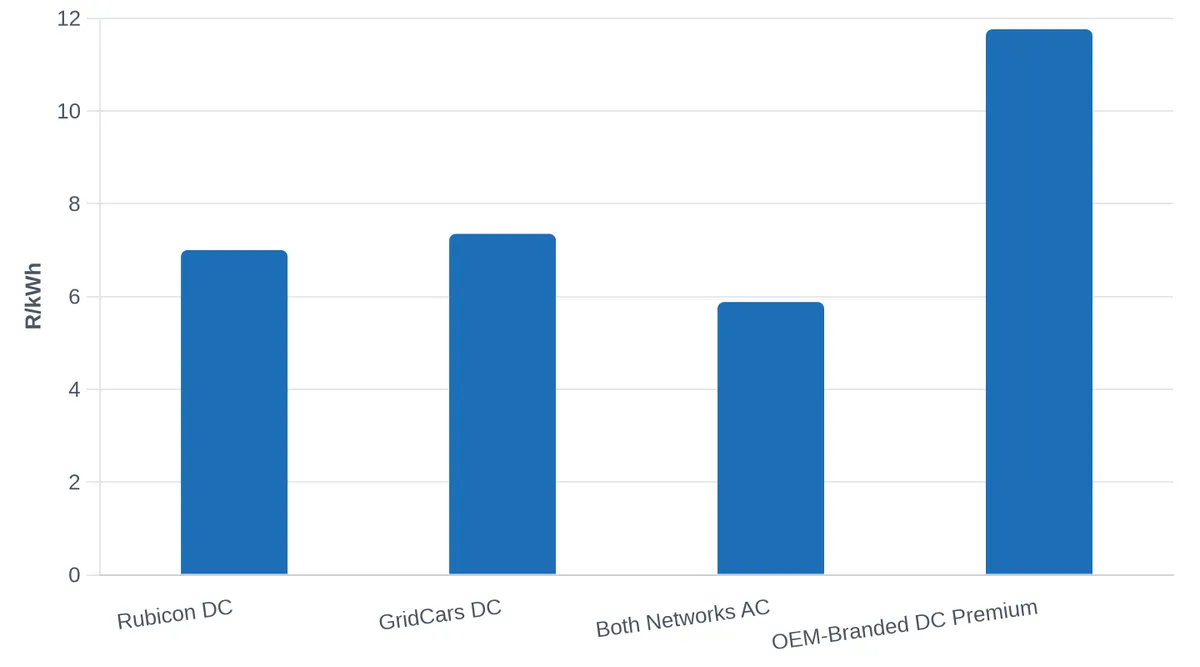
The financial case for a dealer-managed home charger programme rests on a concrete ownership cost gap. ChargePoint SA has quantified this directly (ChargePoint SA, EV Charger Supply for OEMs in South Africa):
| Charging scenario | Assumed consumption (1,000 km/month) | Indicative rate | Estimated monthly cost | Estimated annual cost |
|---|---|---|---|---|
| Dealer-installed home wallbox (off-peak municipal tariff) | ~167 kWh (at 6 km/kWh) | ~R3.40-R4.20/kWh | R568-R701 | R6,816-R8,412 |
| Standard public AC network (post-Dec 2025 increase, ~15% above August 2025 R5.88/kWh) | ~167 kWh | ~R6.76/kWh (indicative post-increase) | R1,129 | R13,548 |
| OEM-branded DC public tariff | ~167 kWh | Up to R11.76/kWh | R1,965 | R23,580 |
The gap between a well-configured home charging programme and a premium OEM-branded public DC tariff reaches up to R16,290 per year for the same 1,000 km per month driven (ChargePoint SA, EV Charger Supply for OEMs in South Africa). For a corporate customer running a fleet of 50 EVs, that annual differential exceeds R800,000.
An EV owner who received a properly installed and configured smart home charger at delivery will not be spending at that OEM-branded public rate. That owner will be an ambassador. One who was handed a brochure and told to find their own electrician, and who then encountered the four-AWG wiring problem on the third attempt, will not.
The smart charger premium is also worth noting. A billing-capable wallbox with scheduled off-peak charging costs R1,500 to R3,000 more than a basic unit, but saves R1,500 to R3,000 per year for a commuter driver through Homeflex off-peak scheduling (Synergy Energy Solutions). That is a first-year payback on the upgrade, and a benefit the dealer can articulate at point of sale.
The right hardware for each part of your dealer programme
ChargePoint SA supplies and installs its own range across all power levels. For a dealer programme, the recommendation depends on the application.
For home charger delivery to your EV buyers: the ChargePoint SA Caro Plus (CP-AC7) is the correct entry point, a 7 kW single-phase tethered Type 2 wallbox with OCPP 1.6/2.0.1, Wi-Fi/Bluetooth, optional solar surplus charging, IP65 weatherproofing, and Type A plus 6 mA DC earth-leakage built in. It is SANS 10142-1 compliant on installation and includes a CoC. Indicative unit price from approximately R8,900, with installation quoted per site. This is the unit that ends the “three failed installation attempts” problem, delivered and installed by a certified team, account-billed to your dealership.
For your showroom demo and customer waiting bays (AC): the ChargePoint SA Caro Pro (CP-AC22) delivers 22 kW three-phase on a tethered 7 m Type 2 cable, with dynamic load balancing, Wi-Fi/Ethernet/4G, OCPP, PV solar charging, and an IP65/IK10 rating. It turns a bay over in a couple of hours and is the best all-round AC pick for a visible showroom position. Where you need billing and auditable transaction records, the CP-AC22-N adds an Eichrecht-conformant smart meter at 1% accuracy, MID metering, and ISO 15118 Plug and Charge. For two adjacent bays from a single unit, the CP-DUO-44 charges two vehicles simultaneously from one enclosure.
For a dealer DC fast-charging bay: the ChargePoint SA CP-DC60 (60 to 120 kW, dual-outlet CCS2, 10.1-inch touch screen, app/QR/RFID/POS payment, OCPP, smart-grid integration) delivers approximately 30-minute top-ups and is forecourt- and fleet-grade. Indicative installed price from approximately R430,000 for the 60 kW configuration. For higher-traffic sites on a highway corridor or multi-brand forecourt, the CP-DC160 (160 to 300 kW, dual CCS2, 350 A) is quoted per site.
The entire range is available under ChargePoint SA’s Commercial EV Charging Programme, one accountable contract covering supply, SANS 10142-1 compliant installation, electrical CoC, ECSA-registered installers, managed billing, load balancing, and remote monitoring from approximately R350 per charger per month. A white-label option allows any unit to be branded in your dealership’s colours, on the enclosure, in the app, and on the operator portal.
What a live multi-site OEM tender looks like in practice
For dealer groups evaluating a network-wide programme, the specification framework documented on Procompare.co.za (a live tender active circa June 2026) is a useful reference. The specification covers 42 units across 14 locations: 2 AC and 1 DC per location (28 AC, 14 DC total) across Cape Coastal, Gauteng, KZN, Eastern Cape, and Limpopo clusters. The tender requires unit and installation pricing, delivery timelines, warranty documentation, and compliance certificates to be submitted as a single package (Procompare.co.za, cited by ChargePoint SA).
This is the format that any dealer group with three or more branches should be using when approaching a charging supplier. A piecemeal site-by-site approach loses the 15 to 20% bulk procurement discount, produces inconsistent compliance documentation, and creates a servicing nightmare across installers with different competency levels.
Eskom demand charges: the operating cost most dealers do not model
If your dealership is billed on an Eskom Megaflex or municipal equivalent tariff, the demand charge component of your electricity account will be the largest ongoing cost of running a multi-bay charging installation, and it arrives whether or not any car actually charges. The Eskom 2026/27 tariff schedule sets the network demand charge at R52.65/kVA/month in the high-demand season and R26.29/kVA/month in the low-demand season (Eskom 2026/27 tariff schedule, cited by ChargePoint SA). These charges are billed on your peak kVA reading for the month.
Smart load balancing is not optional on any multi-bay AC installation. A 20-bay 22 kW AC depot running simultaneously would draw 440 kW theoretical peak demand (ChargePoint SA, Eskom Fleet Electrification guide), at Megaflex rates, that demand charge would be prohibitive. Dynamic load management, which is a standard feature of the CP-AC22, CP-AC22-N, CP-DUO-44, and CP-DC60, distributes available capacity across active sessions and caps peak demand to a pre-set site limit. This is not a luxury feature; it is the mechanism that makes the electricity account manageable.
Eskom tariff increases of 8.76% from 1 April 2026 and 9.01% from 1 July 2026 (Eskom 2026/27 tariff schedule) mean that the operating cost of an unmanaged charging installation will compound annually. A correctly specified system with load balancing locks in a predictable cost base regardless of tariff trajectory.
The profitability timeline: being honest with yourself
Winstone Jordaan of GridCars has stated publicly that the South African market needs approximately 100,000 EVs before charging-as-a-service reaches real profitability (ChargePoint SA, EV Charger Supply for OEMs in South Africa). With an estimated 7,000 to 10,000 EVs on road by end of 2025, that threshold is several years away at any realistic growth rate.
This means that a dealer investing in on-site charging today is not doing so primarily for direct charging revenue. The business case rests on three other pillars: the incremental EV sale that would have gone to a competitor with visible charging infrastructure; the service retention of existing EV owners who prefer the convenience of topping up during a workshop visit; and the brand positioning that comes from being the dealership in your area that takes the EV customer’s experience seriously.
The investor-funded and revenue-share ownership models exist precisely because the charging hardware itself is not yet a profit centre at current utilisation rates. A dealership with a good location and regular footfall can attract ChargePoint SA investment on a host-free basis, getting the infrastructure, the compliance documentation, the managed platform, and the brand benefit without the capex outlay, while sharing in any billing revenue generated.
Frequently asked questions
What is the minimum a dealership needs to spend to start an EV charging programme?
Under the investor-funded or host-free model, a dealership with an attractive location can host ChargePoint SA-owned chargers at zero upfront capex, sharing in any billing revenue. If you prefer to own the hardware outright, a basic 2-bay 22 kW AC installation on a straightforward site (within 10 m of an adequate DB board, no trenching, no DB upgrade required) can come in from approximately R55,000 to R75,000 all-in including hardware, labour, cabling, earth leakage protection, and electrical CoC. Complex sites with distant DB boards, trenching, or board replacements will cost more, the correct approach is a site survey before committing to any figure.
Does the dealership need to become a Charge Point Operator to bill for charging sessions?
No. Under a revenue-share or white-label eMSP arrangement, ChargePoint SA operates as the CPO (Charge Point Operator), managing the hardware, network, and billing platform, while the dealership acts as the site host and may carry the brand on the charger enclosure and app. The dealership receives a share of session revenue (the eMSP margin is typically 15% above the CPO wholesale rate, per Rubicon/CleanTechnica data) without taking on the regulatory and insurance obligations of a full CPO. Alternatively, a dealer group that wants full control can operate its own eMSP under an OCPP-based open platform, ChargePoint SA’s programme supports this.
Which compliance documents must the dealership hold after installation?
Every installation must produce an electrical Certificate of Compliance under the Electrical Installation Regulations 2009, issued by a DoL-registered Installation Electrician or Master Installation Electrician. Commercial installations for tendered or public-access projects additionally require ECSA-registered engineer sign-off. Networked chargers with Wi-Fi or LTE must hold ICASA type approval under Section 35(1) of the Electronic Communications Act. The hardware itself must carry NRCS Letter of Authority and SABS EMC Certificate of Compliance. ChargePoint SA delivers all of these as part of the programme, the dealership’s facilities manager should hold physical copies of each document on file, because the OHS Act places the compliance obligation squarely on the employer (fines up to R1 million; workplace closure; criminal liability for injury or fatality).
How long does a dealer charging installation take from approval to live charging?
Once a site survey is complete and the project scope is fixed, a straightforward single-phase 7 kW wallbox installation takes 4 to 8 hours on the day, with the Certificate of Compliance issued within 7 to 14 days (ChargePoint SA, EV Home Charger Guide 2026). A multi-bay 22 kW AC installation with trenching and a DB upgrade typically runs 3 to 7 working days on site. DC fast charger installations involving civil works, upgraded metering, and network integration take longer and should be planned over 4 to 8 weeks from survey to commissioning. Hardware sourcing is the long-lead variable: NRCS LoA approval alone takes up to 120 working days, which is why sourcing from a supplier that already holds all approvals collapses the timeline significantly.
Can a dealership offer home charger installation to all its EV buyers, not just one brand?
Yes. ChargePoint SA’s dealer programme is brand-agnostic. The home charger (Caro Plus CP-AC7 or Caro Pro CP-AC22 depending on the buyer’s preference and electrical capacity) is compatible with any Type 2 EV sold in South Africa, and the programme can be co-branded to the dealership rather than to a specific vehicle manufacturer. This is particularly useful for multi-franchise dealer groups selling EVs across two or more brands from the same site, or for dealer groups that want a single coherent home-charger offering across their network rather than different OEM programmes with inconsistent quality and compliance levels.
What happens if an EV buyer’s home cannot accommodate a wallbox installation?
A pre-delivery site survey eliminates surprises. The standard ChargePoint SA home-charger programme includes a site assessment before installation is booked. Where the DB board cannot accommodate a dedicated 32 A or 40 A breaker without upgrade (cost: R4,500 to R9,000 for a standard upgrade, or R15,000 to R35,000 for a full board replacement on older premises), the buyer receives a transparent cost breakdown before any work proceeds. The dealership’s account is billed only for work actually completed, with per-branch reporting so your sales team can track every buyer’s installation status. CoC delivery confirms each installation is legally complete.
If you manage a dealer group and are ready to move from “we should do something about charging” to a costed, compliant programme with a fixed scope and a named installation team, the next step is a free site assessment. Become a charging partner and ChargePoint SA will scope your sites, recommend the right hardware and ownership model for each location, and deliver a programme your EV buyers will actually talk about.
Photo: 04iraq / Pexels
Launch a complete dealer charging programme for your showroom
Four ownership models tailored to dealership cash flow and customer strategy.
Explore dealer charging →WhatsApp us
CoC-certified installers, nationwide