Key points
- Eskom launched its pilot charging infrastructure on 22 August 2024, with 10 stations across 5 sites, and its first 20 fleet EVs entered service on 9 September 2025.
- The Distribution Division (approximately 10,000 vehicles) targets full electrification by 2035; the entire ~13,000-vehicle fleet targets electrification by 2040, with net-zero carbon emissions by 2050.
- Eskom signed a Memorandum of Cooperation with BYD on 16 September 2025, covering public charging expansion and future renewable-powered ultra-fast hubs, with 200-300 public stations planned by end-2026.
- A dedicated residential time-of-use EV tariff has been submitted to NERSA for approval. If approved, it will make off-peak home charging significantly cheaper, Eskom’s Homeflex off-peak rate currently sits at R1.45-R2.25/kWh.
- 95% of South African EV owners rely on home charging as their primary solution. Home charging costs approximately R0.60-R0.80/km versus R1.20-R1.50/km on public DC networks, versus petrol at roughly R2.50/km.
- Public DC tariffs rose approximately 15% from 1 December 2025 (GridCars). Any rate you read before that date is a historical benchmark, not a current 2026 figure.
- OCPP 1.6 and OCPP 2.0.1 are not backward compatible. Installing a charger locked to OCPP 1.6 today risks exclusion from future Eskom and public network tender requirements.
- Eskom’s grid reliability has improved materially: a 98.9% energy supply rate in FY2025/26 versus 6,837 load-shedding hours in 2023.
Where Eskom’s pilot actually stands today
On 22 August 2024, Eskom launched its EV charging infrastructure pilot at the Eskom Academy of Learning (EAL) in Midrand, Gauteng, in partnership with GridCars. Ten charging stations, two at each of five sites, were commissioned across Midrand, Brackenfell in Cape Town, Mkondeni in Pietermaritzburg, Tlhabane CNC in Rustenburg, and Marathon CNC in Mbombela. The hardware specification for Phase 1 is a mix of 60 kW DC fast chargers and 22 kW dual AC chargers.
Before Eskom’s own fleet EVs were formally deployed, the pilot stations delivered nearly 3,500 kWh to employees and visitors, confirming the infrastructure functioned reliably under real-world conditions. On 9 September 2025, 20 EVs entered service across Eskom’s Distribution and Generation Divisions, with 100 additional vehicles planned in the near term.
Gabriel Kgabo, GM of the Office of Group Executive Distribution, framed the intent plainly: “By investing in eMobility and the charging infrastructure needed for electric vehicles, we are not only reducing our carbon footprint but also stimulating the local economy and creating new opportunities for growth.”
The scale of Eskom’s fleet electrification ambition
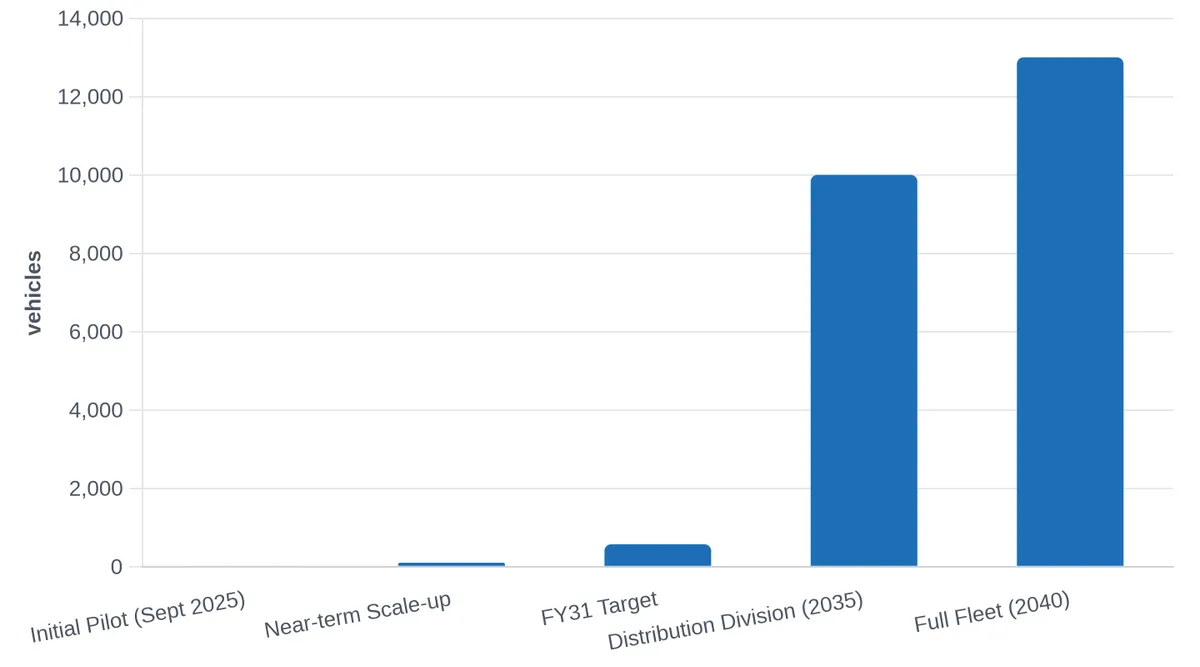
Eskom operates a fleet of approximately 13,000 vehicles. The Distribution Division alone accounts for roughly 10,000 of those and has set a target to electrify its entire divisional fleet by 2035. The broader target, covering all 13,000 vehicles, is 2040, with net-zero carbon emissions by 2050 as the overarching Just Energy Transition goal.
Eskom’s own planning documents show a target of 572 EVs in service by FY31, which gives some sense of the pace of ramp-up required between now and the 2035 divisional deadline. To reach 10,000 vehicles by 2035 from a base of 20 today means averaging roughly 830 new fleet conversions per year from here.
That number carries a striking market context: if Eskom replaced just 10% of its entire ~13,000-vehicle fleet in a single procurement year, that single order would exceed the entire annual national BEV sales volume, which stood at just over 1,000 units reported to NAAMSA in 2024. South Africa had 3,543 registered battery-electric vehicles at end of 2024. Eskom’s programme alone has the potential to reshape SA’s EV market in a way that few other single buyers could.
Eskom Group Chief Executive Dan Marokane put the ambition directly in September 2025: “Eskom is driving South Africa’s shift to a cleaner, low-carbon future. Through e-mobility, we are cutting emissions, boosting innovation, and showing how sustainable energy solutions can create real benefits for communities and the economy. We see ourselves as more than just an electricity provider, we are enablers of progress.”
Public charging rollout: what Eskom and BYD have committed to
On 16 September 2025, Eskom signed a Memorandum of Cooperation with BYD Auto South Africa. The partnership covers the BYD Dolphin Surf launch (currently priced at R341,900 in South Africa), expansion of public charging infrastructure, future renewable-powered ultra-fast charging hubs, and EV battery repurposing for energy storage.
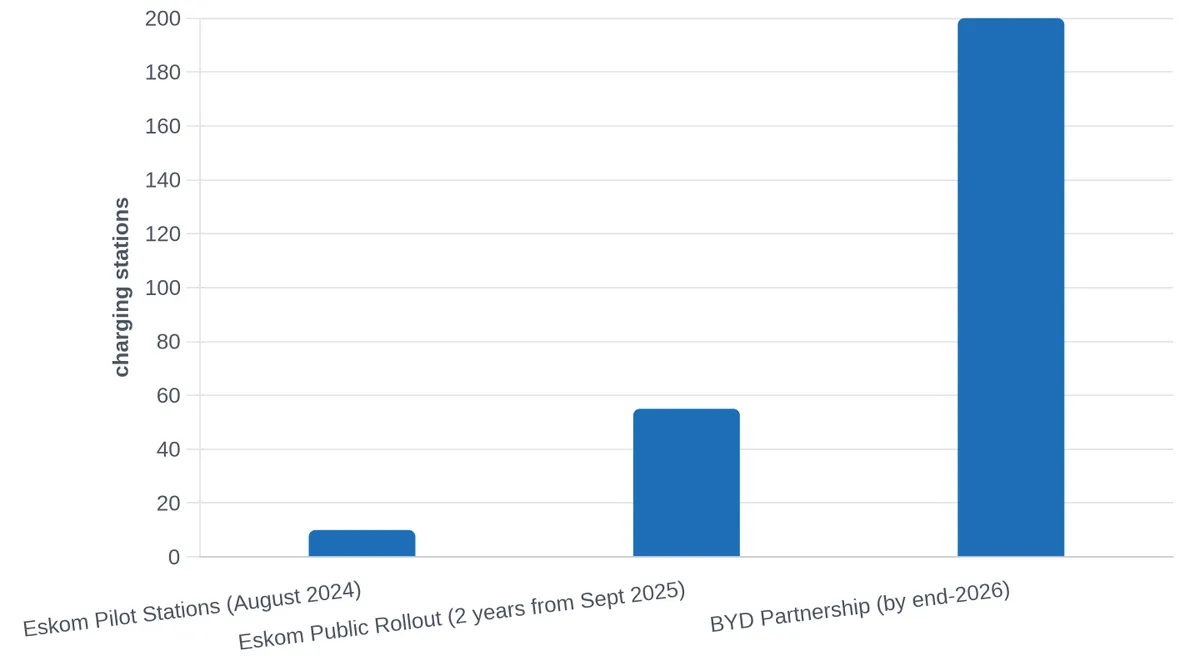
The commercial consequence is significant: 200 to 300 public charging stations are planned across South Africa by end-2026, powered by Eskom and open to all EV brands, not only BYD models. Separately, Eskom has committed to rolling out 55 public EV charging stations within two years of September 2025.
Agnes Mlambo, acting Group Executive for Distribution, confirmed the direction: “Having successfully rolled out EVs within our fleet on 9 September 2025, we are ready to enable wider adoption by bringing practical and accessible charging infrastructure to South Africans.”
For context on where South Africa’s public network sits today: as of early 2026, the country has approximately 445 public EV charging sites with roughly 650 individual chargers and more than 1,200 connectors. GridCars operates approximately 60% of national public charging capacity. The Eskom and BYD commitments, if delivered, would materially expand that network.
What the pilot charger hardware means for your own installation
The two charger types Eskom selected for Phase 1, a 60 kW DC fast charger and a 22 kW dual AC charger, are not arbitrary. They represent the two tiers of commercial EV charging that any fleet operator, workplace, or destination venue needs to evaluate.
60 kW DC fast chargers
DC fast chargers at this power level deliver meaningful top-ups in 30 minutes or less, making them suited to operational fleet vehicles that cannot afford multi-hour dwell times. GridCars’ DC fast charger range runs from 30 kW to 180 kW. For new fleet depot or commercial site installations, the installed cost of a 60 kW DC station runs from approximately R430,000 all-in, and can reach R650,000 or more for a dual-gun configuration. A full DC charging site (supply, civil works, DB board upgrades, commissioning, CoC) can reach R500,000 to R2 million depending on power level and site conditions.
22 kW dual AC chargers
The 22 kW AC charger is the workhorse of workplace and overnight fleet charging. At a site where vehicles dwell for four or more hours, a depot, a staff parking bay, a hotel, a 22 kW AC charger can deliver a meaningful charge without the capital cost of a DC installation. GridCars’ 22 kW AC charger complies with IEC 61851-1 and supports OCPP for network integration, RFID authentication, dynamic load balancing, and carries IP54 weather resistance.
For a private operator installing today, the same hardware categories are available from ChargePoint SA’s own charger range, from the CP-AC22 22 kW three-phase wallbox for home and estate use, to the CP-AC22-N billing-grade commercial unit (OCPP 2.0.1, Eichrecht-conformant smart meter, ISO 15118 Plug and Charge), to the CP-DC60 60-120 kW dual-outlet DC fast charger for forecourt or fleet depot installations.
| Charger type | Power output | Key feature | Typical use case |
|---|---|---|---|
| DC Fast Charger | 60 kW | Fast top-up in ~30 min | Operational fleet vehicles, depot fast lanes |
| Dual AC Charger | 22 kW | IEC 61851-1, OCPP, RFID, dynamic load balancing, IP54 | Overnight depot, workplace, destination charging |
Understand EV charging standards: OCPP, load management & grid impact
OCPP version, billing standards, and why they matter now
One compliance question that does not appear in Eskom’s public-facing pilot announcement, but matters enormously to anyone purchasing chargers today, is the OCPP version requirement embedded in Eskom’s Generation Division tender MWP2991GX (published 20 January 2025) and the accompanying technical specification document 474-13553.
South Africa currently has no legislation mandating a specific OCPP version for commercial or public EV chargers. OCPP adoption remains market-driven and voluntary, unlike the EU (AFIR) or the USA (NEVI program, which mandates OCPP 2.0.1). But the direction of travel is clear: from 2025 onward, commercial EV charging tenders increasingly specify OCPP 2.0.1 compliance. OCPP 2.0.1 was approved as IEC 63584 by the international standards body in late 2024, giving it formal global backing.
The critical risk is this: OCPP 1.6 and OCPP 2.0.1 are not backward compatible. They use completely different data structures and device models. A charger limited to OCPP 1.6 cannot natively upgrade to 2.0.1. Installing OCPP 1.6-only chargers today risks locking your depot or commercial site out of future Eskom and public network tender participation.
On the billing side, South Africa has no equivalent of Germany’s Eichrecht (which requires MID-certified kWh meters and cryptographically signed meter values for all paid public charging). EV charger session-level billing remains an unregulated gap locally, operators set tariffs by commercial agreement. NERSA’s draft Electricity Trading Rules, published 24 November 2025, require advanced metering infrastructure capable of automated real-time time-of-use readings, but most municipal systems currently lack this capability.
What Eskom’s pilot means for your home or commercial charging decision
The Eskom pilot is primarily a fleet and infrastructure story, but it has direct implications for anyone installing EV charging today, at home, at a workplace, or at a commercial site.
The home charging cost case
A well-installed home wallbox remains the cheapest way to charge in South Africa. Home electricity costs R3.40-R4.20/kWh across most municipal indirect customers (post-2025/26 NERSA increases), and the Eskom Homeflex off-peak rate, available to direct Eskom customers, runs R1.45-R2.25/kWh during overnight windows (21:00-05:00 sits entirely in the off-peak band). A 7 kW home wallbox costs R14,000-R26,000 installed, with a payback period of 10-18 months when charged on Homeflex off-peak rates versus petrol costs.
By comparison, public DC fast charging via GridCars eMSP customers was R7.35/kWh as at August 2025, before a further ~15% increase took effect on 1 December 2025. Charging a 60 kWh battery at that public DC rate costs R441, versus roughly R192-R252 at home tariffs. The annual saving from home charging versus relying on public DC is estimated at R10,000-R15,000 per year for a typical SA EV driver.
Eskom’s pending residential time-of-use EV tariff, submitted to NERSA for approval, is designed to incentivise further off-peak shifting and could widen that home-versus-public gap even further if approved.
The commercial and fleet cost case
For fleet operators and commercial property managers, the Eskom pilot provides a useful benchmark. Depot charging designed around overnight off-peak windows, with dynamic load balancing to manage Eskom Megaflex demand charges (R52.65/kVA/month in high-demand season), is the model that delivers the strongest economics. Solar-plus-storage combined with off-peak Homeflex tariffs can reduce charging costs by 50-80% versus public DC rates.
Any depot installation designed now should be assessed for electrical capacity headroom to support 3-5 times the initial charger count. Upgrading a DB board or transformer after the fact is far more expensive than over-specifying at initial build, a lesson embedded in every serious EV fleet planning guide and directly applicable to private operators benchmarking against Eskom’s own programme.
Every installation must comply with SANS 10142-1 (wiring code), SANS 62196-2 (AC Type 2 connectors), SANS 62196-3 (DC CCS2 connectors), and must be commissioned with an electrical Certificate of Compliance from an ECSA-registered installer. The NRCS Letter of Authority carries an approximately 18-week lead time, factor that into your project timeline.
Plan your site free with our Commercial Site Builder, enter your site details and get a recommended charger, estimated cost, and payback calculation before you book an engineered site assessment.
Load-shedding, grid reliability, and the off-grid alternative
Load-shedding was the defining concern for SA EV charging through 2022 and 2023, when Eskom recorded 6,837 total load-shedding hours. The picture has changed materially: Eskom maintained a 98.9% energy supply rate in FY2025/26. That does not mean the risk has disappeared, but it does mean that the worst-case scenario that critics used to argue against EV adoption has eased substantially.
The more durable response to grid reliability risk is the off-grid charging model. In May 2026, CHARGE (formerly Zero Carbon Charge) launched South Africa’s first off-grid EV charging network on the N3 corridor between Johannesburg and Durban, backed by a R100-million DBSA investment. Each N3 station delivers 50% more charging capacity than the earlier Wolmaransstad pilot and operates at 99% uptime with no grid connection. Over 25 EVs and electric trucks used the stations within two days of launch.
For home and commercial sites, solar pairing is the practical domestic equivalent. The average payback period for solar EV charging at home in South Africa is approximately 4.4 years, and solar-plus-storage combined with off-peak charging can reduce energy costs by 50-80% versus public DC rates.
Eskom is also testing smart chargers with GridCars designed to help balance the national grid, not just charge vehicles. EV load forecasting has been integrated into Eskom’s long-term grid planning, and GridCars has piloted a Vehicle-to-Grid project demonstrating how EVs can act as grid assets during peak demand periods.
The policy framework accelerating all of this
Eskom’s pilot does not exist in isolation. The DTIC EV White Paper, released in December 2023, targets transition of South Africa’s automotive industry to a dual ICE/EV platform by 2035. President Ramaphosa signed a 150% tax deduction (Section 12V) for qualifying EV and hydrogen vehicle production investments into law, effective 1 March 2026 through 1 March 2036. EVs currently face a 25% import tariff versus 18% for ICE vehicles, making local and regional assembly the key unlock for affordable EV pricing in South Africa.
Eskom has been engaging government, automotive manufacturers, petroleum companies, and research institutions on e-mobility since 2021. A formal EV Charging Infrastructure Planning Workshop with the Danish Energy Agency was held in May 2024. A Memorandum of Co-operation with Golden Arrow Bus Services was signed in August 2024, focused on EV charging infrastructure development in Cape Town.
Frequently asked questions
What charger hardware did Eskom install in the pilot?
Eskom installed 60 kW DC fast chargers and 22 kW dual AC chargers across five sites, in partnership with GridCars. Two chargers per site, ten in total, covering Midrand, Cape Town, Pietermaritzburg, Rustenburg, and Mbombela.
How many public charging stations is Eskom planning to build?
Eskom has committed to 55 public EV charging stations within two years of September 2025. Separately, the Eskom to BYD partnership targets 200-300 public stations by end-2026, powered by Eskom and open to all EV brands.
What is Eskom’s fleet electrification target?
The Distribution Division (approximately 10,000 vehicles) targets full electrification by 2035. The entire ~13,000-vehicle fleet targets electrification by 2040. Net-zero carbon emissions is targeted by 2050. Eskom plans to reach 572 EVs in service by FY31 as an intermediate milestone.
Does load-shedding still make EV ownership impractical in South Africa?
Eskom maintained a 98.9% energy supply rate in FY2025/26, compared to 6,837 total load-shedding hours in 2023. The immediate risk has eased. A 7.4 kW home charger recovers roughly 30 km of range per hour, paired with a solar inverter and battery backup, most SA EV owners can charge largely independently of grid availability.
What compliance standards apply to EV charger installation in South Africa?
All installations must comply with SANS 10142-1 (wiring code), SANS 62196-2 (AC Type 2 connectors), and SANS 62196-3 (DC CCS2 connectors). An electrical Certificate of Compliance from an ECSA-registered installer is mandatory. The NRCS Letter of Authority carries approximately an 18-week lead time.
Should I install OCPP 1.6 or OCPP 2.0.1 chargers?
OCPP 1.6 and OCPP 2.0.1 are not backward compatible. From 2025 onward, commercial EV charging tenders increasingly specify OCPP 2.0.1. OCPP 2.0.1 was approved as IEC 63584 in late 2024. Installing OCPP 1.6-only chargers today risks exclusion from future Eskom and public network tender requirements.
Get a free installation quote, our ECSA-registered installers cover SANS 10142-1, CoC, and OCPP 2.0.1 compliance under one contract, nationally.
Calculate savings with Eskom’s new EV tariff for home charging
Eskom’s Homeflex off-peak rate: R1.45–R2.25/kWh if NERSA approves the dedicated residential tariff.
See my charging savings →WhatsApp us
CoC-certified installers, nationwide