
The Geely EX5 vs Haval Jolion debate is heating up in South Africa’s compact SUV market. As u/canada_mountains put it on r/electricvehicles: “The Geely EX5 is the 4th best selling EV in Australia for this year so far. If priced right… I think [it] could garner some decent sales here.” In South Africa, the EX5 (sold locally as the Geely E5) landed in November 2025 at R699,999–R788,888, putting it squarely against the country’s 8th best-selling passenger vehicle: the Haval Jolion, which sold 13,607 units in 2025 alone. One’s electric, one burns petrol—but which one makes financial sense for the average South African driver?

This comparison strips away the marketing and digs into the real cost of ownership over five years—purchase price, monthly running costs, service intervals, charging infrastructure, and the load-shedding reality. By the end, you’ll know whether the EX5’s R700k price tag pays for itself, or whether the Jolion’s proven petrol formula still wins on your budget.
Quick summary
- The Geely E5 (EX5) Aspire starts at R699,999 with a 60.22 kWh battery and 430 km WLTP range; the Apex Plus at R788,888 has a 68.39 kWh battery and 450 km range. The Haval Jolion range starts lower, with the Pro Premium at R392,150.
- At 1,500 km/month, the EX5 Aspire costs roughly R730/month to charge at home (14.0 kWh/100 km calculated from 60.22 kWh battery and 430 km range, R3.35/kWh Eskom tariff); the Jolion costs more in petrol—an annual saving for the EV.
- Over five years (90,000 km), the EX5 saves significantly in fuel costs, but the upfront premium means the total cost of ownership equation depends heavily on service, insurance, and resale value.
- The EX5 accepts 11 kW AC charging (full charge in ~5.5–6 hours on a 3-phase home charger) and 100 kW DC fast charging; the Jolion offers no plug-in option, even in its HEV guise (1.8 kWh battery, no external charging).
Price comparison: upfront reality check
The first hurdle is the sticker. Geely’s E5 (the global EX5 rebadged for South Africa) launched in three trims: Aspire (R699,999), Apex (R759,999), and Apex Plus (R788,888). The base Aspire packs a 60.22 kWh battery with 430 km WLTP range, while the flagship Apex Plus upgrades to a 68.39 kWh battery delivering 450 km range. All trims include a 6-year/150,000 km warranty, an 8-year/200,000 km battery warranty, a free wallbox charger, and a R12,000 charging voucher when financed through Geely Finance.
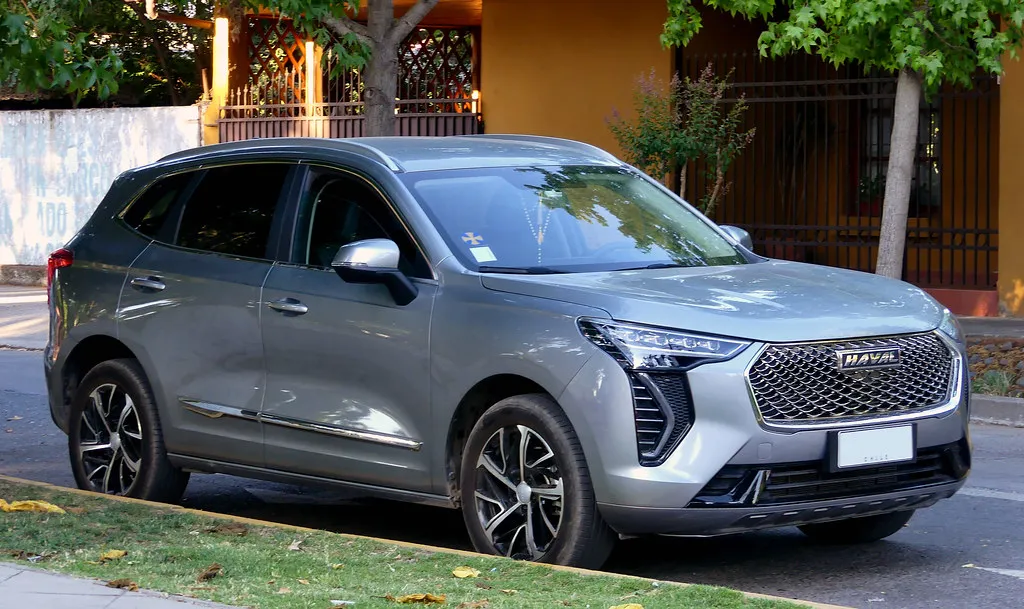
Haval’s Jolion range is more stratified. The newer Jolion Pro starts at R392,150 (Premium) and climbs to R521,450 for the Pro HEV Ultra Luxury hybrid. For a fair comparison, we’ll pit the EX5 Aspire (base EV) against the Jolion Pro Premium auto (mid-spec petrol with similar features and market positioning).
| Model | Variant | Price (ZAR) | Power (kW) | Battery / Tank | Range (km) | Efficiency |
|---|---|---|---|---|---|---|
| Geely E5 (EX5) | Aspire EV | R699,999 | 160 | 60.22 kWh | 430 (WLTP) | 14.0 kWh/100 km* |
| Geely E5 (EX5) | Apex Plus EV | R788,888 | 160 | 68.39 kWh | 450 (WLTP) | 15.2 kWh/100 km* |
| Haval Jolion Pro | Premium 7DCT | R392,150 | 105 | 55 l tank | ~679 | 8.1 l/100 km |
| Haval Jolion Pro | HEV Ultra Luxury | R521,450 | 140 | 55 l tank | ~1,078 | 5.1 l/100 km |
*Efficiency calculated from battery capacity and WLTP range: Aspire 60.22 kWh ÷ 430 km = 14.0 kWh/100 km; Apex Plus 68.39 kWh ÷ 450 km = 15.2 kWh/100 km. Real-world consumption typically runs 10–15% higher.
The EX5 Aspire costs R307,849 more than the Jolion Pro Premium auto. That’s a deposit on a second car. The question: does the running-cost delta close that gap over five years?

Monthly running costs: electrons vs petrol
Let’s assume 1,500 km/month—the South African average for suburban commuters. We’ll use April 2026 tariffs and fuel prices: Eskom direct customer rate of R3.35/kWh (post-NERSA’s 8.76% increase), and 95-octane petrol at roughly R25.00/litre.
Geely EX5 Aspire (charging at home)
The Aspire’s 60.22 kWh battery and 430 km WLTP range yield a calculated efficiency of 14.0 kWh/100 km. Real-world consumption typically runs 10–15% higher, so we’ll use 16.0 kWh/100 km for mixed driving.
- 1,500 km/month × 16.0 kWh/100 km = 240 kWh/month
- 240 kWh × R3.35/kWh = R804/month
If you charge on a municipal tariff (Cape Town Homepower 2 off-peak: ~R2.80/kWh), that drops to R672/month. If you use public DC fast charging at R7.00/kWh (Rubicon eMSP rate), it jumps to R1,680/month—more than petrol for the Jolion.
Haval Jolion Pro Premium 7DCT (petrol)
The Jolion Pro Premium auto claims 8.1 l/100 km combined. Real-world figures from SA owners hover around 8.5–9.0 l/100 km in mixed traffic; we’ll use the claimed 8.1 l/100 km to be conservative.
- 1,500 km/month × 8.1 l/100 km = 121.5 litres/month
- 121.5 litres × R25.00/l = R3,038/month
If petrol climbs to R28/l (inland price), that’s R3,402/month.
Monthly fuel/energy cost summary
| Model | Monthly cost (1,500 km) | Annual cost |
|---|---|---|
| Geely EX5 Aspire (home, Eskom R3.35/kWh) | R804 | R9,648 |
| Geely EX5 Aspire (home, municipal R2.80/kWh) | R672 | R8,064 |
| Geely EX5 Aspire (public DC R7.00/kWh) | R1,680 | R20,160 |
| Haval Jolion Pro Premium 7DCT (R25/l) | R3,038 | R36,456 |
Annual saving (EX5 vs Jolion Pro, home charging): R26,808. Over five years, that’s R134,040 in fuel alone—still R173,809 short of the upfront price delta.
Five-year total cost of ownership
Fuel is only part of the story. Service intervals, insurance, tyres, and depreciation all shift the balance. Here’s a conservative five-year model (90,000 km, no accidents, financed at 11.75% over 72 months).
Service & maintenance
Geely E5: 6-year/90,000 km service plan included (confirmed by Geely SA). Assume two services in five years at R0 cost to owner, plus one set of tyres at year four (R8,000 for four 235/50R18s). Brake pads last longer thanks to regen braking—budget R3,000 for rear pads at 80,000 km. Total: R11,000.
Haval Jolion Pro Premium 7DCT: 5-year/100,000 km service plan included. Oil changes every 10,000 km (nine services over 90,000 km, covered). One set of tyres at 50,000 km (R6,500 for four 215/60R17s), brake pads front and rear at 60,000 km (R4,500). Total: R11,000.
Maintenance is a wash—both brands include service plans that cover the first five years.
Insurance
EV insurance in SA runs 10–15% higher than petrol equivalents due to battery replacement risk and limited repairer networks. Assume R2,800/month for the EX5 (R700k insured value) vs R1,650/month for the Jolion Pro (R392k insured value). Over five years: EX5 R168,000, Jolion R99,000. Delta: R69,000 in the Jolion’s favour.
Depreciation
SA EV resale data is thin, but global trends suggest 50–55% residual at five years for Chinese EVs; petrol SUVs like the Jolion hold 45–50% in the used market. Assume EX5 residual R385,000 (55%), Jolion residual R176,000 (45%). Depreciation: EX5 R314,999, Jolion R216,150. Delta: R98,849 in the Jolion’s favour.
Five-year TCO table
| Cost item | Geely EX5 Aspire | Haval Jolion Pro Premium | Delta |
|---|---|---|---|
| Purchase price | R699,999 | R392,150 | +R307,849 EV |
| Fuel / energy (5 yr, 90,000 km) | R48,240 | R182,280 | −R134,040 EV |
| Service & maintenance | R11,000 | R11,000 | R0 |
| Insurance (5 yr) | R168,000 | R99,000 | +R69,000 EV |
| Depreciation (5 yr) | R314,999 | R216,150 | +R98,849 EV |
| Total cost of ownership | R1,242,238 | R900,580 | +R341,658 EV |
Even with fuel savings of R134,040, the EX5 costs R341,658 more to own over five years than the Jolion Pro Premium auto. The math shifts if you compare the EX5 to the Jolion Pro HEV Ultra Luxury (R521,450 purchase price, 5.1 l/100 km)—the TCO delta narrows to ~R250,000—but the petrol/hybrid car still wins on pure ZAR.

Charging the EX5 at home: 7.4 kW vs 11 kW vs 22 kW
The Geely E5 (EX5) supports up to 11 kW AC charging and 100 kW DC fast charging. That 11 kW limit is the sweet spot for South African homes with three-phase power; single-phase homes max out at 7.4 kW (32 A × 230 V). Here’s what that means in practice.
Charging time: empty to full
| Charger power | Aspire (60.22 kWh) | Apex Plus (68.39 kWh) | Cost per full charge (Eskom R3.35/kWh) | Typical home setup |
|---|---|---|---|---|
| 7.4 kW (single-phase) | ~8.1 hours | ~9.2 hours | R202 / R229 | Standard SA residential, 32 A breaker |
| 11 kW (three-phase) | ~5.5 hours | ~6.2 hours | R202 / R229 | Three-phase supply, 16 A per phase |
| 22 kW (three-phase) | ~5.5 hours* | ~6.2 hours* | R202 / R229 | Vehicle limited to 11 kW—no benefit |
| 100 kW DC (public) | ~36 min (10–80%) | ~38 min (10–80%) | R296 / R336 (at R7/kWh) | GridCars, Rubicon fast chargers |
*The EX5’s onboard charger caps AC input at 11 kW, so a 22 kW wallbox offers no speed advantage—you’re paying for capacity you can’t use.
Recommendation: If you have three-phase power, install an 11 kW charger (ChargePoint SA supplies and installs from ~R18,000). If you’re on single-phase, a 7.4 kW unit (~R12,000 installed) will fully charge the EX5 Aspire overnight (8 hours) without issue. The free wallbox Geely includes is typically 7.4 kW; confirm specs with your dealer.
South Africa–specific realities: load-shedding, solar, and service networks
Load-shedding and charging
Stage 2–4 load-shedding remains sporadic in 2026, but Eskom’s grid is more stable than 2023. If you charge overnight (22:00–06:00), you’ll dodge most scheduled cuts—but a 7.4 kW charger needs 8 hours for a full top-up, so a single 2.5-hour outage can leave you 15–20 km short of a full charge. Solution: size your home battery (if you have one) to cover the charger during cuts, or install a hybrid inverter that prioritises the EV charger when the grid returns.
The Jolion doesn’t care about load-shedding—you fill the tank at the petrol station in three minutes, any time.
Pairing with solar
If you have a 5 kW rooftop solar array (typical for a 3-bed home), you’ll generate ~20–25 kWh/day in summer, 12–15 kWh/day in winter (Cape Town irradiance). Charging the EX5 during the day (when you’re at work) requires either a smart charger that throttles to match solar production, or a battery system that stores excess for evening charging. Most SA EV owners charge overnight on cheap Eskom rates and use solar to offset daytime household loads—mixing the two without a battery is tricky.
The Jolion can’t plug into your solar array, but it also doesn’t add 16 kWh/100 km to your electricity demand.
Service and parts networks
Geely re-entered South Africa in November 2025 with a network of 18 dealers (concentrated in Gauteng, Western Cape, and KZN). Parts availability is unproven—early adopters report 2–3 week lead times for non-critical components. The 6-year warranty and 8-year battery warranty provide a safety net, but if you live in Polokwane or East London, your nearest Geely dealer may be 300 km away.
Haval (GWM) has 70+ dealers nationwide and a 10-year track record in SA. The Jolion is the country’s 8th best-selling passenger vehicle (2025), so parts are plentiful and any GWM dealer can service it. For remote or rural buyers, that’s a decisive advantage.
Range and real-world usability
The EX5 Aspire’s 430 km WLTP range translates to ~340–370 km in real-world mixed driving (highway + urban, no aircon abuse). That’s Cape Town to Swellendam, or Johannesburg to Polokwane, with a 10–15% buffer. In winter (aircon heating, highway speeds), expect 300–320 km. GridCars operates 445 charging sites with 650+ chargers covering the N1, N2, N3, and N4 corridors, but rural routes (R62, N7 north of Springbok) remain sparse. Plan your road trips or stick to urban/suburban use.
The Jolion’s 55-litre tank delivers ~679 km range (8.1 l/100 km for the Pro Premium), and you can refuel anywhere in 3 minutes. For long-distance or rural driving, the petrol car is still the no-brainer.

The honest verdict: who should buy which?
Buy the Geely EX5 if…
- You drive <1,800 km/month, mostly urban/suburban, and can charge at home overnight.
- You have three-phase power or are willing to install it (adds R15,000–R25,000 to your setup cost).
- You value instant torque, silent running, and lower monthly fuel bills over upfront price.
- You’re an early adopter comfortable with a new brand and a thin dealer network.
- You plan to keep the car 7+ years to amortise the purchase premium (or you’re buying for environmental reasons and accept the financial trade-off).
Stick with the Haval Jolion if…
- You need to minimise upfront cost—R392k vs R700k is a R308k deposit on a house.
- You drive >2,000 km/month, do frequent long-distance trips, or live outside major metros.
- You can’t charge at home (apartment, no off-street parking, or single-phase power with no upgrade budget).
- You want a proven service network and 10-year local track record.
- You’re risk-averse about EV resale values in the SA market (still unproven beyond 3–4 years).
As u/OutInTheBay noted on r/electricvehicles: “Looks like a great offering for someone who just wants a practical car without all the geeky extra screens / features….” The EX5 is a solid, no-nonsense EV—but in South Africa’s price-sensitive market, “solid” doesn’t always beat “half the price.”
Ready to charge smarter?
If the EX5’s numbers work for your budget and driving pattern, the next step is a site assessment. ChargePoint SA will evaluate your electrical panel, recommend the right charger size (7.4 kW or 11 kW), and give you a fixed-price quote—no surprises. We’ve installed over 600 home chargers across South Africa, from Johannesburg townhouses to Cape Town estates, and we’ll make sure your setup is load-shedding resilient and Eskom-compliant.
Book your free site assessment and get a same-day quote. If you’re still on the fence between EV and petrol, we’ll walk you through the real costs—no sales pitch, just the math.
Image credits
“2025 Geely EX5 Inspire front” by Wikimedia Commons, CC BY-SA 4.0 · “2025 Geely EX5 Inspire rear” by Wikimedia Commons, CC BY-SA 4.0 · “2024 Haval Jolion Pro front view” by Wikimedia Commons, CC BY-SA 4.0 · “2022 Haval Jolion 1.5T Elite” by Wikimedia Commons, CC BY-SA 4.0