
Key points
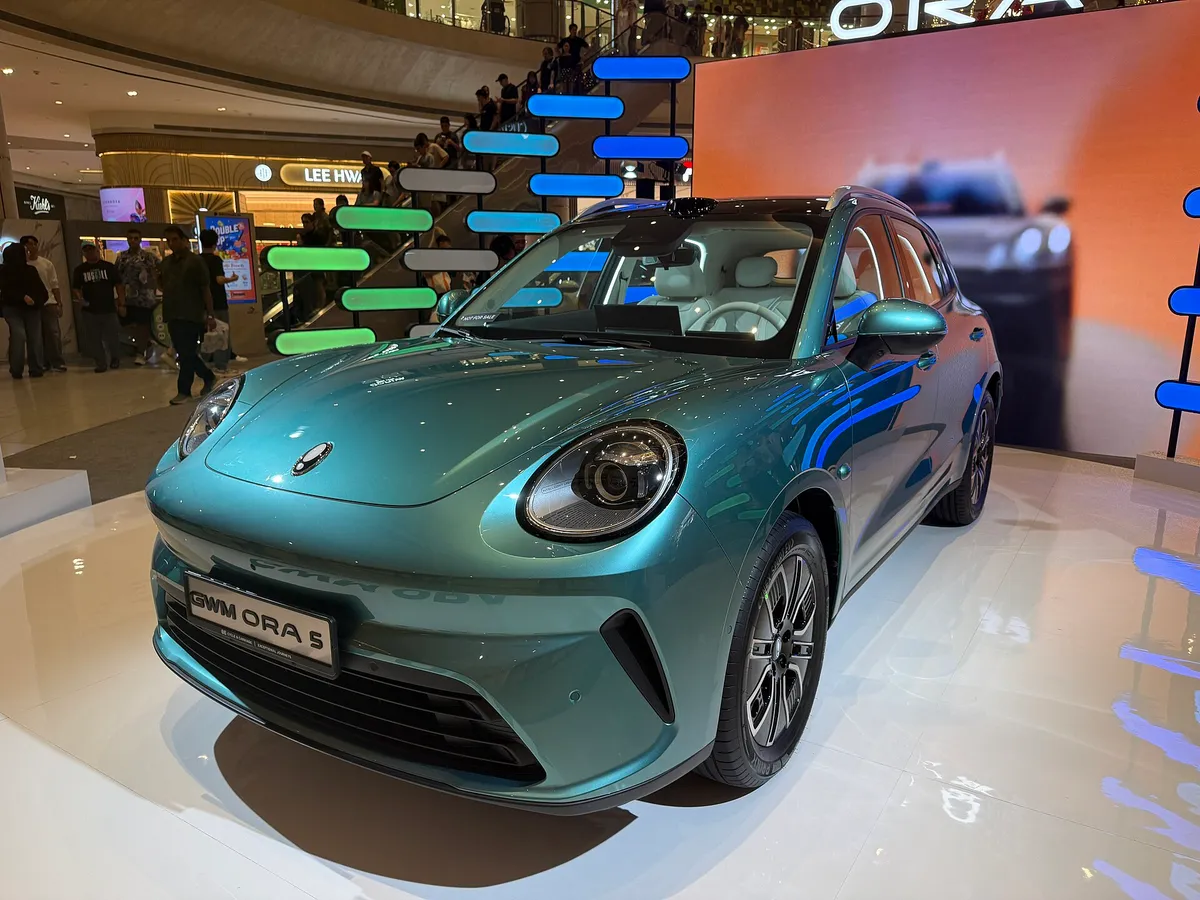
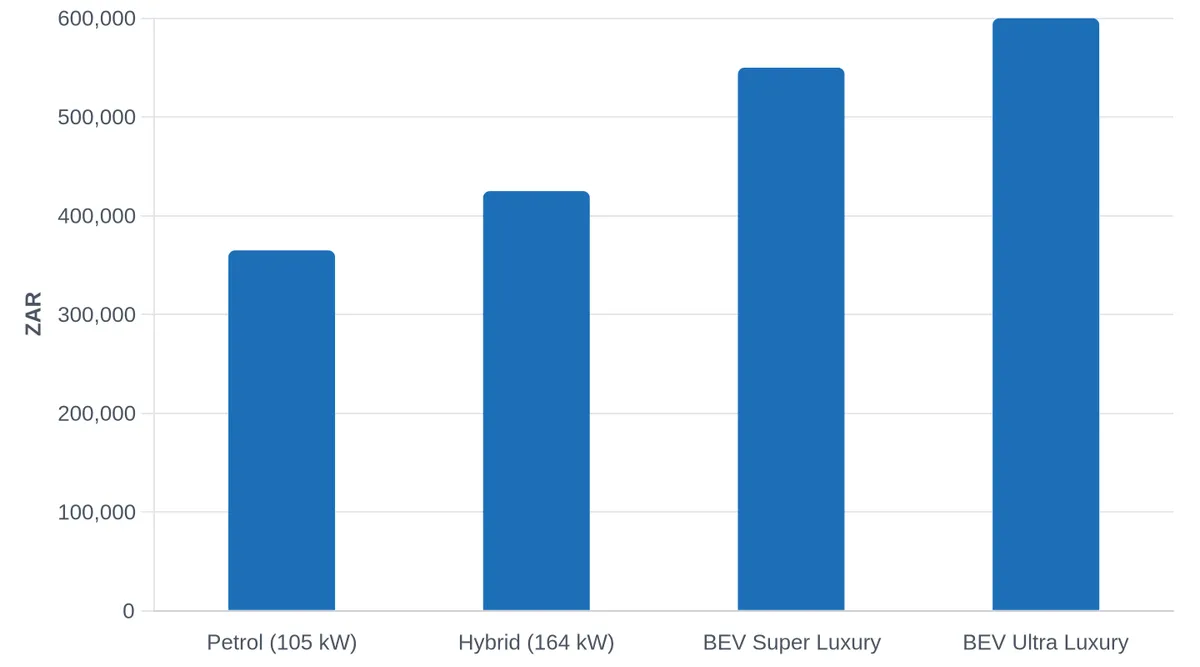
- The GWM Ora 5 BEV Super Luxury retails at R549,900 (R599,900 for Ultra Luxury), making it the most affordable GWM battery-electric vehicle in South Africa as of its July 2026 launch, per Cars.co.za.
- The 58.3 kWh LFP battery delivers a WLTP-rated 440 km of range (TopAuto), plan for roughly 350-380 km in real SA mixed driving, based on a 16% shortfall recorded on the related Ora 03 platform.
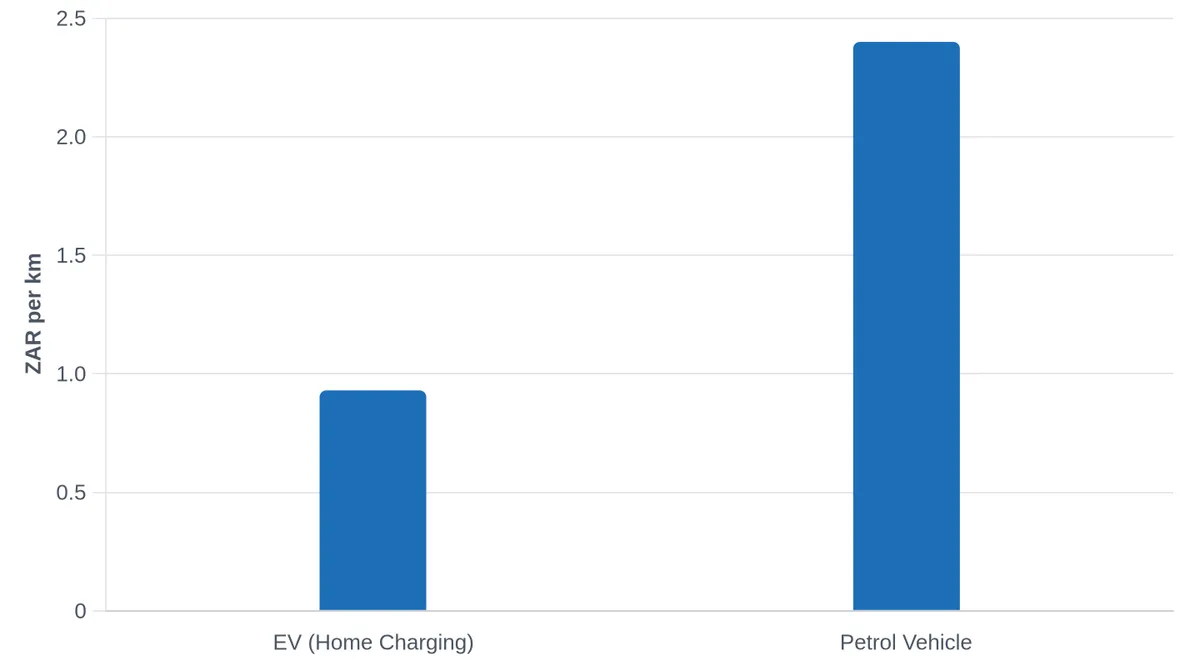
- Home charging at current municipal tariffs (R3.70-R4.50/kWh, Energybee) costs approximately R0.93/km versus R2.40/km for petrol, a saving of around R26,827 per year for a 50 km/day commuter (ChargePoint SA).
- The 7-year/200,000 km vehicle warranty and 8-year/150,000 km battery warranty are best-in-class for this price bracket, per Cars.co.za and GWM South Africa.
- Public DC fast charging at R7.00-R7.50/kWh (EV24.africa) costs roughly R120/100 km, close to petrol, so home charging is not optional, it is essential to the savings case.
- Depreciation risk is real: similar GWM models show 22-27% value loss over three years (AutoTrader South Africa), budget for this before signing.
Context: why this launch matters right now
When the Mini Cooper SE was briefly South Africa’s most affordable BEV at R709,400 in 2022, electric vehicles were firmly a luxury segment purchase. By September 2025, the BYD Dolphin Surf had reset the floor to R339,900 (DriveElectric/TechCentral). GWM’s Ora 5 BEV, launched in July 2026 at R549,900 per CAR Magazine, sits in an increasingly crowded mid-range that now includes mainstream buyers, people who finance a family car and need the running-cost maths to stack up, not just the badge appeal.
GWM has been operating in South Africa since 2007, becoming a proper subsidiary by 2017 (AutoTrader South Africa). It now has 66 dealerships, 78 approved repair centres across all nine provinces, a 5,500 square metre Durban parts warehouse holding approximately 8,000 different spare parts with stock value exceeding R150 million, and a stated over-90% parts availability rate (GWM Zululand). That infrastructure matters when you are committing to a vehicle with a 7-year warranty.
“By offering three powertrains at launch, we are giving South African motorists genuine choice within a highly competitive compact SUV segment.”
Thinking about a home charger?Get a fixed-price installation quote — a few quick questions and we’ll send your cost, with no surprises on the day.Get my fixed-price quote →Floyd Ramabulana, Head of Marketing at GWM South Africa, at the official July 2026 Ora 5 launch
The Ora 5 range spans petrol (from R364,900), hybrid (from R424,900), and BEV (from R549,900), all on the same body. That breadth is deliberate: it lets a buyer choose their powertrain risk level without changing the showroom experience.
What you are buying: specs that matter
The BEV Super Luxury variant pairs a 150 kW, 260 Nm electric motor with a 58.3 kWh lithium iron phosphate battery (Cars.co.za). LFP chemistry is worth noting: it is thermally more stable than nickel-manganese-cobalt cells, charges happily to 100% daily without the degradation penalty, and GWM backs it with an 8-year/150,000 km high-voltage battery warranty. Average fleet data puts LFP degradation at roughly 1.8% per year, retaining 85.6% capacity after eight years (Feyree Battery Analysis), so by the end of the warranty the battery should still deliver around 380-390 km of WLTP range.
The Ultra Luxury adds R50,000 to reach R599,900 and brings a powered tailgate, panoramic roof, wireless charger, heated and ventilated seats, and a full ADAS suite (Cars.co.za). Standard equipment on the Super Luxury already includes a 14.6-inch touchscreen, 10.25-inch instrument cluster, 360-degree camera, LED headlamps, and faux-leather seats, a spec level that would cost considerably more from a European or Japanese brand in this price bracket.
What range will you actually get in South Africa?
GWM quotes 520 km on the NEDC cycle and 440 km on WLTP (TopAuto). Neither figure is what you should plan your day around.
The closely related Ora 03 platform provides the most relevant local benchmark. TopAuto’s professional tester drove 893 km over 12 days in South African conditions and recorded a real-world consumption of 18.7 kWh/100 km, producing a maximum range of 337 km from the 63 kWh battery, around 16% below the 400 km WLTP claim.
“Over 12 days and 893km of travels my average energy consumption came out to 18.7kWh/100km, which equates to a maximum driving range of 337km on the 63kWh battery pack, around 16% lower than the 400km GWM claims the GT model can do.”
TopAuto professional tester, after an extended 12-day SA driving test of the Ora 03 (June 2024)
Apply the same 16% shortfall to the Ora 5 BEV’s 440 km WLTP rating and you get a practical planning range of around 370 km. In hot Highveld summers with air conditioning running, budget closer to 330-350 km. Highway driving is a separate story: the Ora 03 achieved only 200 km from 90% to 10% charge in a Gerotek freeway simulation (IOL Motoring), because sustained motorway speed removes the regenerative braking that recovers energy in urban stop-start driving.
“Although this is half the claimed range, keep in mind that EVs do have a much shorter battery life on freeway runs due to the lack of regenerative braking opportunities.”
IOL Motoring, reporting on the Ora 03 Gerotek freeway simulation test (March 2024)
For a daily commuter doing 50 km, this is irrelevant, the Ora 5 BEV will complete a week of commuting on a single overnight charge. For a Johannesburg-to-Durban trip, you will need one public charging stop. That is not a disqualifying issue, but it requires planning.
The charging picture: home versus public

According to ChargePoint SA, 90% of EV charging happens at home. That single statistic should frame every cost discussion: if you cannot install a home charger, the economics change substantially.
GWM bundles a 7 kW AC wallbox solution with the Ora range (Engineering News). A dedicated 7 kW wallbox adds approximately 50 km of range per hour, meaning the Ora 5 BEV’s 58.3 kWh battery charges from near-empty to full in roughly 6-8 hours overnight (ChargePoint SA), perfect for the South African pattern of evening arrival and morning departure.
Home electricity in South Africa’s major metros currently ranges from R3.70 to R4.50/kWh (Energybee, reflecting the 9.01% municipal increase effective 1 July 2026). In Johannesburg, the consolidated tariff sits at approximately R3.48/kWh (City of Johannesburg); in eThekwini, approximately R3.20/kWh; in Tshwane, approximately R3.55/kWh flat rate. Cape Town residents on the Time-of-Use Homeflex tariff can access off-peak rates as low as R1.45-R2.25/kWh (ChargePoint SA), making overnight charging significantly cheaper.
Public DC fast charging at GridCars and Rubicon-network stations currently costs R7.00-R7.50/kWh (EV24.africa). Note: the R7.00-R7.35/kWh figures that circulated as August 2025 GridCars rates have since been revised upward by approximately 15% from 1 December 2025, treat current public DC rates as at least R7.00/kWh at the low end, and budget accordingly. South Africa has approximately 445 public charging sites with 650 chargers and over 1,200 connectors (ChargePoint SA), roughly one charging site for every 11 fuel stations. Reliability issues including ICE vehicles blocking bays, offline stations, and payment system failures are documented (ChargePoint SA). Home charging is not a luxury feature for SA EV owners; it is the primary cost-control mechanism.
See your real home charging cost on the GWM Ora 5
Cost-of-ownership comparison: the numbers that matter
| Vehicle | Purchase price | Fuel/energy cost per km (home) | Estimated 5-yr maintenance | Battery/hybrid warranty | Service interval |
|---|---|---|---|---|---|
| GWM Ora 5 BEV Super Luxury | R549,900 | R0.56-R0.74/km (at R3.48-R4.50/kWh, 16 kWh/100 km) | ~R12,000 (EV24.africa) | 8 yr / 150,000 km (LFP) | 12 months / 15,000 km |
| GWM Ora 5 HEV Super Luxury | R424,900 | R1.44-R1.74/km (7.15 L/100 km × R25.94-R26.10/L) | ~R28,000-R35,000 est. | 8 yr / 150,000 km (hybrid) | 12 months / 15,000 km |
| GWM Ora 5 Petrol Super Luxury | R364,900 | R1.86-R1.89/km (7.15 L/100 km × R26.10/L inland) | ~R40,000-R50,000 est. | 7 yr / 200,000 km (vehicle) | 12 months / 15,000 km |
| Toyota Corolla Sedan 1.8 HEV XR | R584,400 | R1.01/km (3.9 L/100 km × R25.94/L) | ~R25,000-R35,000 est. | 8 yr / 160,000 km (hybrid battery) | Toyota schedule |
| BYD Dolphin Surf Dynamic | R339,900 | R0.42/km (12.5 kWh/100 km × R3.48/kWh) | ~R12,000 est. | 8 yr / 200,000 km | BYD schedule |
Five-year running cost: BEV versus petrol (1,500 km per month)
Using ChargePoint SA’s verified figures for a driver covering roughly 18,000 km per year (1,500 km per month):
- Johannesburg home charging at R3.85/kWh blended: R514/month for electricity, or R6,168/year.
- Cape Town off-peak charging at R2.87/kWh blended: R687/month for 240 kWh (1,500 km), or R8,244/year.
- Petrol equivalent (9 L/100 km at R26.10/L inland, July 2026, Koodo/DMPR): approximately R2.35/km, or R42,300/year at 18,000 km.
- Annual fuel saving (BEV vs petrol): ChargePoint SA benchmarks R26,827/year saving for a 50 km/day commuter, consistent with the above spread.
- Five-year fuel/energy saving: approximately R100,000-R130,000, depending on municipality and tariff.
- Five-year maintenance saving (EV R12,000 vs petrol R45,000): R33,000 (EV24.africa).
- Combined five-year operational advantage of the BEV over the Ora 5 petrol: roughly R130,000-R160,000.
- Purchase price premium of BEV over petrol: R185,000 (R549,900 vs R364,900).
The maths show the BEV reaches operational break-even against the petrol Ora 5 at roughly 18,000 km/year in three to four years, consistent with ChargePoint SA’s 2-3 year break-even estimate for average drivers. High-mileage drivers doing 30,000 km or more per year close the gap in under 18 months.
Against the Toyota Corolla Sedan 1.8 HEV at R584,400, the Ora 5 BEV at R549,900 is actually cheaper to buy. The Corolla Hybrid’s claimed 3.9 L/100 km (Cars.co.za) translates to roughly R1.01/km at July 2026 petrol prices, still notably more expensive than home-charged BEV operation. The Ora 5 BEV is also covered by a longer battery warranty (8 yr/150,000 km vs Toyota’s 8 yr/160,000 km, which is comparable).
“The total cost of ownership of an EV is significantly lower than an ICE vehicle, even though the purchase price remains higher.”
Ndia Magadagela, CEO of Everlectric, citing South African commercial fleet data covering 12.5 million km (Business Day, 2026)
On-road costs: what you actually pay at registration
The showroom price is not what you pay to drive away. Hagalu’s data shows the Ora 5 Ultra Luxury (R599,900 showroom) costs R641,498 on-road in Cape Town and R635,999 in Durban. Allow for the same order of on-road premium on the Super Luxury, roughly R35,000-R42,000 above the sticker price, when calculating your finance deposit and monthly repayments.
At a standard 10.5% finance rate over 72 months with a 10% deposit on R549,900, the monthly repayment sits in the region of R8,500-R9,500 before insurance. Add electricity for a 50 km/day commute (approximately R1,410/month at R5.15/kWh per ChargePoint SA) and insurance (EV premiums run 10-15% higher than petrol equivalents, typically R1,200-R1,500/month for a mid-size vehicle), and total monthly ownership cost lands at roughly R11,100-R12,400, comparable to financing a petrol mid-size SUV, with fuel that costs a fraction of a petrol equivalent.
Home charging: what installation actually costs
The Ora 5 BEV’s onboard AC charger accepts up to 7 kW (standard for this class). A 7 kW single-phase wallbox fully charges the 58.3 kWh battery in 6-8 hours overnight. If your home is on three-phase supply (approximately 30% of SA homes, TopAuto), a 22 kW charger halves that time, but the car’s onboard charger is the limiting factor, not the wallbox.
For most Ora 5 BEV owners, the ChargePoint SA Caro Plus (CP-AC7), a 7 kW single-phase tethered wallbox with RFID and app start, IP65 weatherproofing, built-in earth-leakage protection, and SANS 10142-1 compliance, is the practical home charging solution. It is priced from approximately R8,900 per unit (indicative), with installation quoted per site depending on cable run distance, DB board capacity, and whether any electrical upgrades are required. Full installed costs for a 7 kW wallbox in South Africa typically range from R14,000 to R26,000 all-in, including the Certificate of Compliance (ChargePoint SA).
If you are on three-phase supply and want the fastest practical home charge, the Caro Pro (CP-AC22) delivers 22 kW with dynamic load balancing and PV solar integration, from approximately R13,900 per unit plus installation. On Eskom’s Homeflex off-peak tariff (R1.45-R2.25/kWh), either wallbox pays back its installation cost in 10-18 months of fuel savings (ChargePoint SA).
The honest risks: what GWM owners in other markets report
South African buyers have the advantage of reviewing a global owner community before committing. The picture is broadly positive on hardware, with two recurring concerns: software and dealer network stability.
“My only real complaint is the software which is generally pants, both the car’s and the GWM app. For the last few weeks, Android Auto has gone really slow to the point of being unusable.”
A UK-based Ora 03 owner with 18+ months of ownership, SpeakEV forum
The infotainment issues documented on the Ora 03, including the T-Box telecommunication module failures that caused incorrect vehicle location reporting, and the Parkers UK finding that a tester needed 10 minutes to locate the heated steering wheel control, are relevant because the Ora 5 shares platform DNA. GWM has had time to address some of these, but prospective buyers should spend time with the infotainment system during a test drive specifically to evaluate Android Auto responsiveness and menu logic, rather than treating it as a given.
“The interior of the Ora is a winner, offering a blend of retro styling and modern chic just like the outer shell.”
TopAuto professional reviewer, after an extended SA test of the Ora 03
The build quality assessment is consistently positive across multiple reviews: weighty doors, firm controls, premium-feeling materials, and good cabin insulation. The concern is the software layer on top of the hardware.
On dealer network stability: the UK market experience, where GWM closed its European headquarters, its dealer count diminished, and used Ora 03s dropped to below £13,000 on the secondary market, is a genuine cautionary data point. South Africa is a materially different market context, however. GWM has been here since 2007, has 78 repair centres across all nine provinces, a R150 million Durban parts inventory, and 90% next-day parts availability for warranty claims (GWM Zululand). The brand’s long-term commitment to South Africa looks structurally sounder than its short-lived European push. That said, owners in the Eastern Cape, Limpopo, and Northern Cape should verify their nearest service centre location before purchase, the network is concentrated in Gauteng, Western Cape, and KwaZulu-Natal.
One after-sales note worth flagging: some GWM owners report that parts delays and courtesy car availability are inconsistent.
“Sometimes, one has to wait long for certain parts, and it’s not always a given that a courtesy car is supplied.”
A GWM owner, quoted in community discussion on after-sales service
GWM’s warranty documentation states that servicing more than 1,500 km or one month past the stipulated interval (12 months or 15,000 km) may invalidate warranty cover or result in proportional cover only. Set a calendar reminder, the consequence of missing a service date is disproportionate to the inconvenience of booking one.
Depreciation: the number most buyers skip
AutoTrader South Africa estimates 22-27% depreciation on GWM models over three years (the data references the HEV at R424,900 purchase, projecting a trade-in of R310,000-R330,000). Apply the same curve to the BEV at R549,900 and a three-year trade-in could be in the R400,000-R430,000 range, a paper loss of R120,000-R150,000 before running costs enter the calculation. The Toyota Corolla Cross Hybrid, by contrast, retains 80-85% of its value after three years (AutoTrader SA), depreciating at only 5-7% annually.
EVs currently depreciate faster than equivalent hybrid and petrol models in South Africa, per Cars.co.za, primarily due to limited infrastructure and residual buyer uncertainty. This gap is narrowing as EV awareness grows, AutoTrader reports a 220% increase in EV search interest between March 2025 and March 2026, but it has not closed. If you plan to sell or trade in within three years, factor the depreciation risk explicitly. If you plan to keep the car for five to seven years, the running-cost savings more than compensate.
How the Ora 5 BEV fits the broader SA EV market
The GWM Ora 5 BEV at R549,900 occupies a specific and useful gap: more range and more interior space than the BYD Dolphin Surf (R339,900, 250-270 km real-world range per EV24.africa), less expensive than the Volvo EX30 (from R835,500, Volvo Cars South Africa), and from the same brand family as the GWM Ora 03 (from R686,950 for the 48 kWh entry variant, Cars.co.za).
The TopAuto reviewer who tested the Ora 03 in South Africa captured the platform’s natural use case precisely:
“The GWM Ora 03 is the exact type of electric vehicle South Africa needs to kickstart widespread adoption of the eco-friendly technology. It presents the perfect use case for EVs, being compact, noiseless, fun-to-drive city cars rather than continental cruisers or bundu bashers.”
TopAuto professional reviewer, after a 12-day, 893 km SA test of the Ora 03 (June 2024)
The Ora 5 BEV is a logical evolution of that premise: more conventional SUV proportions, a larger 58.3 kWh battery, and a price point that, despite carrying a 25% import duty versus 18% for petrol vehicles (ChargePoint SA), lands meaningfully below R600,000 for the first time in the GWM EV lineup.
For a buyer doing 50-80 km daily in a metro, financing over 60-72 months, charging at home overnight, and planning to own for five or more years, the Ora 5 BEV makes a coherent financial case. The break-even versus the petrol Ora 5 arrives at roughly three to four years at average mileage, and savings compound after that point. The caveat list is honest and manageable: plan your range for real-world figures, not WLTP; install a home charger before or at delivery; test the infotainment system thoroughly; and verify your nearest service centre if you are outside a major metro.
Ready to work out exactly what home charging the Ora 5 BEV would cost at your address and your municipality’s tariff? Calculate your home charging cost with ChargePoint SA’s free EV cost calculator, enter your daily distance and local rate to see your monthly saving against petrol in under two minutes.
Compare the GWM Ora 5 BEV with other affordable EVs
See specs, range, warranty, and total cost of ownership side-by-side.
Compare EV options →WhatsApp us
CoC-certified installers, nationwide
Photo: Grunty89 / WikimediaCommons