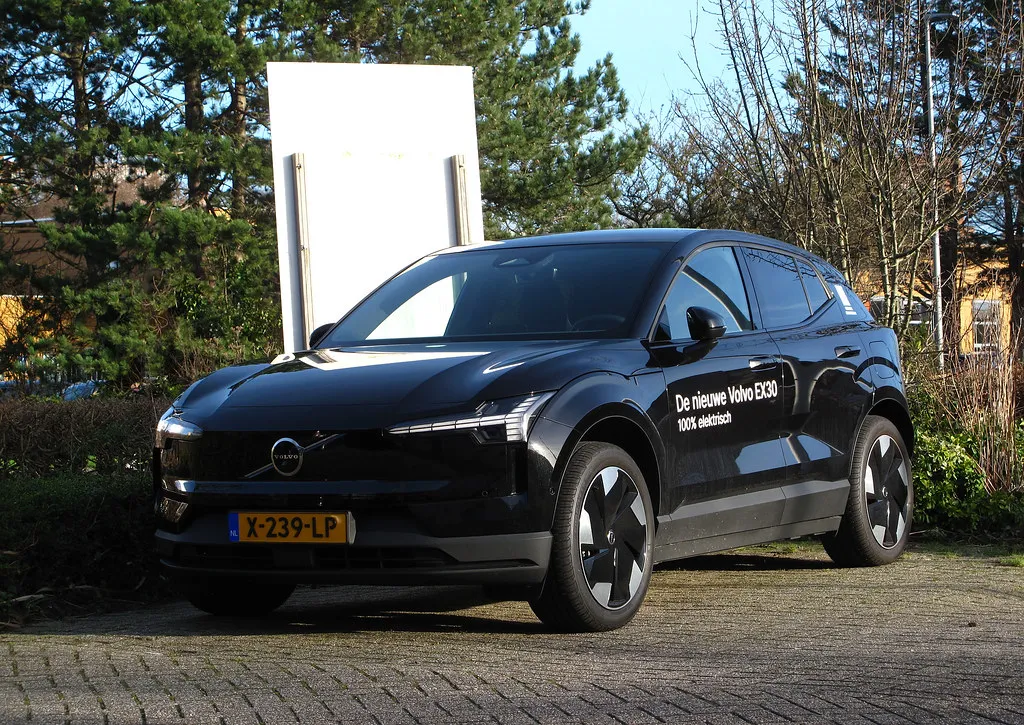

“Just bought my first EV and I am so excited, it is a certified 2025 Volvo EX30 in moss yellow with 4k miles! … My previous car was a 2016 Chevy Sonic so I am not used to having such a nice car lol,” u/maddykatty wrote on r/electriccars. That excitement captures something real: the Volvo EX30 feels like a step up from budget motoring, even if you’re cross-shopping it against a Toyota Corolla Cross 1.8 Xs. But in South Africa, where the EX30 retails from R835,500 and the Corolla Cross 1.8 Xs sits at R458,400, the R377,100 price gap demands a hard look at running costs, charging infrastructure, and whether that electric premium pays off over five years.
This isn’t a theoretical comparison. With EV searches up 220% year-on-year and charging networks expanding rapidly, more South Africans are weighing this exact decision. We’ve crunched the numbers using real Eskom tariffs, public charging costs, and owner-reported consumption figures to show you exactly what each vehicle costs to run, maintain, and own.

Quick summary
- The Volvo EX30 costs R377,100 more upfront but saves approximately R1,850/month on fuel at 1,500 km/month (home charging at R2.50/kWh vs petrol at R24/litre)
- Real-world consumption: EX30 uses 19–23 kWh/100 km in mixed driving (summer), while the Corolla Cross 1.8 Xs averages 6.5–7.2 l/100 km
- Break-even point sits around 4.2 years at average driving patterns, assuming stable electricity tariffs and no solar offset
- The EX30 suits urban commuters with home charging and solar; the Corolla Cross wins for high-mileage drivers, rural routes, and anyone without reliable overnight charging
Price comparison: the R377,100 question
Let’s start with the sticker shock. The Volvo EX30 launched in South Africa in October 2025 at R775,900 for the base Single Motor variant; the Extended Range model we’re comparing here now retails around R835,500. The Toyota Corolla Cross 1.8 Xs, meanwhile, sits at R458,400 after March 2026 price adjustments that added R5,900–R8,800 across the Corolla Cross range.
| Specification | Volvo EX30 Extended Range | Toyota Corolla Cross 1.8 Xs |
|---|---|---|
| Retail price (ZAR) | R835,500 | R458,400 |
| Price difference | +R377,100 | — |
| Powertrain | 69 kWh battery, single motor | 1.8L petrol, CVT |
| Range / tank | 344 km (WLTP) | ~650 km (42L tank) |
| Efficiency (claimed) | 15.5 kWh/100 km | 6.0 l/100 km |
| 0–100 km/h | 5.3 seconds | 10.9 seconds |
| Service plan | 5-year/100,000 km | 3-year/45,000 km |
| Warranty | 5-year/100,000 km + 8-year battery | 3-year/100,000 km |
That R377,100 gap is the elephant in the room. To justify it, the EX30 needs to deliver serious savings elsewhere — or intangible benefits (performance, tech, zero local emissions) that matter enough to offset the premium.
_front.jpg)
Running costs: electricity vs petrol at 1,500 km/month
The EV math: home charging vs public tariffs
Home charging changes everything. At the average Eskom residential tariff of R2.50/kWh (post-April 2026’s 8.76% NERSA-approved hike), and using real-world consumption of 19 kWh/100 km in summer mixed driving (as reported by u/MattRnR after 40,000 km in a European EX30), the monthly cost for 1,500 km looks like this:
- Summer home charging: 1,500 km ÷ 100 × 19 kWh × R2.50 = R712.50/month
- Winter home charging: 1,500 km ÷ 100 × 23 kWh × R2.50 = R862.50/month (consumption rises to ~23 kWh/100 km in cold weather, per the same owner)
- Public DC fast charging: 1,500 km ÷ 100 × 19 kWh × R7.00 = R1,995/month (using Rubicon’s R7.00/kWh DC tariff)
If you charge at home 80% of the time and top up on public DC the rest, your blended monthly cost sits around R1,050. Add solar? You’re looking at near-zero marginal cost for daytime charging, though that requires a R120,000+ solar-and-battery system to be truly load-shedding-proof.
The petrol benchmark
The Corolla Cross 1.8 Xs claims 6.0 l/100 km, but real-world figures from YouTube road tests and owner reports suggest 6.5–7.2 l/100 km in mixed driving. At R24/litre (inland 95-octane average, mid-2026):
- Optimistic (6.5 l/100 km): 1,500 km ÷ 100 × 6.5L × R24 = R2,340/month
- Realistic (7.0 l/100 km): 1,500 km ÷ 100 × 7.0L × R24 = R2,520/month
The savings? R1,470–R1,808/month if you home-charge the EX30 in summer, or R1,658/month averaged year-round. That’s R19,896/year in fuel alone — before you factor in service costs.
Service and maintenance over 5 years
The EX30 includes a 5-year/100,000 km service plan; the Corolla Cross covers 3 years/45,000 km. After that, you’re paying out-of-pocket. EVs need brake fluid, cabin filters, tyres, and the occasional software update. Petrol cars add engine oil, air filters, spark plugs, timing belts (if applicable), and more frequent brake servicing.
Conservative estimate over 90,000 km (5 years at 1,500 km/month):
- EX30: R8,000 (tyres, filters, brake fluid top-ups post-warranty)
- Corolla Cross: R18,000 (two post-warranty services at ~R4,500 each, plus consumables)
Add that R10,000 delta to the fuel savings, and the EX30 pulls ahead by roughly R30,000/year in operating costs.
5-year total cost of ownership
Now the big picture. Assume 90,000 km over five years, home charging 80% of the time, and Cape Town electricity tariffs (slightly higher than Eskom direct at ~R2.70/kWh post-municipal surcharge).
| Cost category | Volvo EX30 | Corolla Cross 1.8 Xs | Difference |
|---|---|---|---|
| Purchase price | R835,500 | R458,400 | +R377,100 |
| Fuel/electricity (5 years) | R63,000 | R151,200 | −R88,200 |
| Service & maintenance | R8,000 | R18,000 | −R10,000 |
| Insurance (estimate) | R90,000 | R65,000 | +R25,000 |
| Depreciation (40% residual) | −R501,300 | −R275,040 | −R226,260 |
| Total 5-year cost | R495,200 | R417,560 | +R77,640 |
The EX30 still costs R77,640 more over five years, even with fuel savings factored in. But two variables change the outcome:
- Solar offset: If 50% of your charging comes from rooftop solar (marginal cost ~R0.50/kWh after payback), you save another R30,000 over five years.
- Petrol price volatility: If inland 95 hits R28/litre (plausible given historical trends), the Corolla Cross’s fuel bill climbs to R176,400 — closing the gap to R52,440.
Break-even sits around 4.2 years at current tariffs, or 3.5 years if you have solar and petrol creeps up. After that, every kilometre in the EX30 is cheaper.
.jpg)
Charging the EX30 at home: 7.4 kW, 11 kW, or 22 kW?
The EX30 supports up to 11 kW AC charging (single-phase) and 153 kW DC fast charging. In South Africa, that means:
- 7.4 kW (32A single-phase): 0–80% in ~7.5 hours. Fine for overnight charging if you’re plugging in daily. Most affordable home install (R18,000–R25,000 for a basic ChargePoint-compatible unit).
- 11 kW (48A single-phase or 16A three-phase): 0–80% in ~5 hours. Ideal if you have three-phase supply and want flexibility for longer trips. Install cost: R22,000–R32,000.
- 22 kW (32A three-phase): The EX30 can’t accept it — the onboard charger tops out at 11 kW. Save your money.
For most users, a 7.4 kW wallbox is plenty. If you’re doing 1,500 km/month, that’s ~285 kWh/month (at 19 kWh/100 km), or roughly 9.5 kWh/day. A 7.4 kW charger delivers 7.4 kWh/hour, so you’re looking at 1.3 hours plugged in per day — easily covered overnight.
DC fast charging on the road
The EX30’s 153 kW peak is respectable but not class-leading. Real-world experience from u/MattRnR: “EX30 has 153 kW maximum charging power… you need this 25 min from 20–80%. In the summer ofc… When it comes to winter and I mean −18°C it sucks. Charging speed is like 60/70 kW max.” South Africa doesn’t see −18°C, but the principle holds: cold batteries charge slower, and the EX30’s thermal management isn’t aggressive.
On South Africa’s expanding DC network — GridCars operates 450+ sites, Rubicon has 103 stations, and CHARGE just opened two off-grid solar stations on the N3 — you’ll find 50–150 kW chargers at most major stops. Budget 30–35 minutes for a 20–80% top-up, and plan your route around the known gaps: the N1 between Beaufort West and Three Sisters, the N2 east of East London, and most of the Free State interior.
South Africa-specific considerations
Load-shedding and grid reliability
Load-shedding has eased in 2026 — Eskom went 180+ consecutive days without scheduled cuts as of mid-year — but the risk hasn’t vanished. If you’re charging at home without backup, Stage 4 can disrupt overnight top-ups. Solutions:
- Solar + battery: A 5 kWh battery (R60,000–R80,000 installed) keeps a 7.4 kW charger fed during 2-hour outages. Pair it with 4–6 kW of solar panels (R80,000–R120,000) and you’re largely grid-independent for daily driving.
- Smart scheduling: Charge during off-peak hours (22:00–06:00) when load-shedding is less frequent and tariffs are lower (some municipalities offer time-of-use rates as low as R1.80/kWh overnight).
- Public charging as backup: GridCars and Rubicon stations are grid-tied, but CHARGE’s off-grid solar hubs eliminate that dependency. By end-2027, they’ll have 60 sites nationwide.
The Corolla Cross, meanwhile, is immune to load-shedding. Fill up at any petrol station, any time. That simplicity matters if your home electrical setup is unreliable or you rent and can’t install a wallbox.
Service network and parts availability
Volvo has 15 dealerships in South Africa, concentrated in Gauteng, Western Cape, and KwaZulu-Natal. Toyota has 250+ dealers nationwide. If you live in Upington or Mthatha, the nearest Volvo technician might be 400 km away. The EX30’s 5-year/100,000 km service plan mitigates this — you won’t need frequent visits — but if something breaks outside warranty, you’re looking at longer wait times for parts and higher labour rates (premium brand penalty).
Battery warranty is 8 years/160,000 km, covering degradation below 70% capacity. That’s competitive, but SA’s heat can accelerate lithium-ion aging. Park in the shade, avoid repeated DC fast charges to 100%, and you’ll preserve range.
Resale value and market maturity
EV resale in South Africa is still an unknown. The used market is thin — most EVs on sale today are <3 years old — so we're extrapolating from global trends (40% residual at 5 years for premium EVs). The Corolla Cross holds value exceptionally well (Toyota's brand strength + proven hybrid tech), often retaining 55–60% after five years. If you're buying to sell in three years, the Toyota is the safer bet.
Real-world ownership: what the forums say
Beyond the spreadsheets, how does the EX30 actually live? u/Electronic_Ad4118 on r/electriccars noted: “Once I sat in the drivers seat though, I had some concerns. The lack of a dashboard and heads up display, and practically any buttons is something I’m not used to… the lack of a dashboard adds to that kind of alien feeling I experienced when sitting down. I also noticed that the trunk space is incredibly limited.”
The EX30’s minimalist interior — everything routed through a central 12.3-inch touchscreen, no instrument cluster behind the wheel — polarises buyers. If you’re coming from a traditional Corolla Cross layout (analogue dials, physical HVAC controls), the learning curve is steep. Boot space is 318 litres with the rear seats up, versus 440 litres in the Corolla Cross. Fold the seats and the EX30 offers 904 litres; the Toyota stretches to 1,260 litres. If you haul gear regularly, the Toyota wins on practicality.
One more gotcha for SA buyers: Volvo confirmed on the EX30 forum that “Integrated In-Car Telecommunication (IITC) is not available for the South African market, and there is currently no estimated time for its release.” Translation: no built-in SIM, no over-the-air updates, no remote climate pre-conditioning via the app unless you tether your phone’s hotspot. The Corolla Cross doesn’t offer OTA updates either, but it also doesn’t promise them.
The honest verdict: who should buy what
Buy the Volvo EX30 if you:
- Drive <2,000 km/month, mostly urban or suburban
- Have off-street parking and can install a home charger (or already have solar)
- Value performance (5.3s 0–100 km/h is addictive) and tech over boot space
- Plan to keep the car 5+ years to recoup the upfront premium
- Live in Gauteng, Western Cape, or KZN where charging infrastructure is densest
Stick with the Corolla Cross 1.8 Xs if you:
- Drive >2,500 km/month or take frequent long-distance trips on rural routes
- Rent, live in a complex without charging, or lack three-phase power
- Need maximum boot space and rear-seat room (family of four with luggage)
- Prioritise resale value and nationwide service access
- Want zero range anxiety and 5-minute refuelling
There’s no wrong answer here — just different use cases. The EX30 is the future, but the Corolla Cross is the pragmatic present. If you can make home charging work and you’re committed to the EV transition, the Volvo pays off. If you need flexibility and can’t afford to be stranded, the Toyota is the rational choice.
Ready to charge smarter?
If the Volvo EX30’s numbers add up for your driving profile, the next step is confirming your home can support it. ChargePoint SA offers free site assessments across Gauteng, Western Cape, and KZN — we’ll check your electrical supply, recommend the right charger (7.4 kW or 11 kW), and give you a fixed-price quote for installation. Whether you’re adding solar, upgrading your distribution board, or just need a plug-and-play wallbox, we’ll get you charging safely and legally.
Book your assessment today and join the 220% of South Africans who searched for EVs this year — some of whom are already saving R1,800/month on fuel.
Image credits
“Volvo EX30 Auto Zuerich 2024” by Wikimedia Commons contributor, CC BY-SA 4.0 · “Volvo EX30 Ultra Single Motor Extended Range” by Wikimedia Commons contributor, CC BY-SA 4.0 · “Toyota Corolla Cross Hybrid Z” by Wikimedia Commons contributor, CC BY-SA 4.0