
Key points
- AC smart chargers (7.4 kW to 22 kW) are the right technology for staff and visitor destination charging at hospitals, cars dwell for 1 to 12 hours and do not need DC fast-charging speed.
- A 10-bay 7 kW installation draws a theoretical 70 kW simultaneously; dynamic load management is non-negotiable, not optional, and directly protects against Eskom Megaflex demand-charge spikes (R52.65/kVA/month high season, FY2026/27).
- Hospitals are classified as medical locations under SANS 10142-1 Edition 3 (2020), which carries dedicated earthing, fault protection and continuity-of-supply requirements above those for standard commercial buildings.
- EV charging circuits must sit on separately managed, lower-priority circuits to ICUs, theatres and life-support systems; the OHS Act and SANS 10142-1 Annex N both require this.
- Every fixed installation needs a Certificate of Compliance (CoC) from an ECSA-registered electrician and must meet SANS 62196-2 (Type 2 AC connectors) and SANS 62196-3 (CCS2 DC connectors).
- Multi-bay hospital installations (5 to 10 bays) typically cost R140,000 to R240,000 all-in; Section 12B accelerated depreciation (40% in Year 1) and a Section 12L energy efficiency credit reduce effective net capital cost by 30 to 45 percent.
- OCPP-compliant chargers allow a single platform to offer free RFID access for staff and pay-per-kWh billing for visitors from the same management dashboard.
Why hospitals are not just another commercial site
If you manage facilities for a hospital, clinic or day-surgery centre, you already know that the building never stops. Emergency rooms cannot close for an electrical upgrade. Ambulance bays cannot be coned off for cable trenching. Patient drop-offs happen every hour of every day.
As Healthcare Facilities Today notes in its analysis of hospital EV charging installation constraints, installing EV charging stations at a 24-hour healthcare campus is nothing like doing the same work at a traditional office park or shopping mall. Healthcare facilities operate at completely different risk levels, medical electrical loads, infection-control rules, emergency-vehicle access and potential substation upgrades all create compliance and timeline risks that standard commercial projects never face.
That physical reality shapes every technical and procurement decision covered in this guide. A mall can shut a parking bay for three days without consequence. A hospital emergency bay cannot. A retail centre can tolerate a nuisance trip on a charger circuit. A hospital campus where the EV charger circuit shares a feeder with critical care cannot afford any ambiguity about electrical segregation.
There is a second pressure specific to South Africa. Load-shedding places an already stressed hospital electrical system under extreme demand. Against that backdrop, adding EV charging load requires careful engineering, not a standard commercial installation. This guide gives you the facts to do it correctly.
The South African hospital grid reality: why EV charging load must be segregated
South African hospitals operate with multi-layer power redundancy. Eskom (or municipal supply) is layer one. Diesel generators are layer two. UPS systems form layers three and four for the most critical loads.
The consequence for EV charging is direct: chargers must sit on the lowest-priority electrical circuit tier. They must never share a feeder with ICUs, theatres, ventilators or life-support equipment. This is not just good practice, it is the only arrangement that survives the OHS Act audit when something goes wrong.
There is an additional South African complication. Many hospitals share feeder lines with Eskom’s broader distribution network, which is why even facilities with generators could not automatically be exempted from load-shedding. Even where hospitals have generators, capacity is finite, outpatients sitting in non-emergency areas can find themselves in total darkness, requiring healthcare professionals to use mobile phone torches during examinations.
The South African Department of Health’s own energy prioritisation strategy makes the hierarchy explicit: solarised energy goes first to theatres and ICUs. EV charging, by definition, sits at the bottom of that priority stack, and your electrical design must enforce that physically.
Plan your hospital charging layout free with the ChargePoint SA Commercial Site Builder, enter your site and get a recommended charger mix, cost estimate and payback calculation before booking an engineered site assessment.
SANS 10142-1, medical locations and what Annex N actually requires
The cornerstone standard for every EV charger installation in South Africa is SANS 10142-1, the national electrical installation code mandated under the Occupational Health and Safety Act (Act No. 85 of 1993). ECA(SA) has announced the release of SANS 10142-1:2026 Edition 3.03, the updated wiring code now governing all EV charger installations including healthcare settings. For hospitals, the standard carries an additional layer: Edition 3 (2020) contains dedicated provisions for medical locations covering earthing, fault protection and continuity of supply, aligned with international norms.
For a hospital EV charging installation specifically, SANS 10142-1 Annex N (the 2025 EV-specific update) adds the following mandatory requirements on top of the standard commercial installation rules:
- A dedicated circuit from the distribution board, the charger cannot share a circuit with any other load.
- A Type A or Type B residual current device (RCD) rated for DC residual currents. A standard household earth leakage unit is not compliant and will not satisfy the CoC.
- Minimum cable sizing of 6 mm² copper for 32 A single-phase runs under 25 m; longer runs or three-phase circuits require upsizing.
- A surge protection device on the dedicated circuit.
- Earthing to a maximum resistance of 1 ohm (lower in coastal or high-salinity soil conditions).
- Outdoor or weather-exposed enclosures rated IP54 minimum.
- Chargers mounted between 0.75 m and 1.2 m above ground for accessibility and damage avoidance.
- A 2.5 m clearance from metal objects connected to a power supply (for example, metal-cased outdoor luminaires).
The CoC itself is valid for two years from the date of issue, provided no changes are made to the installation. Without a valid CoC, your facility’s insurance can reject an electrical fire claim. Under the OHS Act, a hospital without compliant electrical documentation faces personal liability for the responsible person on site, typically the facilities manager or head of technical services.
For hospitals combining EV charging with solar PV or battery storage, NRS 097-2-1:2024 also applies. This standard governs grid interconnection of embedded generation for systems below 1 MVA. The 2024 edition includes a dedicated annexure for battery-hybrid systems and requires anti-islanding protection even when operating in battery backup mode. NRS 097 compliance is mandatory for Eskom and every municipality in South Africa, and specifies a minimum 60-second reconnection delay after grid restoration to prevent simultaneous inverter reconnection and transient overload.
Connector standards matter for procurement: SANS 62196-2 governs Type 2 AC connectors (the South African and European standard, compatible with single-phase and three-phase supply and found on nearly all modern EVs sold locally); SANS 62196-3 governs CCS2 DC connectors for fast-charging applications. Specify both standards in your tender documents.
Charger type selection: what actually works in hospital parking
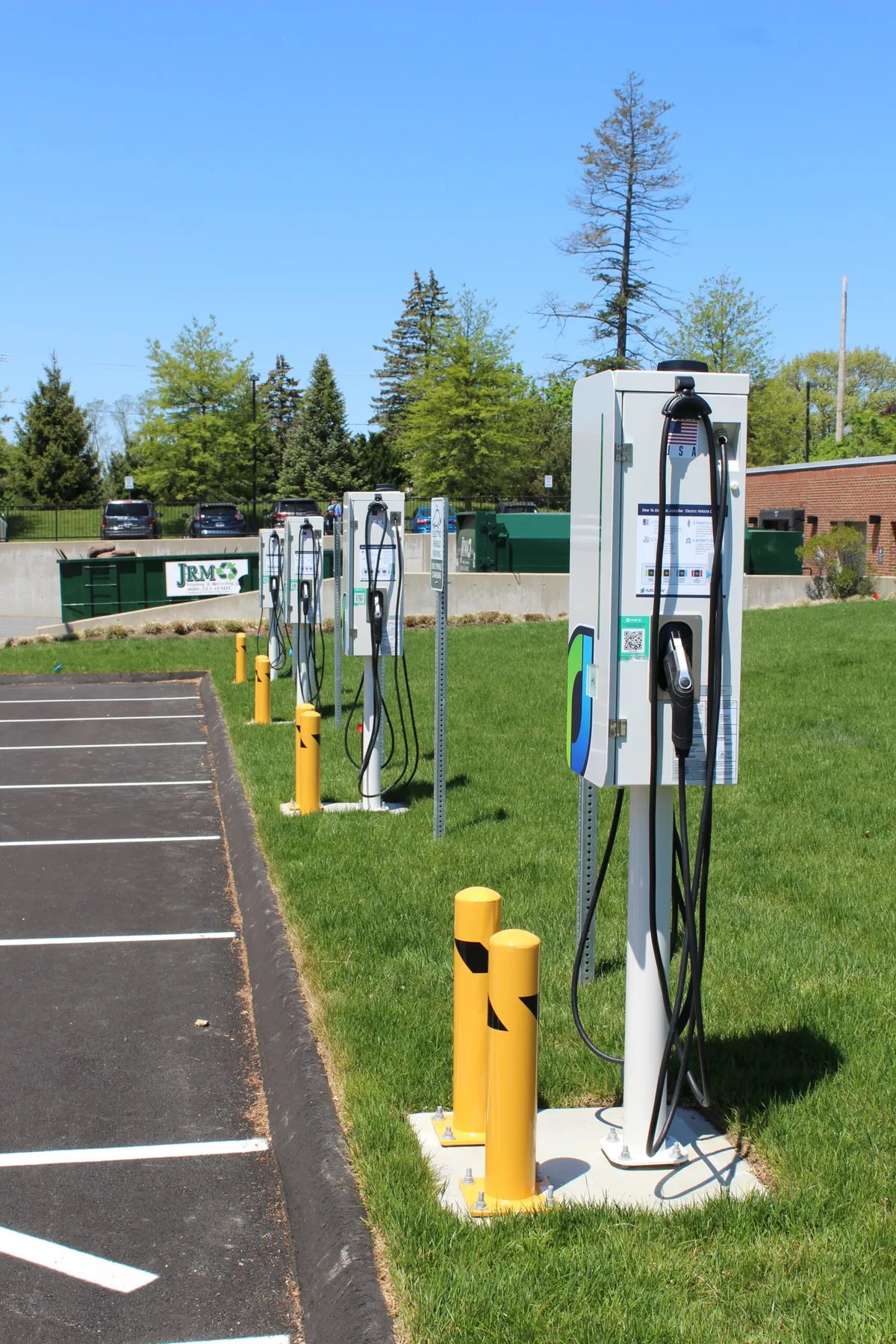
The right charger for a hospital parking bay is almost always an AC Level 2 smart charger, not a DC fast charger. Here is why:
Staff park for 8 to 12-hour shifts. Visitors park for 1 to 4 hours. A 7 kW charger adds approximately 50 km of range per hour. Over an 8-hour shift, that is 400 km of range added, more than enough to fully charge any current EV on the South African market from a near-empty battery. A 22 kW charger adds range roughly three times faster and suits visitor bays where dwell time is shorter.
DC fast chargers (47 kW to 120 kW units) cost R400,000 to over R1.25 million per unit and are generally impractical for hospital parking destination charging unless you operate a fleet of electric ambulances or service vehicles that need rapid turnaround. For those use cases, the ChargePoint SA CP-DC60 (60 to 120 kW dual-outlet, CCS2, from approximately R430,000 installed at 60 kW) is the appropriate tool.
A note on 22 kW AC chargers: only a small number of EVs currently sold in South Africa support the full 22 kW AC charging rate. Most EVs cap their onboard charger at 11 kW, meaning a 22 kW unit delivers no speed advantage over an 11 kW unit for the majority of vehicles. The practical recommendation is to install 22 kW hardware in visitor bays (future-proofing for vehicles that do support it, while the unit simply delivers what the car’s onboard charger accepts) while 7 kW units serve staff bays where the full shift covers any charging need anyway. Monta’s operational guide for hospital EV charging reinforces this approach, noting that energy management must be coordinated with building load profiles to protect clinical equipment.
Recommended charger mix for a mid-sized South African hospital (50 to 200 staff parking bays)
| Bay type | Recommended charger | Rationale | Indicative unit cost |
|---|---|---|---|
| Staff bays (8-12 h dwell) | CP-AC22-N 22 kW or Caro Pro CP-AC22 22 kW | Shift-long dwell; 22 kW hardware future-proofs for vehicles that accept it; dynamic load balancing manages simultaneous demand | From ~R13,900/unit (indicative) |
| Visitor bays (1-4 h dwell) | CP-AC22-N 22 kW billable wallbox | Eichrecht MID metering enables accurate per-kWh billing for visitors; OCPP 2.0.1J; Plug & Charge ready | Quoted per site |
| Twin bays (space-constrained) | CP-DUO-44 twin 2×22 kW | Two bays from one unit; IP54/IK10; dynamic load balancing built in; halves cable runs and DB connections | Quoted per site |
| Fleet/ambulance bay | CP-DC60 60-120 kW DC fast charger | ~30-minute top-up for electric service vehicles; CCS2 standard (SANS 62196-3); OCPP and RFID access control | From ~R430,000 installed (60 kW, indicative) |
Installation costs are quoted per site because the variables, DB board capacity, cable run distance, trenching, civils, three-phase availability at the parking structure and the hospital’s specific load profile, determine the final figure more than the hardware does.
Load management: the non-negotiable requirement for multi-bay sites
Ten 7 kW chargers drawing 32 A each create a theoretical simultaneous demand of 320 A and 70 kW. No standard hospital parking circuit was designed for that load, and attempting to run it without active load management will trip the supply, damage transformer capacity, and, in a hospital where that transformer also feeds other circuits, create a serious patient safety risk.
Dynamic load management (DLM) redistributes available power in real time across all active chargers, so no single circuit is overloaded. Research into EV charging infrastructure in healthcare settings confirms that charging infrastructure typically adds 10 to 15 percent to total connected load on large campuses when DLM is in use. Without it, the same installation could exceed total connected load by two or three times during peak shift-change periods.
For hospitals on Eskom Megaflex tariffs, the financial argument for DLM is even stronger. Eskom’s FY2026/27 network demand charge is R52.65/kVA/month in high-demand season and R26.29/kVA/month in low-demand season, billed on peak demand whether or not anyone is actually charging. A single unmanaged demand spike from simultaneous EV charging that permanently ratchets your registered demand upward will cost more over 12 months than the entire charger installation. Eskom tariffs increased 8.76% from 1 April 2026 and a further 9.01% from 1 July 2026, so the cost of inaction compounds annually.
Every ChargePoint SA commercial charger, from the Caro Pro CP-AC22 through to the CP-DUO-44 twin unit and the billable CP-AC22-N, includes dynamic load balancing as standard. For a hospital, that is not a nice-to-have; it is a prerequisite for a compliant and financially rational installation.
Master load management and demand charges for hospital sites
Solar and battery backup: making hospital EV charging load-shedding-resilient
Public EV charging stations stop working during load-shedding. For a hospital, that means staff arriving for a night shift to find their vehicles uncharged and no ability to recharge before the next shift. The solution is a solar-plus-battery-backed charging circuit, separated from critical clinical loads.
Eskom’s Homeflex TOU off-peak rate runs R1.45 to R2.25/kWh between 22:00 and 06:00 (and 10:00 to 18:00 on weekdays) against a peak rate above R3.40/kWh, meaning scheduled overnight charging on grid power alone already reduces energy cost substantially compared to peak-hour charging. Add solar and the blended effective cost drops further still.
For the solar and battery integration to be legal and safe, NRS 097-2-1:2024 compliance is mandatory. Any hospital combining solar PV or battery storage with EV charging must ensure the inverters are type-tested against NRS 097-2-1 and that the system maintains anti-islanding protection in battery backup mode.
Zero Carbon Charge (CHARGE) launched South Africa’s first off-grid, solar-powered public EV charging stations on the N3 corridor in May 2026, backed by a R100 million DBSA investment, demonstrating that grid-independent EV charging is commercially and technically viable in the South African context. The same principle applies to a hospital campus: a solar-buffered charging circuit keeps staff vehicles charged even when the grid is down, without touching the clinical backup power supply.
The 2024 Eskom/GridCars pilot at five Eskom sites incorporated solar and battery integration for grid resilience alongside smart load management, the closest South African institutional precedent to a hospital deployment, and proof that the hardware, software and commercial structures to do this properly already exist locally.
Hospital-specific zoning: staff bays, visitor bays and ambulance bays
A hospital EV charging deployment works best when the three user populations, staff, visitors and fleet vehicles, are physically and logically separated from the outset.
Staff bays belong in employee-only parking zones, access-controlled by RFID card. This serves two purposes: it prevents visitors from occupying staff charging bays during a long shift, and it allows the hospital to subsidise or fully fund staff charging as a benefit. Smart charging software can optimise energy draw based on shift patterns, pushing the heaviest charging load to off-peak hours when the building’s other electrical demand is lower.
As a facilities manager or HR director, this matters because healthcare is a talent market under continuous pressure. Offering free or subsidised EV charging for clinical staff, doctors, nurses and allied health professionals who have made the investment in an EV, is a meaningful and visible retention benefit. The cost of the electricity itself is modest: a 7 kW charger running for a full 8-hour shift consumes 56 kWh, which at a commercial blended rate of approximately R2.77/kWh (incl. VAT, per NERSA-approved 2025/2026 tariffs) costs around R155 per session. Across 20 staff sessions per day, that is R3,100 per day, roughly R93,000 per month. That number looks large until you compare it to the fully-loaded cost of replacing a specialist nurse or doctor.
Visitor bays should be equipped with billing-grade hardware. The CP-AC22-N with its Eichrecht-conformant smart meter (1 percent accuracy, MID certified) records every transaction to the precision required for enforceable per-kWh billing. Hospitals can set tiered pricing: pay-per-kWh for visitors, free or discounted for staff, all managed from a single OCPP dashboard. The GridCars ChargePocket Voucher model, which allows partners to buy vouchers and distribute them to drivers for specific sites, offers an additional option: a hospital could issue vouchers to long-stay patients or their families as a goodwill gesture or as part of a private ward amenity package.
Fleet and ambulance bays require a different calculus. Electric ambulances and service vehicles need rapid turnaround, which means DC fast charging is justified. The ChargePoint SA CP-DC60 (60 to 120 kW dual-outlet DC, CCS2, RFID and OCPP) delivers approximately 80 percent charge in around 30 minutes. At a hospital campus scale, a single dual-outlet DC unit can service multiple vehicles across a shift with proper scheduling software.
OCPP, billing and access control for a multi-user healthcare site
OCPP (Open Charge Point Protocol) is the communication standard that connects EV chargers to a backend management platform. For a hospital, OCPP is what makes the difference between a charging bay you cannot account for and one that generates an auditable transaction record for every kilowatt-hour dispensed.
OCPP 1.6 (released 2015) remains the minimum baseline for compatibility with most management platforms. OCPP 2.0.1 (released 2020, approved as IEC 63584 in 2024) adds certificate-based authentication, mandatory TLS encryption, Plug and Charge support (ISO 15118) and more detailed energy reporting. OCPP 2.1 (released January 2025) adds fixed-cost, energy-based and time-based billing models as standard, plus session resumption after unexpected reboots, useful in a hospital context where a power event triggering a charger reboot should not lose the transaction record.
For hospital procurement, specify OCPP 1.6J as the minimum baseline and require written confirmation from the supplier of a firmware upgrade path to OCPP 2.0.1. The ChargePoint SA CP-AC22-N ships with OCPP 2.0.1J and ISO 15118 Plug and Charge already active.
OCPP handles session authentication, energy metering and transaction records. Actual payment processing sits in the charge station management system (CSMS) or an integrated payment gateway, OCPP ensures the underlying data is complete, accurate and tamper-evident, which is what your finance department needs for cost allocation and what your auditors need for compliance reporting.
Access methods for a hospital multi-user site:
- Staff: RFID card (simple, reliable, works without a smartphone or data connection) linked to a staff number for cost allocation or free access.
- Visitors: ad-hoc contactless card payment or QR code scan on the charger, no account required.
- Fleet vehicles: autocharge (ISO 15118 Plug and Charge) linked to the vehicle’s identity, no human action required.
EMI and implantable cardiac devices: what the clinical evidence shows
One concern that arises specifically in hospital environments is whether EV charger electromagnetic interference (EMI) poses a risk to patients or staff with implantable cardiac devices (ICDs or pacemakers). The only published peer-reviewed clinical study to date, from Wright State University, Christ Hospital and Miami Valley Hospital, found that transvenous ICD function was not interrupted by EMI from either a 220 V wall charger or a 480 V DC supercharger when the EV was being charged.
This finding is reassuring for staff and visitor cardiac device wearers in the general parking environment. It is not, however, a clearance for placing chargers adjacent to MRI suites or other high-field diagnostic equipment, where the relevant standards are those governing medical imaging environments rather than EV charging. Keep EV charger circuits and their cable runs away from medical imaging areas and consult your biomedical engineering team before finalising charging bay locations near diagnostic departments.
Cost of installation: what a hospital should budget
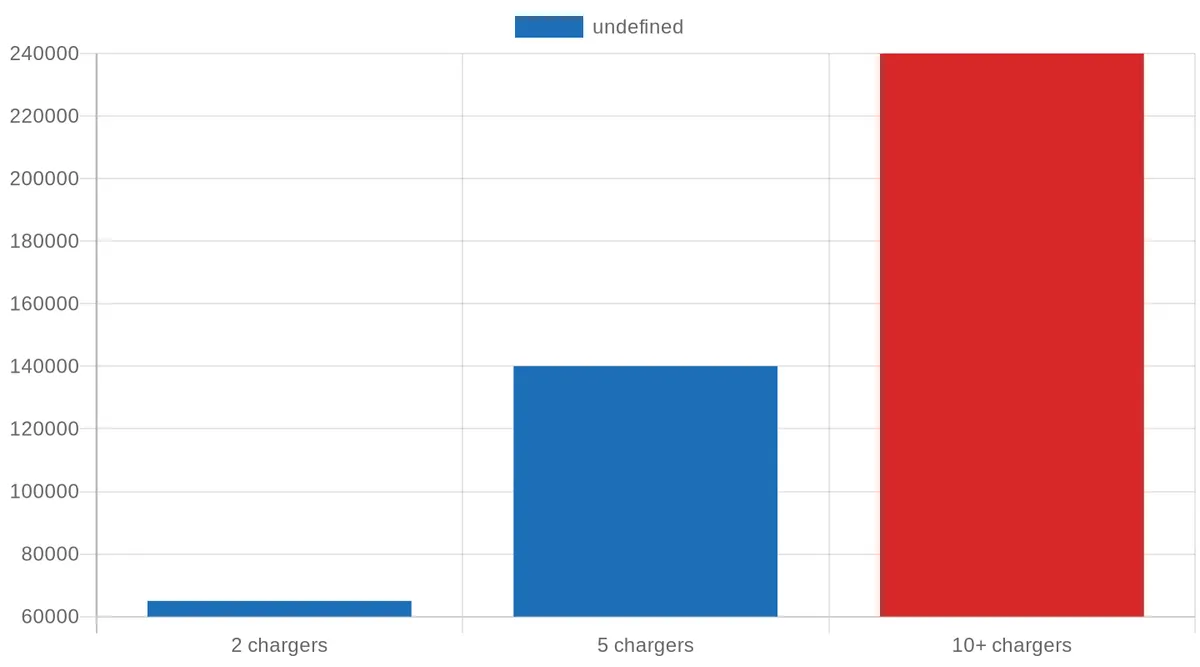
Installation costs for a hospital EV charging project are site-specific because the dominant cost drivers are the cable run from the nearest DB board with available capacity, whether three-phase supply exists at the parking structure, earthing resistance conditions, civils (trenching, conduit, concrete work) and whether a DB board upgrade is required.
The benchmarks below provide planning-level guidance:
| Installation scale | Indicative total cost (hardware, install, commissioning) | Notes |
|---|---|---|
| 2 AC chargers | ~R65,000 | Suitable for a pilot or outpatient clinic |
| 5 AC chargers | ~R140,000 | Starter deployment for a district hospital |
| 10+ AC chargers | R240,000+ | Mid-scale for a regional or private hospital |
| DB board upgrade (if required) | Additional R3,000-R8,000 | New board or additional circuit breakers |
| 1 x 60 kW DC fast charger (fleet bay) | From ~R430,000 installed (indicative) | Dual-outlet CP-DC60; ambulance/fleet use |
| Hardware component only (per AC unit) | R8,000-R18,000 | Excludes labour and CoC |
| Installation labour (per unit) | R5,000-R15,000 | Varies by run length, civils, phases |
| CoC per installation | R500-R1,500 | Mandatory; issued by ECSA-registered electrician |
The full process from quote to CoC issuance typically takes 7 to 14 days for a standard site; a hospital project with civil works, trenching and staged installation across an active campus will take longer and should be scoped with the installer before committing to a programme.
Cost of ownership comparison: staff free charging vs visitor pay-per-use vs public network
| Charging model | Energy cost per session | Capital recovery |
|---|---|---|
| Staff free charging (hospital pays energy) | ~R155/session (56 kWh × R2.77/kWh blended commercial rate) | Absorbed as staff benefit; Section 12B accelerated depreciation (40% Year 1) and Section 12L credit (R0.95/kWh saved) reduce effective capital cost by 30-45% |
| Staff subsidised 50% (hospital pays half) | ~R77.50/session to hospital; ~R77.50 to staff | Partial cost recovery; retains retention benefit |
| Visitor pay-per-kWh | Cost neutral to hospital; margin possible above cost of electricity | Revenue from visitor sessions offsets capital cost; estimated ROI 2.4-3.2 years |
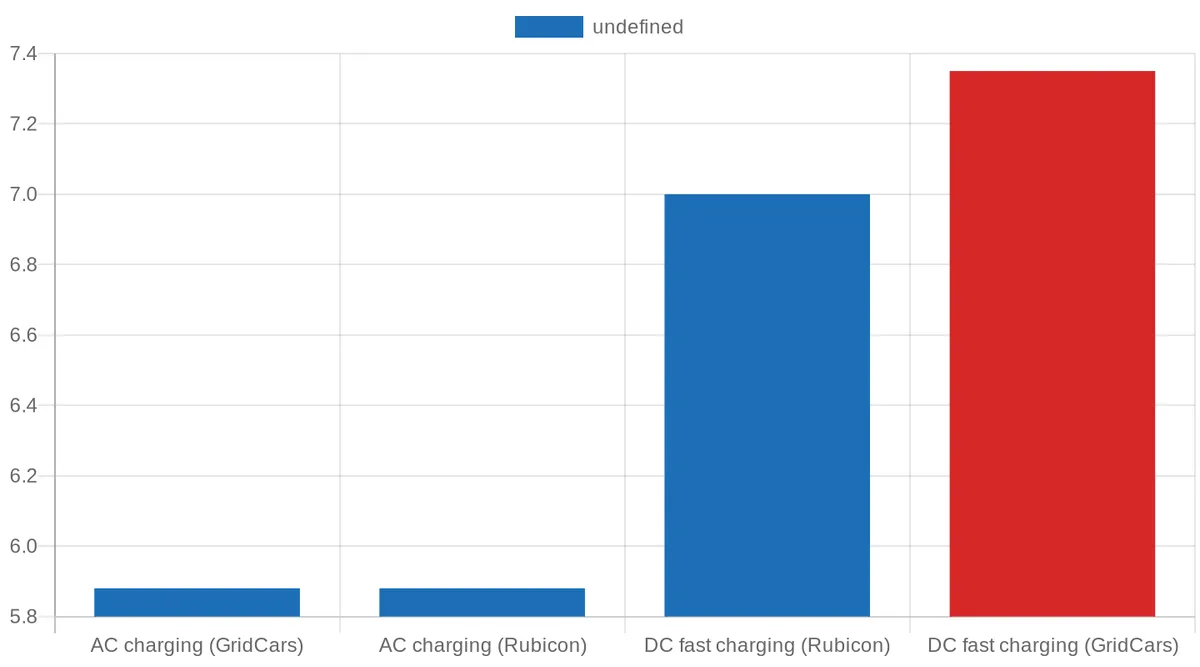
| Staff using public AC chargers (no hospital infrastructure) | ~R5.88-R6.00/kWh AC (as at August 2025; confirm current rates with your CPO as tariffs change) | Zero capital; zero retention benefit; no operational control |
Note on public network tariffs: the AC figure of approximately R5.88/kWh cited above reflects nationally applicable standard public AC charging tariffs as reported in November 2025. Public network rates are subject to change; always confirm current rates with the relevant charging point operator before building them into a business case.
For a hospital financing the installation, the Section 12B accelerated depreciation (40 percent in Year 1) and Section 12L energy efficiency credit (R0.95/kWh saved) reduce the effective net capital cost by 30 to 45 percent. A 10-bay installation at R240,000 has an effective post-tax cost of approximately R132,000 to R168,000. Spread over a 60-month equipment finance agreement, that is R2,200 to R2,800 per month, comparable to one junior staff member’s monthly transport allowance.
The Eskom workplace pilot: the closest SA precedent to a hospital deployment
Eskom’s 2024 workplace charging pilot, delivered in partnership with GridCars, installed 60 kW DC fast chargers and 22 kW dual AC chargers at five Eskom sites across the country, 10 charging stations in total, serving 20 vehicles ranging from light delivery vehicles to light trucks. Eskom described the stations as
Photo: Giant Asparagus / Pexels
Plan EV charging for your hospital’s staff and visitor bays
The Commercial Site Builder is free, with no obligation to proceed.
Plan my hospital charging →WhatsApp us
CoC-certified installers, nationwide