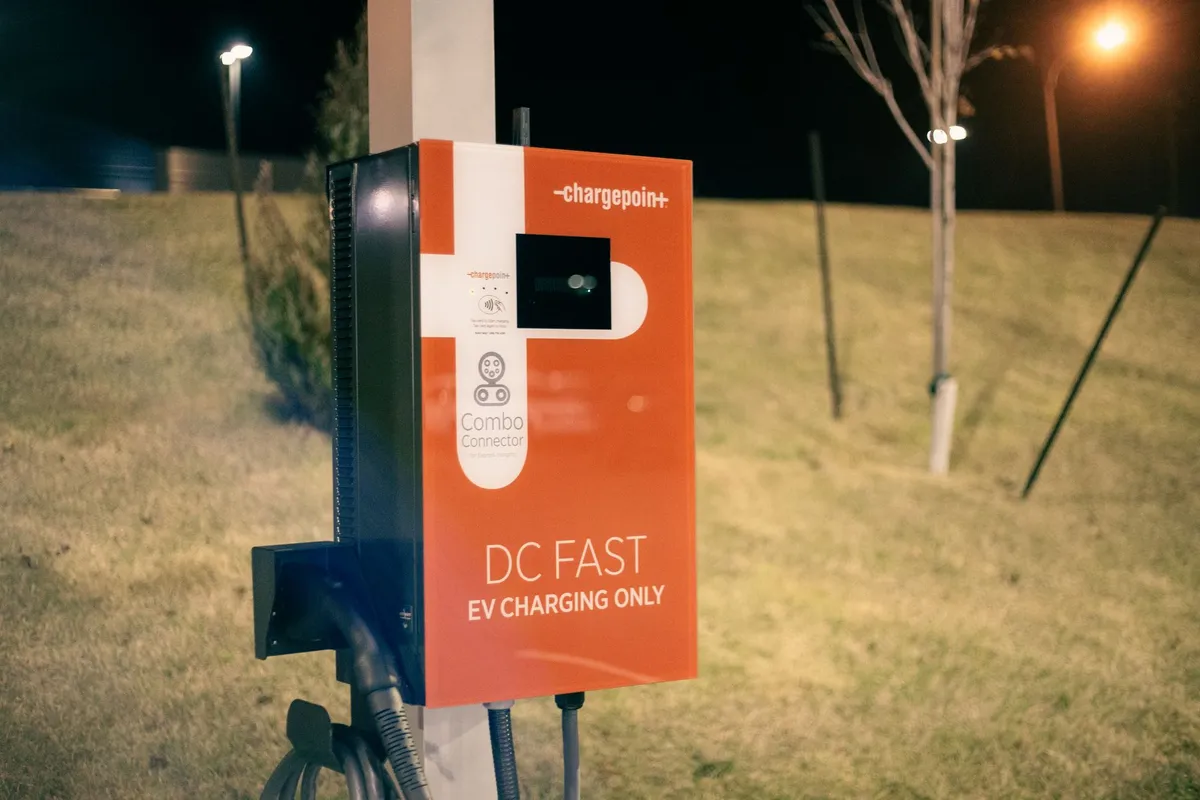
- ChargePoint SA operates as a single-contract managed installer: the wireman who quotes is the same person on your site, with a 2-year workmanship warranty and CoC issued on every installation.
- GridCars is South Africa’s largest charge-point operator (CPO), running approximately 445 sites and 650+ chargers as of late 2025, but operates through partner/network electricians rather than in-house installers.
- A MyBroadband poll of SA EV owners found only 23% reported smooth experiences at GridCars stations; 46% reported unresolved problems.
- GridCars implemented a circa 15% tariff increase from 1 December 2025. Treat pre-December 2025 public rates as historical benchmarks only.
- For commercial and fleet depot installations, ECSA sign-off remains mandatory under SANS 10142-1 and the OHS Act No. 85 of 1993.
- A dual-gun 60 kW DC site costs approximately R650,000 all-in, with ongoing O&M and software costs of approximately R3,500 per month plus Eskom demand charges of approximately R3,300 per month.
- ChargePoint SA’s Commercial EV Charging Programme covers supply, installation, compliance, billing and remote monitoring from a single accountable contract, from approximately R350 per charger per month in managed services.
If you manage a fleet, run a commercial property, or are making a procurement decision for workplace EV charging, you face a choice that is rarely explained honestly: do you engage a managed installer who owns the hardware, the compliance and the ongoing support under one contract, or do you connect to an established charging network that already has the software platform and the brand recognition?
Both models have genuine strengths. Both have documented weaknesses in the South African context. This article lays out the verified facts so you can make the right call for your specific site, your fleet size and your budget, without being sold a story by either side.
How the two models actually work
Understanding the structural difference is essential before comparing any individual metric.
ChargePoint SA is an integrated installer-advisor. It supplies hardware from its own range, deploys ECSA-registered technicians for installation, issues the electrical Certificate of Compliance (CoC) on every job, and provides ongoing O&M, software and remote monitoring under a single contract. There is no handoff between a sales team, an installation subcontractor and a separate support desk. As ChargePoint SA’s own service model states: the wireman who quotes is the same person who performs the installation, with no call centre and no subcontractor surprise on the day.
GridCars is a charge-point operator (CPO) and eMobility service provider (eMSP). It owns and manages the largest public charging network in South Africa, connecting approximately 445 sites and 650+ chargers representing around 60% of the country’s total public charge points as of late 2025 (Engineering News, December 2025). Its business model is network-scale public access. For commercial or workplace deployments, GridCars connects your site to its OCPI-roaming backend and billing platform, but physical installation is handled through partner or network electricians rather than in-house technicians. In secondary cities such as Nelspruit, this means a lead time of 2 to 3 weeks via a named partner such as Zest EV Solutions.
Neither model is universally superior. The right choice depends on your use case: a fleet depot needing captive, metered charging operates under completely different requirements from a retail destination trying to attract public EV drivers.
Installation timelines: what the verified data shows
Timeline is one of the most misrepresented variables in commercial EV procurement. Vendors quote the physical installation time; the total elapsed time from decision to live charging is almost always longer.
| Milestone | ChargePoint SA | GridCars (via partner electrician) |
|---|---|---|
| Initial quote | Within 24 hours (four photos; no site visit required) | Varies by partner; no published SLA |
| Physical install (single-phase 7 kW) | 4 to 8 hours on-site | Comparable (partner-dependent) |
| Physical install (three-phase or complex) | 1 full day; 1 to 2 days if DB board work needed | Partner-dependent; no published benchmark |
| Quote to CoC (freestanding/commercial site) | 7 to 14 days | Not published |
| Sectional title / body corporate sites | 3 to 8 weeks (includes 2 to 6 weeks for trustee approval) | Same regulatory timeline applies to any installer |
| Installer scheduling in secondary cities | 2 to 4 weeks (e.g. Nelspruit) | 2 to 3 weeks (Nelspruit, via Zest EV Solutions) |
The honest conclusion: for a straightforward freestanding commercial site in a major metro, ChargePoint SA’s 7 to 14 day quote-to-CoC timeline is a meaningful differentiator. In secondary cities or complex sites, both models face similar scheduling realities. The critical variable is not which brand you choose but whether your installer understands SANS 10142-1 Annex N, which introduced EV-specific requirements in the 2024/2025 code update, including a dedicated Type A or Type B RCD rated for DC residual currents, minimum 6 mm2 copper cable for 32 A single-phase runs under 25 m, a 1-ohm earthing threshold and a surge protection device on the dedicated EV circuit. Many generalist electricians working through partner networks are not current on these requirements.
An incomplete application to a body corporate, missing a load calculation or sub-meter plan, gets deferred and adds another full month to any project regardless of who the installer is. If you manage a body corporate or estate and are evaluating charger installation for residents, this is not a supplier problem: it is a process problem that specialist documentation eliminates.
Compliance: what commercial buyers must verify
For procurement managers, HR directors and fleet managers commissioning workplace charging, the compliance chain is your risk exposure, not the vendor’s.
SANS 10142-1 is compulsory under the Occupational Health and Safety Act No. 85 of 1993. Every fixed electrical installation, including EV chargers, must comply. An electrical CoC must be issued on completion; its cost (typically R800 to R1,500, itemised separately in any compliant quote) is not optional. A CoC that is more than two years old at the point of property transfer blocks the transfer entirely, which is a material liability for any property-owning entity.
Since October 2025, residential EV charger installations no longer require a separate ECSA Professional Engineer sign-off for CoC issuance: a DoL-registered electrician is sufficient. However, for commercial and fleet depot projects, ECSA sign-off remains mandatory. ChargePoint SA uses ECSA-registered installers as standard. When evaluating any GridCars partner electrician for a commercial site, this is the first compliance question to ask.
The charger hardware itself requires an NRCS Letter of Authority (LoA), which can take up to 120 working days (approximately six months) to process, as well as an SABS EMC Certificate of Conformance for electromagnetic compatibility. Hardware suppliers who have not cleared these requirements expose the buyer to enforcement risk. AC connectors must comply with SANS 62196-2; DC connectors with SANS 62196-3. Issuing a CoC without proper inspection is a criminal offence carrying penalties of up to 12 months imprisonment plus R200 per day for continuous offences over up to 90 days.
GridCars’ own hardware (the Advanced AC Charger) is specified at up to 22 kW with Type 2 connectors and IEC 61851-1 compliance, which maps to the South African SANS 62196-2 requirement. OCPP compliance is listed. These are the baseline minimums: the question for any commercial buyer is whether the specific unit proposed for your site holds current NRCS LoA and SABS EMC certificates, and whether the installer holds the correct ECSA registration for the scale of your project.
Network reliability and uptime: the numbers that matter for fleet managers
If you manage a fleet, a station that is offline is not an inconvenience: it is an operational failure that grounds vehicles.
The most relevant public data point is a MyBroadband poll of South African EV owners in a Facebook community, summarised by Tech-Brunch: 46% of respondents reported unresolved problems with GridCars chargers, 31% experienced problems that were eventually fixed, and only 23% reported smooth experiences. Specific stations reported as offline for extended periods include Alzu near Emalahleni and Mooirivier Mall in Potchefstroom. In early May 2026, widespread network glitches exacerbated frustrations across multiple platforms, with critics noting that upgrades have not kept pace with demand growth.
An AutoTrader SA journalist, writing from direct road-trip experience in August 2024, advised: “It’s worth mentioning that GridCars is not right 100% of the time, the fast charger in Caledon on the N2, for example, doesn’t always work but shows that it’s online on the map. If you’re planning a mega road trip in your EV, it’s probably best to call GridCars beforehand to find out if the charger is working as it should.”
GridCars has acknowledged future investment in predictive maintenance platforms and ultra-fast liquid-cooled chargers (Engineering News, December 2025), framing this as roadmap rather than current capability. Its OCPI roaming integration, the first on the African continent when launched in July 2022, remains a genuine technical milestone that demonstrates genuine protocol sophistication.
ChargePoint SA’s commercial programme advertises average on-site repair response under 90 minutes in major metros, a 24-hour support line and the first 30 minutes of any call-out free. Its parts database exceeds 14,000 items, with pickup locations in Sandton and Cape Town. The global ChargePoint Assure programme targets 98% annual station uptime, including downtime from hardware-related outages. These figures are the operator’s own stated commitments; independently verified uptime data for South African commercial installations is not publicly available from either party, which is why you should ask any supplier for a contractual SLA, not a marketing claim, before signing.
Billing transparency and tariff risk: the hidden cost in the GridCars model
For fleet managers who need to allocate energy costs by vehicle, driver or cost centre, billing transparency is not a nice-to-have: it is a finance requirement.
GridCars’ public charging tariffs before the December 2025 increase were R7.35 per kWh for DC and R5.88 per kWh for AC (Grokipedia, citing GridCars sources, August 2025). From 1 December 2025, GridCars implemented a circa 15% increase. OEM partner customers without fixed-rate subsidy agreements in their contracts saw customer costs rise automatically. Treat all pre-December 2025 figures as historical benchmarks only: the current 2026 rate is approximately 15% above those baselines.
The CPO-to-eMSP margin structure adds a further layer of opacity. As Hilton Musk, Rubicon’s Head of E-Mobility, disclosed in November 2025: at AIDC-EC charging stations, Rubicon eMSP customers pay R7.00 per kWh while GridCars eMSP customers pay R8.24 per kWh for the same physical station. The wholesale margin between CPO and eMSP is typically around 15%, implying a CPO DC wholesale rate of approximately R6.39 per kWh and AC at approximately R5.11 per kWh before retail markup (ChargePoint SA OEM partnership analysis). In some OEM-branded configurations, DC tariffs can reach R11.76 per kWh, a 60 to 68% premium over the standard GridCars network rate.
GridCars’ ChargePocket prepaid wallet carries an explicit no-refund policy: once purchased, tokens can only be used for EV charging and no transfers or refunds can be made. A South African ChargePocket app user posted the following on the Apple App Store: “I used to love this app because I’d place funds in advance in it to plan for future charges. Now arriving at charge points I get errors not recognising charging points anymore, charge function not working anymore and forcing you to pay with your own bank card anyway, what’s worse there is no refund.” This is the operational consequence of the published policy meeting a reliability failure.
EFT top-ups to ChargePocket may take up to 48 hours to reflect; tokens are only allocated once the payment appears in GridCars’ bank account. Fleet operators who need predictable daily charging access should build this into their treasury planning.
For monthly billing on OEM-branded accounts such as Jaguar Electrifies, GridCars issues detailed statements of individual charge sessions once per month. Cancellation of an OEM-branded account and refund of the remaining balance requires a phone call to +27 12 349 2462 (8 am to 5 pm) or an email to the director’s personal address. No published SLA for support response or resolution time accompanies GridCars’ public contact details (phone: +27 10 109 3344; WhatsApp: +27 60 070 2372).
South Africa currently has no mandatory EV charger session-level billing calibration law equivalent to Germany’s Eichrecht. Session-level billing is an unregulated gap: operators set tariffs by commercial agreement without a mandated calibration framework. NRS 057 and SANS 474:2006 cover distribution metering but do not yet address EV charger session billing specifically. Under NRS 057, all billing meters must be calibrated at a SANAS-accredited calibration laboratory, but the enforcement of this requirement at individual EV charge points is not yet standardised across the industry.
This is where ChargePoint SA’s CP-AC22-N billing-grade wallbox provides a substantive difference. Its Eichrecht-conformant smart meter achieves plus or minus 1% accuracy and records every transaction with MID metering, OCPP 2.0.1J and ISO 15118 Plug and Charge. If you operate a site where employees or visitors are billed per kWh, the billing accuracy of the hardware is not a procurement detail: it is a legal and reputational exposure. Billing disputes arising from metering inaccuracies, failed sessions billed incorrectly, or tariff configuration errors are harder to investigate after the fact when a network stores only summary billing data without underlying session telemetry.
Understand billing, tariffs, and cost recovery in commercial charging
Total cost of ownership: a structured comparison

The table below compares the two models across the primary TCO variables for a representative commercial workplace or fleet charging installation. All figures are indicative and must be validated against your specific site.
| TCO Variable | ChargePoint SA (managed installer) | GridCars (network partner) |
|---|---|---|
| Hardware ownership | Buyer owns hardware; ChargePoint SA supplies and installs from its own range | GridCars or site owner may own hardware; depends on contract structure |
| Indicative unit cost (22 kW AC) | From approximately R13,900 (CP-AC22, indicative) + installation quoted per site | Hardware pricing via partner; not publicly listed |
| Indicative DC fast-charger cost (60 kW) | From approximately R430,000 installed (CP-DC60, indicative) | Not publicly listed; site-dependent |
| Monthly O&M and software (dual-gun 60 kW DC site) | Approximately R3,500 per month (ChargePoint SA OEM model) | Not publicly disclosed; embedded in network agreement |
| Eskom demand charge (60 kW DC site, high season) | Approximately R3,300 per month (R52.65/kVA/month, Eskom Megaflex FY26/27) | Same tariff applies regardless of supplier |
| Managed services fee (AC chargers) | From approximately R350 per charger per month (Commercial Programme) | Embedded in network revenue share; not itemised |
| Tariff volatility risk | Buyer controls retail rate on private/semi-public sites; Eskom pass-through is the primary variable | Subject to CPO tariff decisions; circa 15% increase Dec 2025 with limited notice |
| Workmanship warranty | 2-year workmanship warranty included; CoC on every installation | Partner-dependent; no published standard warranty |
| On-site repair response (major metros) | Average under 90 minutes; 24-hour support line | No published SLA |
| Billing meter accuracy | CP-AC22-N: Eichrecht-conformant, plus or minus 1%, MID metering, OCPP 2.0.1J | IEC 61851-1 and OCPP listed; billing accuracy standard not published |
| Breakeven (captive fleet depot, approximately 350 kWh/day) | Approximately 1.2 years; approximately 80% IRR (illustrative) | Dependent on revenue-share structure; not published |
| Payback at low utilisation (approximately 30 kWh/day) | May not reach payback at pure public retail model without anchor demand | GridCars director: “no business case” below approximately 100,000 EVs nationally |
The Eskom tariff trajectory is a shared risk: 8.76% from 1 April 2026 and 9.01% from 1 July 2026 (Eskom FY26/27 tariff schedule). Both models pass this through to site economics. The Megaflex network demand charge of R52.65 per kVA per month in high-demand season is billed whether or not anyone charges, which is why low-utilisation sites face a structurally challenging payback regardless of which supplier installs the hardware.
The right model for your use case
If you manage a fleet depot
Captive fleet charging is the use case where the managed-installer model most clearly outperforms the public network model. You control who charges, when they charge and at what rate. You need session-level billing data for cost allocation. You need an SLA with teeth. ECSA sign-off is mandatory. The ChargePoint SA Commercial EV Charging Programme, combining supply, SANS 10142-1-compliant installation, a CoC, OCPP 2.0.1 billing, load balancing and remote monitoring under a single accountable contract, is the structure that fits this requirement. For a high-throughput depot, the CP-DC60 (from approximately R430,000 installed, indicative) delivers 30-minute top-ups and dual-outlet simultaneous charging. For lower-throughput depots with multiple bays, the CP-DUO-44 twin 2×22 kW wallbox charges two vehicles from a single unit with dynamic load balancing, which reduces infrastructure cost without sacrificing capacity.
If you run a hotel, destination venue or retail park
Destination charging is a guest amenity and a revenue opportunity. You need billing-grade metering so you can charge guests per kWh, app and RFID access for ad-hoc users, and a platform that your facilities team can operate without specialist training. The CP-AC22-N billable business wallbox, with its Eichrecht-conformant smart meter at plus or minus 1% accuracy, OCPP 2.0.1J and ISO 15118 Plug and Charge, is designed for exactly this context. GridCars’ network connection could theoretically put your site on the public map, but its circa 15% December 2025 tariff increase, the no-refund ChargePocket policy, and the absence of a published support SLA are material considerations for a hospitality brand where guest experience is a reputational asset.
As a body corporate trustee or estate manager
Body corporate installations require an ordinary resolution (more than 50% of votes in favour) for a common-property charger, under the Sectional Titles Schemes Management Act. Exclusive-use-area charger rights are real property rights under STSMA section 27, not personal rights under sections 10(7) and (8). An incomplete application, missing a load calculation or sub-meter plan, adds a full month to the approval timeline. ChargePoint SA has prepared the documentation and attended trustee meetings directly, which eliminates the deferral risk that generalist installers consistently produce. Most installations in Johannesburg and Cape Town complexes land between R16,000 and R20,000 all-in once sub-metering and CoC are included. The CP-DUO-44 twin wallbox is the practical choice for complexes adding two bays simultaneously: one unit, one installation, two outlets.
For a mall or property manager
Public-facing retail charging involves peak wait times that are already eroding customer satisfaction at existing GridCars hubs. At Sandton City’s eight GridCars wallboxes, the busiest charging hub in Gauteng, typical 30-minute waits during peak hours are documented. At Mall of Africa, 60-plus minute waits are common on Saturdays. If you are installing new capacity at a retail property, the question is not whether to use the GridCars network or a private installer: it is whether you want to own the charger asset and the billing relationship, or hand that revenue and data to a network operator. Owning the asset under a managed-installer model gives you the revenue, the tenant data and the flexibility to adjust tariffs as Eskom costs change.
What GridCars does genuinely well
A fair comparison requires acknowledging GridCars’ genuine strengths. It was the first EV charging network operator on the African continent to integrate OCPI roaming, in July 2022. Its network breadth, approximately 445 sites and 650+ chargers accounting for around 60% of South Africa’s public charge points, means that if you need a presence on the national public map rather than a captive private site, GridCars delivers the distribution that no single managed installer can match. Its Eskom pilot installation, 10 charging stations at five Eskom sites launched in August 2024 with one 60 kW DC fast charger and one 22 kW dual AC charger per site, and the nearly 3,500 kWh delivered before the fleet even formally launched, demonstrates genuine large-account delivery capability. Its stated roadmap for ultra-fast liquid-cooled chargers and predictive maintenance platforms (Engineering News, December 2025) is credible given the company’s track record of hardware evolution.
The honest caveat, from GridCars’ own founder Winstone Jordaan, speaking at Enlit Africa: “There’s just no business case. We need about 100,000 vehicles on the road before any of us will see real profitability. But that doesn’t mean we shouldn’t build the foundation now.” This candour matters for procurement decisions. A network operator navigating a pre-profitability phase has constrained resources for SLA improvements, maintenance staff and support infrastructure. That is not a criticism: it is a market reality that any commercial buyer should factor into their risk assessment.
The recommended products for commercial and fleet deployments
Based on the use cases above, ChargePoint SA’s commercial range includes the following models that fit the scenarios in this article:
- CP-AC22-N (22 kW billable AC): Billing-grade workplace and destination charging with Eichrecht-conformant metering at plus or minus 1% accuracy, OCPP 2.0.1J and ISO 15118 Plug and Charge. The right choice for any site where employees or visitors are billed per kWh. See the full spec and request indicative pricing.
- CP-DUO-44 (twin 2×22 kW): Two charging bays from one unit, with dynamic load balancing and optional MID metering. Practical for estates, body corporates and workplaces adding multiple bays in a single installation. Quoted per site.
- CP-DC60 (60 to 120 kW DC fast charger): Fleet-depot and destination fast charging, from approximately R430,000 installed (60 kW, indicative). Dual-outlet CCS2, 10.1-inch touchscreen, app, QR, RFID and POS payment, OCPP and smart-grid integration. Approximately 30-minute top-ups.
- Commercial EV Charging Programme: The full single-contract wrapper, supply plus installation plus SANS 10142-1 compliance plus CoC plus ECSA-registered installers plus OCPP/OCPI platform plus managed billing, access control, load balancing and remote monitoring, from approximately R350 per charger per month. Explore the Commercial EV Charging Programme.
Frequently asked questions
Does a commercial EV charger installation require ECSA sign-off in South Africa?
Yes. Since October 2025, residential installations no longer require a separate ECSA Professional Engineer sign-off for CoC issuance. However, commercial and fleet depot projects continue to require ECSA sign-off as a mandatory condition under SANS 10142-1 and the Occupational Health and Safety Act No. 85 of 1993. When evaluating any installer or network partner for a commercial site, confirm that the person issuing the CoC holds the correct DoL registration and that an ECSA-registered engineer is engaged for the project. ChargePoint SA uses ECSA-registered installers as standard on all commercial and fleet projects.
How does a circa 15% GridCars tariff increase affect our fleet charging budget?
GridCars implemented a circa 15% tariff increase from 1 December 2025. If your fleet charges on the GridCars public network without a fixed-rate subsidy agreement in your contract, your per-kWh cost increased automatically on that date. Using the pre-increase AC benchmark of R5.88 per kWh, a 15% increase implies a current rate of approximately R6.76 per kWh for AC public charging, before any eMSP margin is added. For fleets charging significant volumes daily, even a 15% tariff movement is a material budget variance. Private captive charging on your own infrastructure, billed at your municipal rate plus a managed services fee, provides predictability that public-network pricing does not.
What is the difference between OCPP 1.6 and OCPP 2.0.1 for fleet billing purposes?
OCPP 1.6 and OCPP 2.0.1 are not backward compatible: they use completely different data structures and device models. OCPP 2.0.1 was formalised as IEC international standard IEC 63584 in late 2024. For fleet billing, OCPP 2.0.1 consolidates transaction-related data with more granular session records, using sequence numbers rather than chronological message order, which aids billing reconciliation and dispute investigation. A fleet that installs OCPP 1.6 hardware today cannot natively upgrade to 2.0.1 without significant hardware changes. ChargePoint SA’s CP-AC22-N runs OCPP 2.0.1J as standard. Only 68 charger models worldwide held formal OCA OCPP 2.0 certification as of September 2025: the gap between a vendor claiming “OCPP 2.0.1 ready” and holding formal certification is a real operational distinction.
Can a body corporate refuse to allow an EV charger installation?
A body corporate can defer an application, but the legal framework under the Sectional Titles Schemes Management Act does not permit an unreasonable permanent refusal for a charger installed within an exclusive-use area at the owner’s expense. For a charger on common property, an ordinary resolution (more than 50% of votes) is required, not a 75% special resolution. Exclusive-use-area rights flow from STSMA section 27 (real property rights) rather than sections 10(7) and 10(8) (personal rights). An application that includes a professional load calculation, a sub-meter plan, a wiring diagram compliant with SANS 10142-1 Annex N, and indemnity documentation is far less likely to be deferred than an incomplete submission. An incomplete application that misses any one of these elements is typically deferred for a full month until the next trustee meeting.
What should a fleet manager ask a charging supplier before signing a multi-site contract?
Ask for: the contractual SLA for on-site repair response time, not a marketing claim; confirmation of ECSA registration for the lead installer; evidence that the hardware holds a current NRCS Letter of Authority and SABS EMC Certificate of Conformance; the billing meter accuracy standard (MID metering or equivalent) and how session telemetry is retained for dispute investigation; whether the monthly managed services fee is fixed or subject to unilateral increase; and whether the OCPP version is 1.6 or 2.0.1 with formal certification rather than “ready” status. A supplier that cannot answer all six questions in writing before contract signature is not ready for a multi-site commercial engagement.
How long does a commercial EV charger installation take from first contact to live charging?
For a straightforward freestanding commercial site in a major South African metro, ChargePoint SA’s verified timeline is a quote within 24 hours (from four photos), physical installation of 4 to 8 hours for a single-phase 7 kW wallbox or one full day for a three-phase installation, and CoC issuance within 7 to 14 days from quote acceptance. If the DB board requires work or the cable run is complex, allow 1 to 2 days for installation. In secondary cities such as Nelspruit, allow 2 to 4 weeks for installer scheduling before the physical installation day. For sites involving a body corporate or estate approval process, add 2 to 6 weeks for trustee meeting scheduling and document review, with an additional full month if the initial application is incomplete.
The bottom line for South African commercial buyers
GridCars is the right answer for one specific commercial question: does my brand or property need to appear on the national public charging map? If the answer is yes, GridCars’ network breadth, its OCPI roaming infrastructure and its OEM-partnership experience make it the most direct route. Accept that you are buying network reach, not SLA certainty, and price the tariff volatility risk into your business case accordingly.
For every other commercial charging requirement, from fleet depot fast charging to workplace cost-allocation to destination billing to estate management, the managed-installer model delivers what the network-partner model structurally cannot: a single point of accountability for hardware, compliance, CoC, metering accuracy, support response and billing transparency. The critical variable is not which brand you choose but whether your installer is current on SANS 10142-1 Annex N, whether the hardware holds current NRCS LoA and SABS EMC certifications, and whether the metering standard gives you the session-level data your finance function requires.
ChargePoint SA’s Commercial EV Charging Programme covers all of these requirements under one contract, with ECSA-registered installers, Eichrecht-conformant billing-grade hardware and remote monitoring, from approximately R350 per charger per month in managed services. The site assessment is free, and it produces a recommended charger specification, a cost estimate and a payback model specific to your building, your fleet size and your Eskom tariff band, before you commit to anything.
Ready to cut through the variables for your specific site? Plan your site free with our Commercial Site Builder and get your recommended charger, cost and payback in a single session, with a no-obligation engineered site assessment to follow.
Plan your commercial EV charging site—compare models upfront
The Commercial Site Builder is free, with no obligation to proceed.
Plan my charging site →WhatsApp us
CoC-certified installers, nationwide