Key points
- Audi has invested more than R50 million across three waves of public charging infrastructure since 2022, adding 150 kW and 200 kW DC ultra-fast chargers at highway and mall locations nationwide.
- A 120-150 kW DC charger can take the Audi e-tron 55 from 5% to 80% (roughly 370 km of range) in approximately 30 minutes, but only if the car’s onboard electronics and battery temperature cooperate.
- Public DC fast charging in South Africa currently costs R7.00-R7.35/kWh (August 2025 Rubicon and GridCars eMSP rates), roughly 75-140% more expensive than home charging at R3.00-R4.00/kWh.
- Over 80% of electric charging takes place at home, according to Audi SA’s own data, fast public chargers are a top-up tool, not a primary strategy.
- South Africa has approximately 445 public charging sites, 650 individual chargers and 1,200-plus connectors nationally as of early 2026, with a 1:7 EV-to-charger ratio that compares favourably to the global 1:10 benchmark.
- Known coverage gaps remain: a roughly 300 km stretch on the N1 between Beaufort West and Three Sisters, sparse N2 coverage between East London and Durban, the Free State interior, and Limpopo outside Polokwane.
- Audi’s public network is open to all EV brands. You do not need to own an Audi to use any of these chargers.
When Audi South Africa commissioned its first 150 kW DC ultra-fast public chargers back in August 2022, local EV drivers were still largely rationing range and planning around 50 kW stops. Today, with Wallbox Supernova 150 kW units deployed at six strategic national locations in Wave 3 (July 2024) and a 200 kW charger already live at Mall of Africa in Midrand, the headline speeds are genuinely impressive. The question is what those speeds mean in practice, on South African roads, with South African electricity prices and South Africa’s still-developing network.
This article works through the charging specifications of each Audi e-tron model sold here, maps the public network as it stands today, and gives you a clear-eyed cost comparison so you can decide how much a fast public charger is actually worth to you.
The Audi e-tron charging specifications that actually matter
Every Audi e-tron model sold in South Africa uses a Type 2 AC connector (the European standard) and a CCS (Combined Charging System) DC connector for fast charging. That matters because South Africa’s public network is predominantly CCS-compatible. Here is what each model can actually accept:
| Model | Onboard AC charger | Peak DC charge rate | 0-80% DC time (ideal) | Overnight home charge (11 kW) |
|---|---|---|---|---|
| e-tron 55 / Q8 e-tron | 9.6 kW standard; up to 19.2 kW optional (Blink Charging) | 150-170 kW (Audi Press / Audi Indianapolis) | ~30-31 minutes (Audi USA FAQ / Audi Indianapolis) | ~13 h from flat; 8 h overnight adds ~256 km (Audi SA FAQ) |
| Q4 e-tron | 11 kW (11.5 kW max) (Blink Charging) | 175 kW (Blink Charging) | 36-37 min (5-80%) verified real-world (Inside EVs) | ~7.5 h at 11 kW (Inside EVs) |
| e-tron GT | 11 kW standard; 22 kW optional (Zapmap) | 270 kW (earlier) / 320 kW (newer) (Recharged) | 18-23 min (10-80%) ideal; 22.5 min verified (5-80%) (Audi USA FAQ / Recharged) | ~8 h 49 min at 11 kW (EVKX.net) |
One principle overrides all of these numbers: a vehicle charges at whichever is lower between the charger’s output and the car’s onboard charger rating (Blink Charging). Plugging an e-tron GT into a 22 kW AC charger does not give you 270 kW. Plugging any e-tron into a charger rated higher than the car’s DC acceptance rate gives you the car’s ceiling, not the charger’s. A 150 kW charger is only useful if the car can accept 150 kW, and even then only for part of the charge curve, since DC fast-charge speeds taper as the battery fills above about 80%.
The real-world margin is also worth noting. Recharged’s Audi Q4 e-tron charging speed test found that environmental factors and the battery’s need to ramp up to peak power add 5-15 minutes to manufacturer-quoted times in practice. Book extra time on cold mornings or after a long highway run when the battery is already warm.
“Every trim comes with an on-board AC charger around 11 kW, which is about as strong as you’ll find in this segment. That doesn’t mean you’ll always see 11 kW at the wall, but it does give you plenty of headroom if your electrical panel can support it.”
What Audi has actually built: three waves of infrastructure
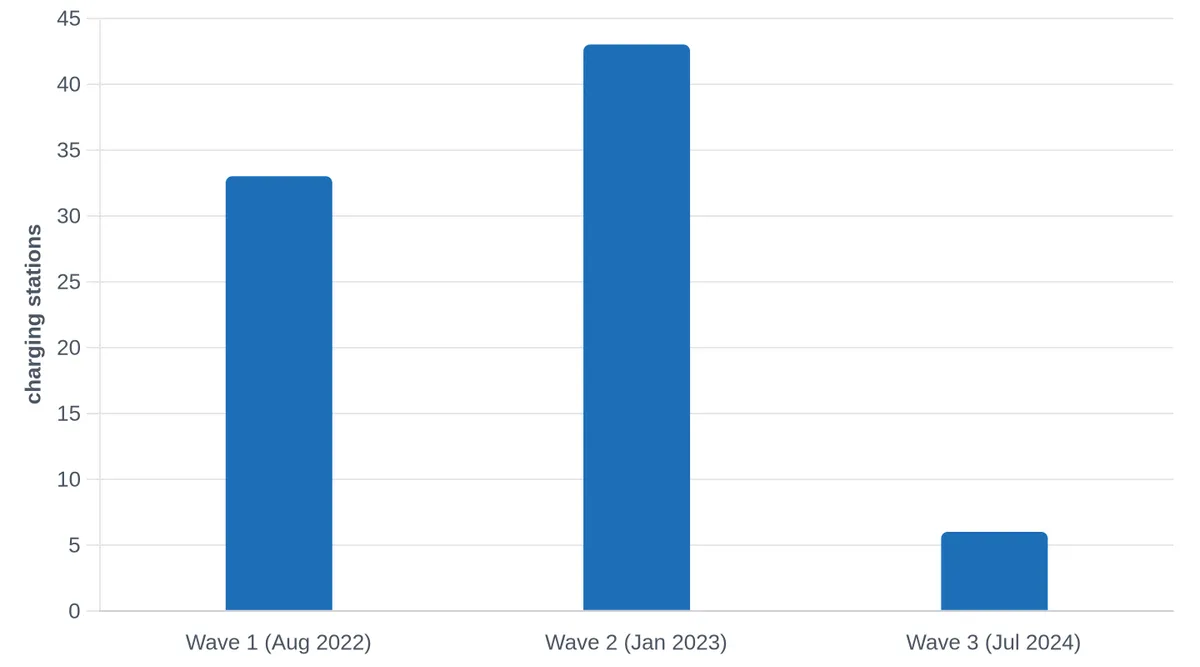
Audi South Africa’s more than R50 million public charging investment (Engineering News / Zero2Turbo) has unfolded in three distinct phases, each adding meaningfully to what was there before.
Wave 1 (August 2022), with GridCars: 33 installations totalling 70 charge-point connectors, including four 150 kW DC ultra-fast units at key highway fuel stops. Named locations for the 150 kW chargers: N1 Colesberg Caltex (Northern Cape), N2 Mossel Bay Langeberg Mall (Western Cape), N3 Tugela North Engen (KwaZulu-Natal), and N4 Riverside Mall Mbombela (Mpumalanga). The 80 kW DC chargers filled in secondary corridor gaps at Richmond, Plettenberg Bay, Tugela South, Alzu Petroport and Kranskop. Twenty-four 22 kW AC chargers completed the network (Audi Centre Claremont / Audi SA official).
Wave 2 (January 2023), with Rubicon: 43 additional stations across six provinces. Notably, this wave included South Africa’s first 200 kW DC ultra-fast charger, installed at Mall of Africa in Midrand, powered via one of the largest rooftop solar PV systems in the Southern hemisphere (Engineering News). The provincial breakdown: Gauteng 15, Western Cape 11, Eastern Cape 10, KwaZulu-Natal 4, Mpumalanga 2, Free State 1 (Engineering News). Together, Waves 1 and 2 delivered 127 DC and AC connectors.
Wave 3 (July 2024): Six new Wallbox Supernova 150 kW DC ultra-fast chargers at six locations on major national routes, each with two concurrent charging ports: N1 at Fleurdal Mall (Bloemfontein), N1 at Century City (Cape Town), N1 at Tygervalley Shopping Centre (Cape Town), N2 at Galleria Mall (Amanzimtoti), N2 at Somerset Mall (Somerset West), and N3 at The Avenues Centre (Hilton) (Engineering News).
All of these chargers are open to every EV driver regardless of brand (Audi SA official). You do not need an Audi to use them. The ChargePocket app and GridCars live map cover all stations, and Audi directs its own e-tron customers to the ChargePocket app for location and status information.
Payment works via RFID card, the GridCars mobile app (Android and iOS), credit or debit card via NFC at newer units, or roaming via Hubject interoperability (GridCars South Africa). The practical reality of this, however, is not always smooth:
“GridCars RFID card is essential if you travel the N1 corridor regularly. The app sometimes has signal issues in the Karoo, so having the physical card as a backup has saved me twice.”
“The lack of a universal tap-to-pay card option at most SA chargers is still the biggest frustration. In Europe you just tap your Visa and go, here you need three different apps.”
The South African public network in 2026: where things stand
Audi’s infrastructure is part of a broader national picture. By early 2026, South Africa had approximately 445 public charging sites, 650 individual chargers and more than 1,200 connectors nationally (ChargePoint SA). That represents remarkable growth from around 143 public stations in 2020, with approximately 50% annual growth sustained over five years. The EV-to-charger ratio sits at roughly 1:7, better than the global 1:10 benchmark.
GridCars, headquartered in Roodepoort and founded in 2009, operates approximately 60% of South Africa’s total public charge points, covering approximately 445 sites and 650-plus chargers as of late 2025 (ChargePoint SA). Rubicon has 110 publicly available stations nationwide, with around 80 owned and operated directly, and approximately 50% supporting DC fast charging (DriveElectric / TechCentral). Together, the two networks handle just under 5,000 charge sessions per month nationally (DriveElectric / TechCentral), a low number that reflects the current size of the EV market rather than any shortage of charger availability.
The N1 Johannesburg to Cape Town corridor now has major DC fast-charger stops at Huguenot Toll, Touws River, Three Sisters, Richmond, Hanover, Colesberg, Trompsburg and Springfontein (Plugshare SA route map / GridCars corridor map). But gaps remain. The roughly 300 km stretch between Beaufort West and Three Sisters on the N1 is the most discussed problem on owner forums. The N2 between East London and Durban is sparse. The Free State interior and Limpopo outside Polokwane have limited coverage (ChargePoint SA).
There is also a regulatory quirk worth noting: Rubicon has publicly stated that Pretoria’s Basic Charge policy makes public charger installations financially unviable in the city (EV24 Africa), which explains why one of South Africa’s largest metros is conspicuously under-served. That is a municipal policy issue, not a technology one.
Install the right home charger for your Audi e-tron
What ultra-rapid charging actually costs at the pump
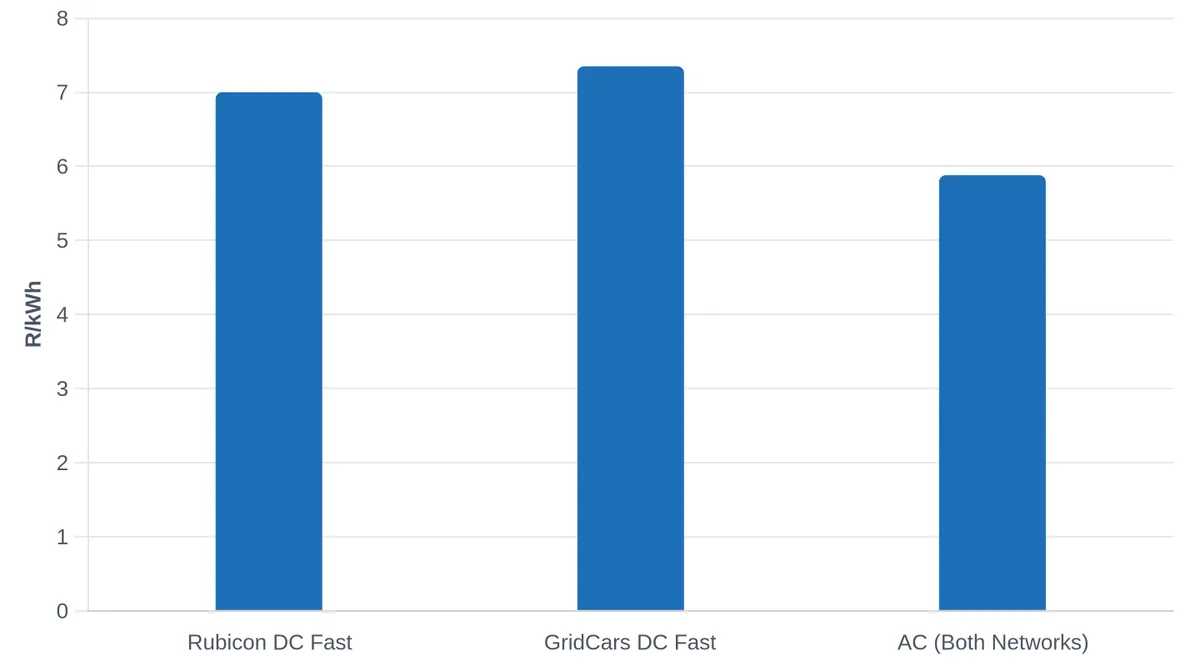
Speed has a price. The August 2025 published tariffs from Rubicon and GridCars (note: these were the most recently published rates; GridCars applied approximately a 15% increase from 1 December 2025, so 2026 rates are higher) put public DC fast charging at R7.00/kWh for Rubicon eMSP customers and R7.35/kWh for GridCars eMSP customers (Rubicon official blog). AC public charging on both networks was R5.88/kWh. At the same AIDC-EC stations, Rubicon customers paid R7.00/kWh while GridCars customers paid R8.24/kWh for the same charger, a reminder that the eMSP you register with matters (Rubicon official blog). OEM-branded premium stations can go higher still: the BMW Menlyn site in Gauteng has been observed at R11.76/kWh (ChargePoint SA).
South Africa currently uses only flat-rate tariffs at public stations. No time-of-use or dynamic pricing is applied at public charging points (Crown Electrical News / Rubicon), which means there is no off-peak discount to take advantage of at a public charger the way there is at home.
Home electricity costs vary meaningfully by municipality and tariff type:
| Source | Rate (2025) | Notes |
|---|---|---|
| Eskom residential average (DriveElectric) | R3.34-R4.21/kWh | Household consuming ~656 kWh/month |
| Johannesburg City Power flat rate (ChargePoint SA) | ~R3.80/kWh | Flat rate residential |
| Durban eThekwini flat rate (ChargePoint SA) | ~R3.20/kWh | Lowest of the three major metros |
| Eskom Homeflex off-peak overnight (ChargePoint SA) | R1.45-R2.25/kWh | Typically 22:00-06:00 window |
| City of Cape Town Home Power Plus off-peak (ChargePoint SA) | ~R2.10/kWh | Optional TOU tariff |
| Johannesburg / Cape Town residential off-peak (ChargePoint SA, 2026) | R1.75-R1.89/kWh | Off-peak overnight rates |
The real-money comparison is stark. For a full charge on an Audi e-tron 55 with its 95 kWh battery (ProCompare): home charging at roughly R3.50/kWh costs around R315-R332; GridCars DC fast charging at R7.35/kWh costs around R698; Rubicon DC fast charging at R7.00/kWh costs around R665. Public DC charging costs more than double what home charging costs for the same energy. Scaled to 20,000 km per year at an average consumption of 20 kWh/100 km, that premium compounds into thousands of rands annually (ProCompare).
“Home charging is a no-brainer at around R60 per 100 km. The moment you’re hitting public fast chargers at R7/kWh you’re paying more than a modern turbodiesel per kilometre, the savings evaporate on road trips.”
For context: petrol at 9 L/100 km at R23.36/L costs around R42,000 per year for 20,000 km. Home charging at R2.50-R3.50/kWh for the same distance costs R7,500-R10,500 per year, a saving of R31,500-R34,500 annually (ChargePoint SA). That saving largely holds even after accounting for occasional public fast charging on long trips. But an EV owner who relies primarily or solely on public DC charging loses most of that advantage (ProCompare).
The Charge Forward subscription is worth a quick look for road users. At R199/month, it unlocks a discounted R5.99/kWh rate versus the pay-as-you-go R7.50/kWh (Charge Forward SA). As one community member puts it:
“R199/month for Charge Forward subscription only makes sense if you’re doing at least 3-4 fast charges a month. Otherwise pay-as-you-go is cheaper unless you’re a road warrior.”
Battery health: what frequent fast charging does to your e-tron pack
DC fast charging stresses the battery more than AC Level 2 charging at home. Occasional fast charging is acceptable and within the design parameters of every Audi e-tron battery. Making it your primary charging strategy, however, accelerates wear (Recharged.com). Under a home-dominant charging regime, most well-maintained Audi e-tron packs track around 1-2% capacity loss per year in normal use (Recharged.com). The e-tron 55 carries an 8-year/160,000 km battery warranty in South Africa (Hippo.co.za / Audi SA).
There is also an efficiency consideration: with AC home charging, charging losses are less than 7%. With DC fast charging, additional energy is drawn to cool the battery during the rapid energy transfer, meaning not all dispensed energy enters the pack and the effective cost per kilometre is slightly higher than the per-kWh tariff alone suggests (AudiWorld Forums).
The home charger question: what to install for an Audi e-tron
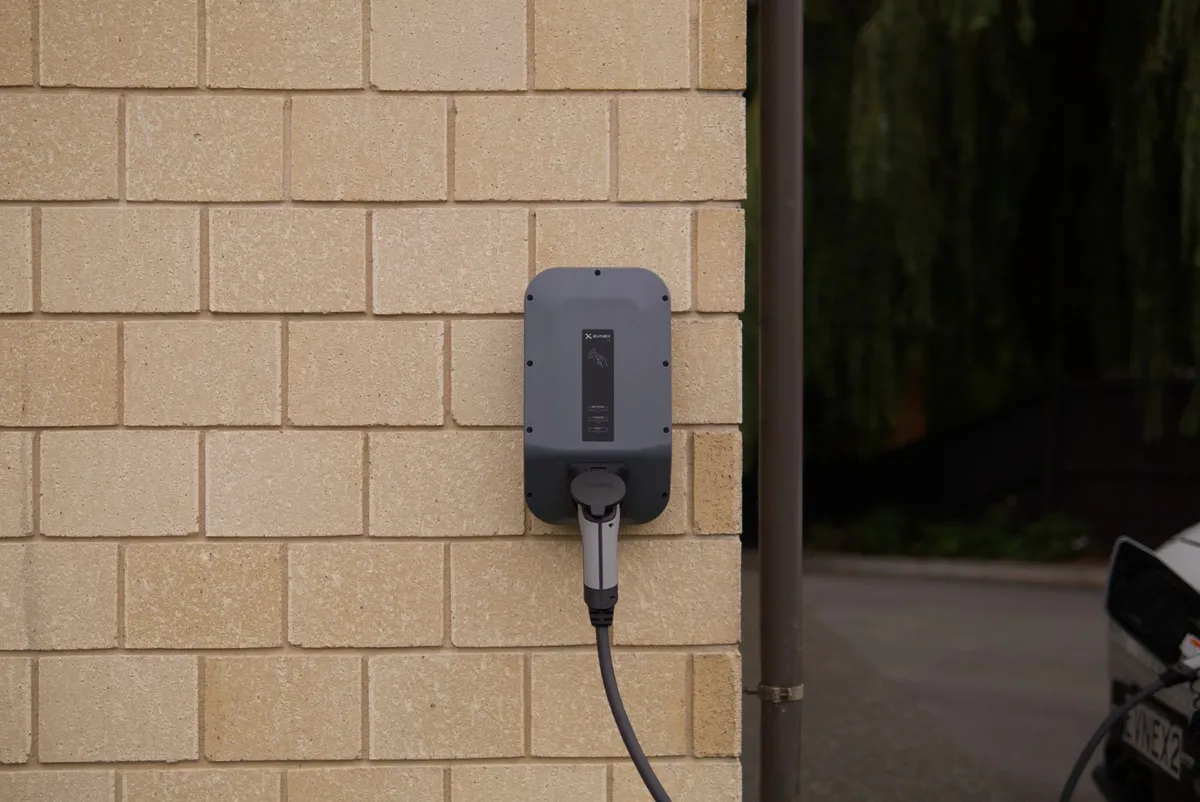
Audi SA’s own data confirms that over 80% of electric charging takes place at home (Audi SA official). The average South African drives no more than 30 km per day during the working week (Hippo.co.za), meaning a full overnight charge is rarely necessary. Even an 8-hour charge on a 32-amp supply adds approximately 256 km of range to the e-tron 55 (Audi SA FAQ), which is more than eight days of average commuting. This is the mathematical case for not chasing speed at home.
That said, if your home has three-phase supply, the 22 kW option changes the calculus considerably, particularly for the e-tron GT with its optional 22 kW onboard charger (Zapmap). For the Q4 e-tron, the standard 11 kW onboard charger means a 22 kW charger at home delivers no additional speed over an 11 kW unit, you charge at the car’s ceiling, not the charger’s output (Blink Charging).
“I am getting 7.5 kw [I have a 40 amp breaker]”
That owner’s experience illustrates the 80% rule neatly: a 40-amp breaker provides 32 usable amps continuously (80% of rated capacity), which at 240V gives around 7.7 kW, close to the 7.5 kW reported. As another forum contributor noted:
“With a 40 amp breaker, the load will adjust so it doesn’t overheat. You can only use 80% of that 40 amp breaker.”
For most South African Audi e-tron owners, the ChargePoint SA Caro Pro (CP-AC22) makes practical sense as a home or estate wallbox. It delivers up to 22 kW three-phase with a tethered 7 m Type 2 cable, IP65 weatherproofing, dynamic load balancing (so it does not trip your DB board), OCPP connectivity, and optional PV solar integration that lets you charge on your own rooftop generation. Indicative unit pricing starts from around R13,900, with installation quoted per site since cable run length, DB board configuration and civils vary considerably. For single-phase homes or those after a simpler entry-level option, the Caro Plus (CP-AC7) at from around R8,900 (indicative, installation extra) handles 7 kW single-phase with the same OCPP, Wi-Fi and solar-charging capability in an IP65 enclosure.
Installed costs across the industry range from R14,000-R26,000 all-in for a 7 kW single-phase unit, and R24,000-R40,000 all-in for 22 kW three-phase (ChargePoint SA home charger guide). Single-phase e-tron installs via ChargePoint SA typically land at R13,000-R15,000 including Certificate of Compliance; three-phase installs run R18,000-R40,000 depending on the property (ChargePoint SA). Always get installation costs quoted per site, they vary with every DB board.
Cost of ownership: a direct comparison
| Scenario | Rate | Cost per 100 km (20 kWh/100 km) | Annual cost (20,000 km) |
|---|---|---|---|
| Home charging, Eskom Homeflex off-peak overnight | R1.45-R2.25/kWh | R29-R45 | R5,800-R9,000 |
| Home charging, Durban eThekwini flat rate | ~R3.20/kWh | ~R64 | ~R12,800 |
| Home charging, Joburg City Power flat rate | ~R3.80/kWh | ~R76 | ~R15,200 |
| Public AC charging (GridCars / Rubicon, Aug 2025) | R5.88/kWh | ~R118 | ~R23,500 |
| Public DC fast charging, Rubicon eMSP (Aug 2025) | R7.00/kWh | ~R140 | ~R28,000 |
| Public DC fast charging, GridCars eMSP (Aug 2025) | R7.35/kWh | ~R147 | ~R29,400 |
| Premium OEM-branded DC station (e.g. BMW Menlyn) | R11.76/kWh | ~R235 | ~R47,100 |
| Petrol, 9 L/100 km at R23.36/L (ICE benchmark) | R23.36/L | ~R210 | ~R42,000 |
Note: the August 2025 public DC tariffs of R7.00 and R7.35/kWh were superseded by approximately a 15% GridCars network increase from 1 December 2025. Current 2026 rates at public DC stations are likely higher than these figures. Always check the relevant network app before a long trip.
The table makes the ownership case plainly: home charging off-peak produces the lowest running cost of any scenario. Public DC fast charging erases roughly half of the cost advantage over petrol. Relying primarily on public fast charging at premium OEM-branded stations costs more per kilometre than petrol (ChargePoint SA analysis).
What about network reliability and the gap years ahead?
South Africa’s load-shedding situation has improved substantially. A milestone of 300 consecutive load-shedding-free days was reached at midnight on 12 March 2026 (ChargePoint SA), and Eskom reported a 98.9% energy supply rate for FY2025/26, compared to 6,837 total load-shedding hours in 2023 (ChargePoint SA / Eskom Winter Outlook 2026). For EV charging, this means overnight charging is now reliably available for most South Africans without the backup planning that dominated discussions two years ago.
The network is also growing. Eskom plans to roll out 55 public EV charging stations over the next two years from September 2025 (Eskom official), and BYD has stated plans for 200-300 flash charging stations (up to 1,000 kW) by end of 2026 (ChargePoint SA). The NERSA tariff increases of 8.76% from April 2026 and 8.83% from April 2027 (NERSA) will nudge home electricity costs upward, but the gap between home and public charging remains large enough to keep the home-first charging strategy financially compelling for most owners.
South Africa also has over 250,000 residential solar installations (ChargePoint SA), and if your home is among them, your effective home charging rate could be close to zero during daylight hours. A charger with PV solar integration, like the Caro Pro (CP-AC22), lets you route surplus generation directly into the car.
Practical guidance for Audi e-tron owners
Here is how to think about ultra-rapid public charging in the context of South African ownership:
- For daily use: Home charging is the right strategy. The average South African drives under 30 km per day (Hippo.co.za). An overnight charge recovers that in under an hour even on a standard 7 kW wallbox.
- For long-distance trips: The Audi public network fills in the major national corridors adequately today, with genuine ultra-rapid speeds at key stops. Allow 30-40 minutes at a 150 kW DC charger for the e-tron 55 (accounting for real-world ramp-up time), and around 20-25 minutes for the e-tron GT at a compatible high-power station.
- For cost management: Register an RFID card with either GridCars or Rubicon before your first long trip. Carry the physical card on N1 and N2 routes where app signal is not guaranteed. Check tariffs in the relevant app before initiating a session, rates vary by network and by station even on the same network (Rubicon blog).
- For battery longevity: Reserve DC fast charging for road trips and top-ups. Home Level 2 AC charging is gentler on the pack, produces less than 7% charging losses (AudiWorld Forums), and costs less than half the rate of a public DC session.
- On Audi’s tariff transparency: Note that Audi South Africa’s own website publishes no per-kWh tariffs for its public charging network. Its FAQ states: “For further information please contact your preferred Audi e-tron Dealer” (Audi SA official FAQ). For actual session costs, the GridCars app or Rubicon app is the authoritative source before you plug in.
To work out exactly what your charging setup will cost based on your municipality, tariff type, daily driving distance and battery size, calculate your home charging cost using ChargePoint SA’s free calculator.
Compare your Audi e-tron home vs public charging costs
Public DC fast charging costs R7.00–R7.35/kWh; home charging R3.00–R4.00/kWh.
Calculate your real costs →WhatsApp us
CoC-certified installers, nationwide
Image: Audi