Key points
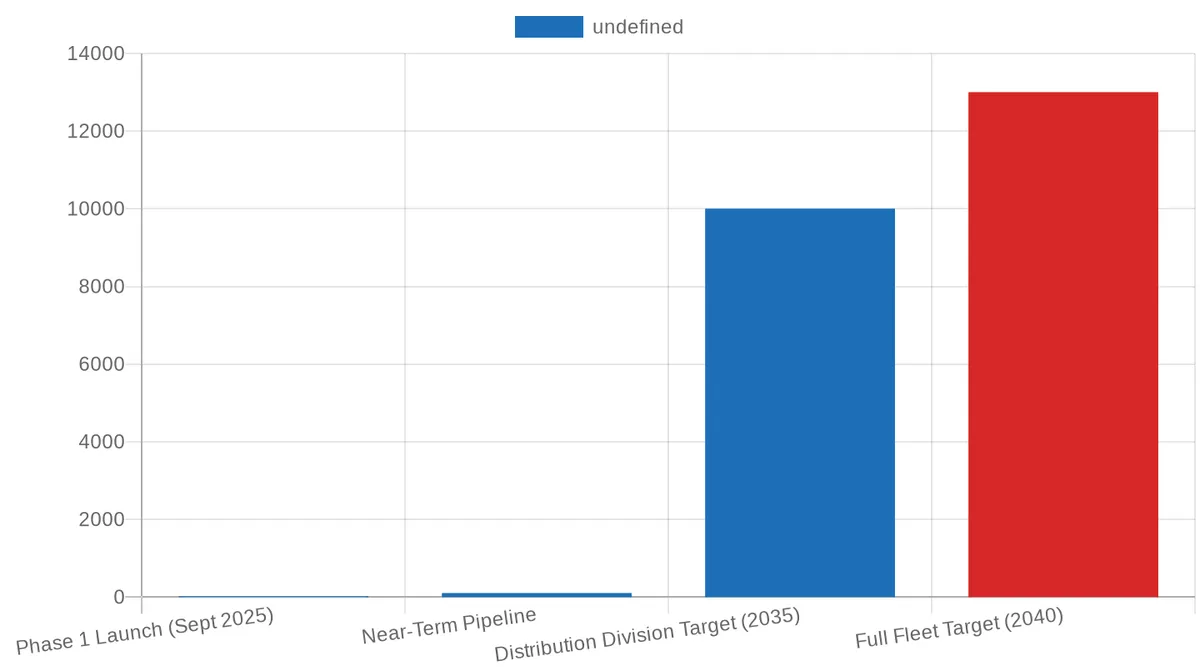
- Eskom’s Distribution Division operates approximately 10,000 of a total fleet of approximately 13,000 vehicles, with a target to fully electrify the Distribution fleet by 2035 and the broader fleet by 2040 (Eskom official press release).
- The formal pilot launched on 9 September 2025 with 20 light delivery vehicles and light trucks deployed across the Distribution and Generation Divisions.
- Ten charging stations are already installed at five Eskom sites, Midrand (EAL), Brackenfell, Mkondeni, Tlhabane (Rustenburg), and Marathon (Mbombela), each receiving one 60 kW DC fast charger and one 22 kW dual AC charger, installed in partnership with GridCars.
- Before the fleet even launched, the pilot chargers had delivered nearly 3,500 kWh to employees and visitors; 100 additional EVs are planned in the near future and Eskom has committed to rolling out 55 public charging stations within two years of September 2025.
On 22 August 2024, Eskom quietly changed the conversation about electric vehicles in South Africa. At the Eskom Academy of Learning (EAL) in Midrand, Gauteng, the utility launched its pilot EV charging infrastructure in partnership with GridCars, ten stations at five sites, two hardware types, and a clear signal that the country’s largest electricity provider intends to lead from the front. Thirteen months later, on 9 September 2025, the first 20 electric vehicles entered service across the Distribution and Generation Divisions. The scale of what follows will be unlike anything the local EV market has seen before.
Understanding what Eskom is building, and why the hardware and software choices it is making now will echo through thousands of future fleet and workplace installations, is essential reading for every fleet manager, facilities director, and charging infrastructure planner in South Africa.
The scale of the opportunity, and the obligation
The numbers are not abstract. Eskom’s Distribution Division alone operates approximately 10,000 vehicles out of a total fleet of approximately 13,000. The updated target, confirmed in September 2025, is full electrification of the Distribution Division fleet by 2035, with the broader fleet target set for 2040, a goal first articulated by Monde Bala, Eskom Group Executive for Distribution, as early as February 2023.
To grasp the market impact: the entire South African BEV market sold just over 1,000 units in 2024, the first year the national figure breached that threshold (CleanTechnica / NAAMSA). If Eskom replaced just 10% of its approximately 13,000-vehicle fleet in a single year, that single procurement would exceed the entire annual national BEV sales volume. Fleet electrification at this scale is not an incremental shift, it is a structural transformation of the local EV ecosystem.
“Eskom is driving South Africa’s shift to a cleaner, low-carbon future. Through e-mobility, we are cutting emissions, boosting innovation, and showing how sustainable energy solutions can create real benefits for communities and the economy. We see ourselves as more than just an electricity provider, we are enablers of progress.”
Eskom’s engagement with e-mobility stakeholders has been under way since 2021, drawing in government, automotive manufacturers, petroleum companies, and research institutions. In May 2024, a formal partnership workshop was held with the Danish Energy Agency to prepare South Africa’s grid and regulatory framework for greater EV uptake. In August 2024, a Memorandum of Co-operation with Golden Arrow Bus Services set out plans for EV charging infrastructure development in Cape Town. And in September 2025, a partnership with BYD linked Eskom’s fleet roll-out directly to the mass-market arrival of the Dolphin Surf and the development of future renewable-powered ultra-fast charging hubs. The groundwork has been laid with unusual thoroughness for a South African infrastructure programme.
What the pilot infrastructure actually looks like
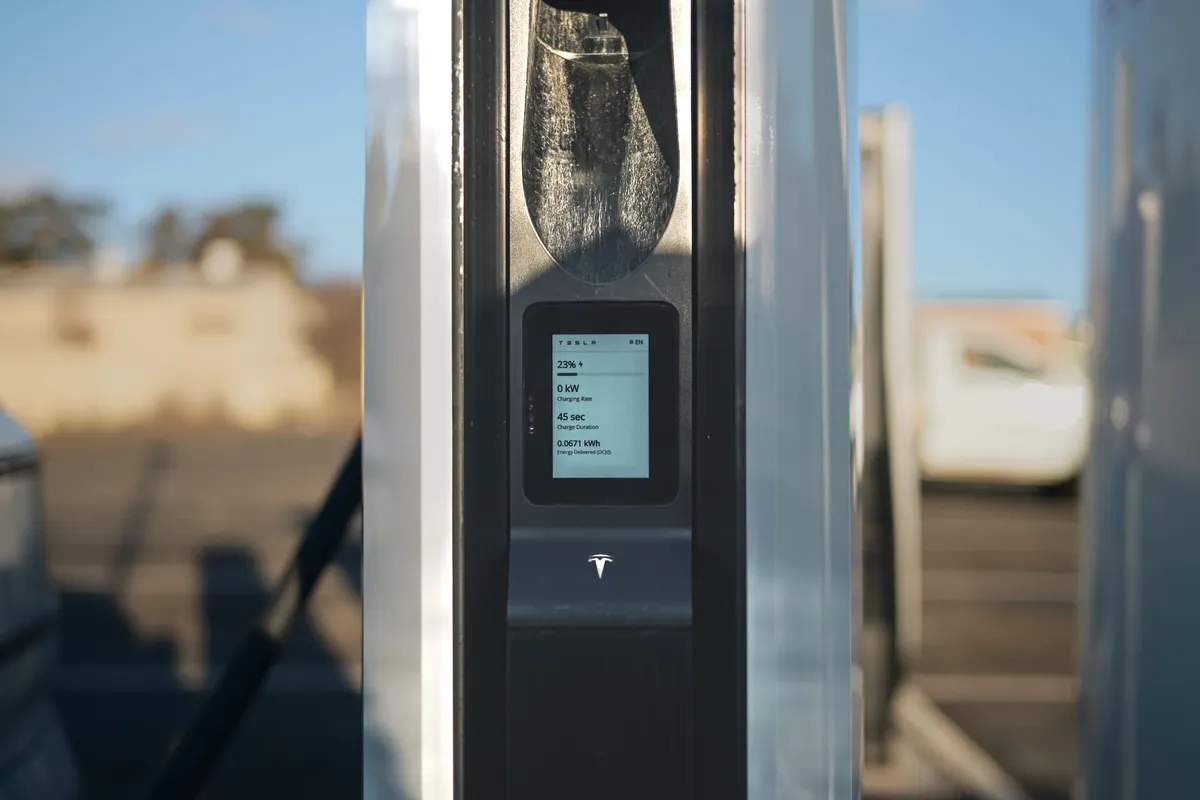
The hardware choices Eskom made for its pilot are not arbitrary. Each of the five sites, Midrand (EAL), Brackenfell (Cape Town), Mkondeni (Pietermaritzburg), Tlhabane CNC (Rustenburg), and Marathon CNC (Mbombela), received two charger types performing two distinct duties (Eskom official press release, August 2024):
- 22 kW dual AC chargers: assigned to overnight depot charging of fleet vehicles.
- 60 kW DC fast chargers: assigned to daytime workplace charging for employees and visitors.
This split-duty model is deliberate and instructive. Overnight AC charging at 22 kW is cost-efficient: a fleet vehicle parked from 18:00 to 06:00 has twelve hours to absorb a full charge at off-peak tariff rates. Under the Eskom Homeflex time-of-use tariff, the overnight window from 21:00 to 05:00 sits entirely within the off-peak band, peak rates only apply 06:00-08:00 and 17:00-20:00. Fleet managers scheduling depot charging in this window avoid peak demand charges entirely.
The 60 kW DC fast chargers serve a different purpose: they reduce dwell time for vehicles that need a rapid top-up during the working day, and they serve employees and visitors who arrive with partially depleted batteries. The fact that these chargers had delivered nearly 3,500 kWh before the fleet vehicles even formally deployed confirms that the employee and visitor use case alone justifies the investment in fast charging at a site of this size.
For fleet operators benchmarking against Eskom’s approach, the split model is worth replicating: AC overnight charging covers 80-90% of duty cycles at lower cost per kWh; DC fast charging covers operational exceptions and serves the broader site population.
Tender architecture: what Eskom’s procurement tells the market
Beyond the pilot, Eskom’s Generation Division issued open tender MWP2991GX on 20 January 2025, calling for the supply, delivery, installation, commissioning, and maintenance of EV charging stations at various power stations. Site clarification meetings were held at five power stations in late January 2025: Sere Wind Farm (Vredendal), Koeberg, Lethabo, Matimba, and Komati. The tender included a key technical document, the 474-13553 Generation Electric Vehicle Project Charging Infrastructure Technical Specification (Rev 1), a 3.3 MB PDF that sets out the technical requirements for compliant hardware.
The internal clauses of that specification (OCPP version, metering standard, payment method requirements) are not publicly indexed. However, the existence of a formal technical specification document at Rev 1 signals that Eskom has moved beyond pilot-phase hardware improvisation into structured, standards-referenced procurement. A separate NEC3 Engineering and Construction Contract was also issued for EV charging stations at Distribution Division sites, confirming that both major divisions are now running parallel infrastructure programmes.
Any supplier or installer wishing to participate in future Eskom tenders should treat the following as baseline requirements, even without access to the full specification:
- OCPP compliance (OCPP 2.0.1, now formalised as IEC 63584 since late 2024, is increasingly the baseline for serious commercial tenders globally).
- Open-standards hardware that is not locked to a proprietary backend.
- Metering capable of supporting time-of-use billing and energy management integration.
- NRCS Letter of Authority for all charger hardware (mandatory for any mains-connected EV charger sold in South Africa, with an approximately 18-week lead time).
- SANS 10142-1 compliant wiring and a Certificate of Compliance on every installation.
The smart charging and grid integration imperative
What distinguishes Eskom’s infrastructure programme from a simple fleet procurement is the grid integration layer. Eskom is testing smart chargers with GridCars that are designed to help balance the national grid, not merely charge vehicles. EV load forecasting has been integrated into Eskom’s long-term grid planning to manage increased electricity demand. Smart charging systems and time-of-use tariffs are being developed to optimise energy use.
This is not a peripheral feature, it is the central justification for using open-protocol chargers rather than proprietary systems. A charger that communicates only via a closed vendor protocol cannot participate in grid balancing, cannot respond to Eskom’s demand-side management signals, and cannot integrate with a CSMS (Charge Point Management System) chosen independently of the hardware vendor. For a fleet of approximately 13,000 vehicles drawing potentially tens of megawatts at peak, the difference between smart-managed and unmanaged charging loads is the difference between a grid benefit and a grid liability.
Eskom has also submitted a residential time-of-use EV charging tariff to NERSA for approval, aimed at incentivising off-peak EV charging. If approved, this tariff structure will create direct financial incentives for fleet operators to schedule charging outside peak windows, making smart charger scheduling capabilities a commercial necessity rather than a technical luxury.
Open standards: why OCPP version matters for fleet and commercial buyers
South Africa has no legislation mandating a specific OCPP version for commercial or public EV chargers, unlike the EU (where AFIR references OCPP in tenders) or the USA (where the NEVI program mandates OCPP 2.0.1 and 97% uptime for all federally funded stations). In South Africa, OCPP adoption is market-driven and voluntary.
That regulatory gap makes protocol selection a procurement risk rather than a compliance box-tick. The critical facts buyers must understand:
- OCPP 1.6 and OCPP 2.0.1 are not backward compatible, they use completely different data structures and device models. A fleet that installs OCPP 1.6 hardware today cannot natively upgrade to 2.0.1 without significant hardware changes.
- OCPP 2.0.1 was approved as IEC international standard IEC 63584 in late 2024. OCPP 2.1, released in January 2025, adds vehicle-to-grid (V2G) support, distributed energy resource (DER) control, and ISO 15118-20 alignment, and is backward compatible with 2.0.1.
- As of September 2025, only 68 charger models worldwide held formal OCA OCPP 2.0 certification. The gap between “OCPP 2.0.1 ready” and “OCPP 2.0.1 certified” is not marketing nuance, it is a real operational distinction.
For fleet and workplace charging buyers, the practical implication is straightforward: specify OCPP 2.0.1 certified hardware (not merely OCPP 2.0.1 compatible) and insist on evidence of OCA certification before signing a supply contract. Hardware locked to a proprietary backend carries quantifiable risk over a ten-year fleet horizon.
OCPI (Open Charge Point Interface) is the complementary roaming protocol that governs backend-to-backend communication between charge point operators (CPOs) and e-mobility service providers (eMSPs). GridCars became the first EV charging network operator on the African continent to integrate OCPI roaming in July 2022. South Africa is listed as an active OCPI-adopting country. For Eskom’s public charging ambitions, 55 public stations within two years of September 2025, OCPI integration will determine whether Eskom’s stations are accessible to drivers on all networks or only to Eskom-specific account holders.
Understand fleet charging, load management & grid integration
Eskom’s hardware partner: GridCars in context
| Parameter | AC Depot Overnight | DC Daytime Fast |
|---|---|---|
| Hardware deployed at Eskom pilot sites | 22 kW dual AC charger | 60 kW DC fast charger |
| Primary use case | Overnight fleet charging (21:00-05:00) | Daytime employees and visitors |
| Approximate charge time (60 kWh battery) | ~3-4 hours at 22 kW | ~45-60 minutes (10%, 80%) |
| Eskom Homeflex off-peak tariff window | 21:00-05:00 (fully off-peak) | Daytime, standard or peak rate applies |
| Indicative energy cost (depot, off-peak) | R1.45-R2.25/kWh (Homeflex off-peak) | Standard/peak Eskom rate applies |
| Public GridCars retail tariff (Aug 2025) | R5.88/kWh (AC public) | R7.35/kWh (DC public, GridCars eMSP) |
| Connector standard | Type 2 (IEC 62196 / SANS 62196-2) | CCS2 (SANS 62196-3) |
| OCPP protocol (GridCars hardware) | IEC 61851-1 / OCPP compliant | OCPP compliant |
| Eskom Megaflex demand charge (FY26/27) | R52.65/kVA/month (high-demand season); R26.29/kVA/month (low-demand season), billed on peak kVA regardless of utilisation | |
| Cost to drive 100 km (EV, depot rate) | ~R37-R60 at R3, R4/kWh vs ~R210 for a 9 L/100 km petrol vehicle | |
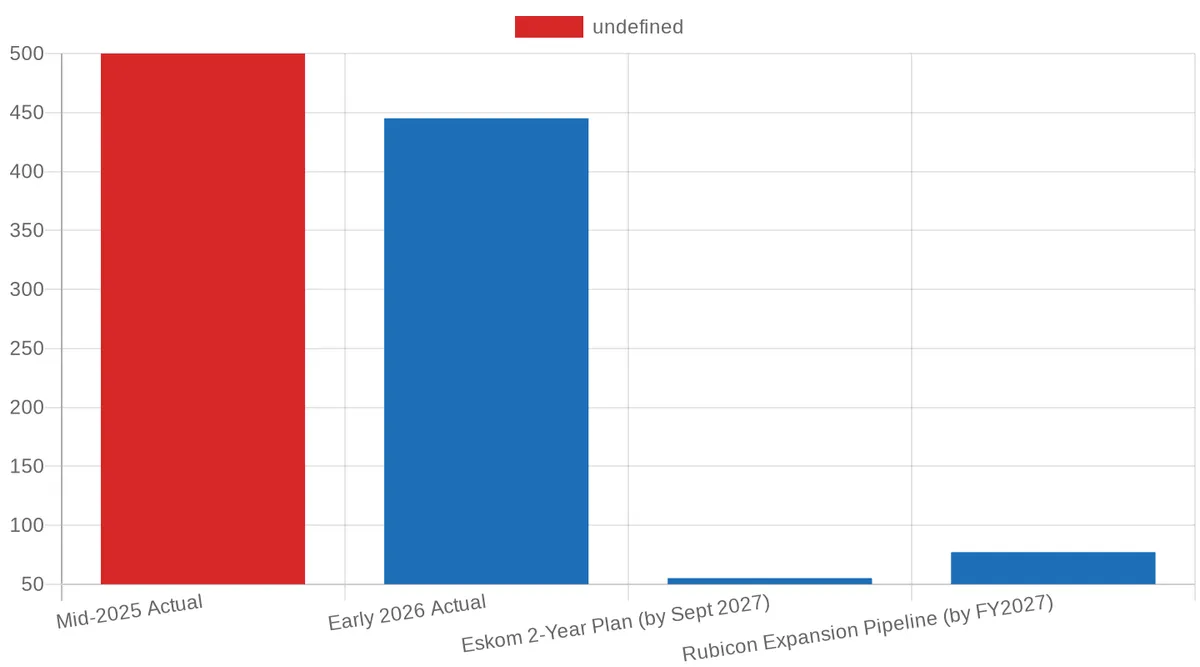
GridCars, headquartered in Roodepoort and founded in 2009, is South Africa’s largest public EV charging network operator, with approximately 445 sites, 650+ chargers, and 1,200+ connectors as of late 2025, roughly 60% of the country’s total public charge points. As Eskom’s charging infrastructure partner, GridCars brings both the network scale and the OCPI roaming capability that Eskom’s public-facing ambitions require.
GridCars’ 22 kW Advanced AC Charger (the hardware type deployed at Eskom’s pilot sites) complies with IEC 61851-1 and OCPP for network integration, features RFID authentication and dynamic load balancing, and carries IP54 weather resistance. These are not entry-level specifications, they reflect the commercial-grade requirements that fleet depot installations demand.
The public charging tariffs as of August 2025 were R7.35 per kWh (DC, GridCars eMSP) and R5.88 per kWh (AC, both Rubicon and GridCars eMSP customers), August 2025 figures that should be verified for current 2026 rates. For fleet depot charging on Eskom’s own tariff rather than GridCars public retail pricing, the cost per kWh will be substantially lower, particularly overnight in the off-peak band.
Cost of ownership comparison: EV fleet depot charging vs petrol
The financial case for fleet electrification is strongest where vehicles have predictable daily routes and return to a depot overnight, precisely the use profile of Eskom’s light delivery vehicles and light trucks. Using verified figures:
- Running cost per 100 km (EV, depot off-peak charging): An EV consuming 15 kWh per 100 km costs approximately R21.75, R33.75 per 100 km at Eskom Homeflex off-peak rates of R1.45-R2.25/kWh. Even at a flat municipal rate of R3.50/kWh, the cost is approximately R52.50 per 100 km.
- Running cost per 100 km (petrol, 9 L/100 km): approximately R210 per 100 km.
- Monthly saving per vehicle at 20,000 km/year (approximately 1,667 km/month): Between approximately R2,600 and R2,950 per vehicle per month on fuel alone, before accounting for lower EV maintenance costs.
- Fleet of 1,200 vehicles (roughly 10% of Eskom’s total): Potential fuel-cost saving of R3.1m, R3.5m per month across the sub-fleet, before any maintenance savings.
Industry data drawn from 12.5 million kilometres of South African commercial EV operation shows a 27% lower total cost of ownership versus diesel, providing hard ROI numbers that underpin the business case for large fleet operators following Eskom’s lead.
The demand charge dimension is the variable fleet planners must model carefully. The Eskom Megaflex tariff charges R52.65/kVA/month in the high-demand season and R26.29/kVA/month in the low-demand season (Eskom 2026/27 tariff schedule), billed on the peak kVA recorded in the billing period whether or not every charger was in use at that moment. A depot with twenty 22 kW AC chargers running simultaneously presents a theoretical peak demand of 440 kW. Smart charging with dynamic load balancing, staggering charge start times and capping simultaneous draw, directly reduces the peak kVA figure and therefore the monthly demand charge bill. This is precisely why the smart charging pilot with GridCars is not a peripheral experiment: it is the mechanism that makes large-scale depot charging economics viable.
Ready to model your own depot’s load profile and payback? Plan your site free with our Commercial Site Builder, enter your fleet size and grid connection and get a tailored hardware scope, cost estimate, and payback projection.
The BYD partnership and what it means for public charging
The Memorandum of Cooperation signed between Eskom and BYD on 16 September 2025 covers the Dolphin Surf launch, expansion of public charging infrastructure, and future discussions on renewable-powered ultra-fast charging hubs and EV battery repurposing for energy storage.
“Future discussions may also consider renewable-powered ultra-fast charging hubs, recycling and repurposing used EV batteries for energy storage and backup systems, and integrating EVs into Eskom’s demand-side management strategies to help balance electricity supply and demand.”
The battery repurposing element is particularly significant for South Africa’s grid context. Used EV battery packs, typically retired at 70-80% of original capacity, retain enough energy storage to serve as stationary grid buffers. If Eskom can repurpose batteries from its own fleet in the early 2030s, those packs could serve as distributed energy storage at the very substations and depots that the vehicles operated from. This closes a loop between fleet electrification and grid resilience that no petrol vehicle could ever participate in.
BYD’s planned 200-300 Flash Charging stations across South Africa by 2026 will add meaningful public charging density on routes that Eskom’s 55 planned public stations cannot cover alone. For a country where Western Cape and Gauteng currently account for 78% of all public charging points, the geographic distribution of both programmes will determine whether South Africa achieves genuine national EV usability or merely metro usability.
What fleet operators and workplace charging installers must prepare for
Eskom’s programme is the largest single fleet electrification signal South Africa has produced. For other state-owned entities, private fleet operators, and facilities managers considering workplace charging, the implications are direct:
1. Depot design: plan for the full fleet load, not the pilot load
Twenty vehicles across five sites is a pilot. A Distribution Division fleet of approximately 10,000 vehicles electrified by 2035 requires approximately 833 vehicles per year entering service, supported by charging infrastructure that scales proportionally. Any depot installation designed now should be assessed for electrical capacity headroom to support three to five times the initial charger count, upgrading a DB board or transformer after the fact is far more expensive than over-specifying at initial build.
2. Specify open-standard hardware with genuine OCPP certification
The instruction from the global market is clear. OCPP 2.0.1 is now IEC 63584. From 2025 onward, commercial EV charging tenders increasingly require OCPP 2.0.1 compliance. Chargers limited to OCPP 1.6 risk exclusion from future tender participation and from backend systems that fleet operators choose independently of their hardware vendor. Verify OCA certification, not merely vendor claims of compatibility.
3. Build billing-grade metering into commercial and public installations from day one
South Africa has no MID metering mandate for EV charger billing equivalent to Europe’s Measuring Instruments Directive. However, Eskom’s own regulatory environment is moving toward transparent, verifiable energy accounting, NERSA’s draft Electricity Trading Rules published November 2025 require AMI-grade metering. Installing billing-grade metering at workplace chargers now avoids a costly retrofit when the regulatory framework catches up with commercial reality.
4. Schedule intelligently to avoid peak demand charges
The Eskom Megaflex demand charge structure means that even a few minutes of simultaneous full-power charging across a large fleet can set a monthly billing peak that persists for 30 days. Smart chargers with dynamic load balancing and time-of-use scheduling are not optional extras for a fleet depot, they are the primary tool for managing the demand charge component of the electricity bill.
“The launch of these vehicles is not only about mobility, it is about reimagining the energy landscape, reducing carbon emissions, and ensuring every community benefits from the transition to sustainable transport.”
5. Ensure full compliance: NRCS LoA, SABS EMC CoC, ICASA type approval, SANS 10142-1, and electrical CoC
Every EV charger connected to the South African mains supply requires an NRCS Letter of Authority (approximately 18-week lead time), a mandatory SABS EMC Certificate of Compliance, and, for networked chargers with Wi-Fi or LTE OCPP connectivity, ICASA type approval. The installation must comply with SANS 10142-1 Annex N and be covered by a Certificate of Compliance under the Electrical Installation Regulations (OHS Act No. 85 of 1993). A non-compliant installation invalidates insurance and exposes the property owner and employer to direct liability. Only a Department of Labour-registered electrical contractor may legally carry out EV charger wiring.
Recommended hardware for fleet depot and workplace charging
For fleet operators and facilities managers building charging infrastructure to the standard Eskom’s programme is establishing, hardware selection should match the use case precisely:
For overnight depot fleet charging (the 22 kW overnight use case): The ChargePoint SA Caro Pro (CP-AC22) is a 22 kW three-phase AC wallbox with a tethered 7 m Type 2 cable, dynamic load balancing, Wi-Fi / Ethernet / 4G / Bluetooth, full OCPP compliance, and PV solar charging integration. Rated IP65 and IK10, it is built for the unattended overnight depot environment. Indicative unit price from approximately R13,900, installation quoted per site based on cable run, DB board capacity, and number of bays.
For billable workplace and visitor charging (where energy billing is required): The ChargePoint SA CP-AC22-N adds Eichrecht-conformant smart metering (1% accuracy, every transaction recorded), MID metering, OCPP 2.0.1J, and ISO 15118 Plug and Charge to the 22 kW AC platform. For sites where employees or visitors are billed per kWh, this is the correct specification. Installation price is quoted per site.
For multi-bay estates or complexes needing two charge points from a single unit: The ChargePoint SA CP-DUO-44 handles two vehicles simultaneously (flexible 2×11 kW / 1×22 kW / 2×22 kW configurations) with dynamic load balancing, OCPP, and optional MID metering from one IP54 / IK10 enclosure.
For daytime fast charging (the 60 kW DC use case, matching Eskom’s pilot specification): The ChargePoint SA CP-DC60 delivers 60-120 kW via dual CCS2 outlets, with a 10.1-inch touchscreen, app / QR / RFID / POS payment, OCPP, and smart-grid integration. Indicative installed price from approximately R430,000 for the 60 kW configuration. For higher-throughput corridor or hub locations, the CP-DC160 delivers 160-300 kW and is quoted per site.
ChargePoint SA’s Commercial EV Charging Programme covers the full scope under one accountable contract: supply, SANS 10142-1 compliant installation, electrical CoC, ECSA-registered installers, OCPP / OCPI open platform, managed billing, RFID / app access control, load balancing, and remote monitoring from approximately R350 per charger per month.
The regulatory horizon: what comes next
South Africa’s regulatory framework is moving, if slowly. NERSA’s draft Electricity Trading Rules, published 24 November 2025 with a public hearing on 27 January 2026, require advanced metering infrastructure capable of automated real-time time-of-use readings, which most municipal systems currently lack.
For EV charging infrastructure, this matters in two ways. First, the metering standard for electricity installations broadly (NRS 057 / SANS 474:2006) will eventually need to address EV charger session-level billing, currently an unregulated gap where operators set tariffs by commercial agreement without a mandated calibration framework. Second, the EV load forecasting integration Eskom has already built into its grid planning means that smart charging signals (demand response, time-of-use pricing) are a near-term operational reality, not a future aspiration.
The DTIC EV White Paper of December 2023 and National Treasury’s 150% tax deduction (Section 12V) for qualifying EV and hydrogen vehicle production investments, effective 1 March 2026 through 1 March 2036, add a manufacturing dimension to the picture. If South Africa is to avoid the 25% import tariff disadvantage that currently makes EVs a premium-market product (versus 18% for ICE vehicles), local or regional assembly is the structural solution. Eskom’s fleet procurement at scale, particularly if BYD follows its Brazil precedent of establishing local assembly after achieving strong import sales, could catalyse exactly this transition.
Eskom’s supply reliability has improved materially: the utility maintained a 98.9% energy supply rate in financial year 2025/26 (Eskom Winter Outlook 2026), compared to near-constant disruption in 2023 when total load-shedding hours reached 6,837 (MDPI Energies, December 2025). The 2027-2030 window carries real risk as coal retirements at Camden, Komati, Hendrina, and Grootvlei proceed, but the worst of the 2022-2023 crisis is structurally behind the current fleet electrification timeline. For fleet operators, the smart charging and backup-power design considerations that dominated the 2023 conversation have not disappeared, they have simply become less immediately acute.
What this means for South Africa’s EV ecosystem
Eskom’s fleet electrification programme is the most significant single signal the South African EV market has received. A state-owned entity with approximately 13,000 vehicles, a 2040 full-electrification target, an active smart-charging pilot, a formal BYD partnership, 55 public charging stations planned for the next two years, and procurement tenders already issued across both Distribution and Generation Divisions is not performing a compliance exercise. It is executing a serious infrastructure programme with the potential to reshape the economics of EV charging in this country.
For every fleet manager benchmarking their own programme, every workplace facilities director weighing up whether to install charging bays, and every charging infrastructure company deciding which standards to build to: the standard that Eskom is setting, open protocols, split AC/DC duty cycles, smart grid integration, and bilateral partnerships with the largest EV manufacturer in the world, is the standard worth meeting.
South Africa’s public EV charging network reached an EV-to-charger ratio of approximately 1:7 by mid-2025, better than the global 1:10 benchmark, with over 500 public stations operational and Eskom adding 55 more on its own account. The infrastructure trajectory is positive. The question for commercial operators is not whether to build, but whether to build to a standard that will still be compliant, interoperable, and commercially viable when Eskom’s 1,000th fleet EV enters service.
If you are a fleet operator, estate manager, or commercial property owner ready to plan your EV charging infrastructure, plan your site free with our Commercial Site Builder, get a tailored hardware and installation scope matched to your load profile, budget, and grid connection.
Plan depot charging for your fleet electrification
The Commercial Site Builder is free, with no obligation to proceed.
Plan my fleet charging →WhatsApp us
CoC-certified installers, nationwide