
Key points
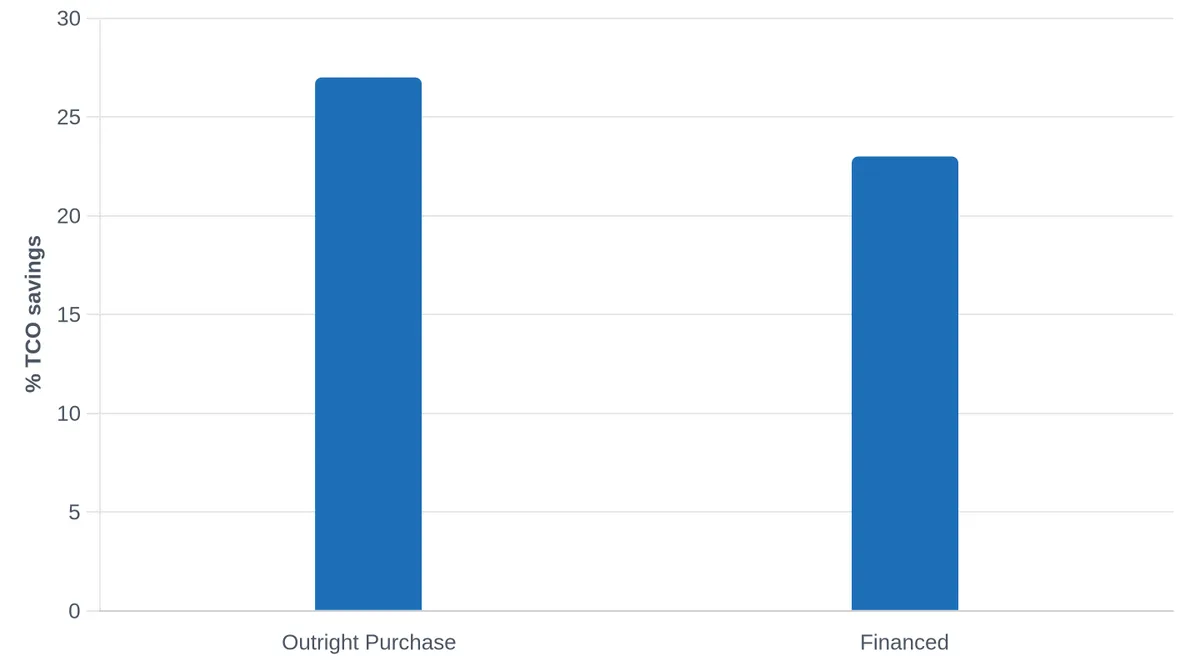
- Everlectric’s 12.5 million kilometres of real South African commercial fleet data shows 27% lower TCO for outright-purchased EVs and 23% lower when financed versus diesel equivalents.
- The break-even mileage threshold is approximately 3,200 km per month for one-ton EVs and 2,500 km per month for four-ton and eight-ton vehicles, depot charging at R4.50/kWh is the critical enabler.
- Last-mile delivery fleets (100-220 km per day, depot charging) can expect a 2-3 year payback; corporate transport 3-4 years; short-haul logistics 3-5 years.
- Depot charging at R4.50/kWh versus public DC fast charging at R7.00-7.35/kWh (August 2025 rates, since increased approximately 15% from December 2025) creates a 40% cost swing that determines individual payback.
- WattSpot’s dedicated fleet network recorded 18,884 sessions across three Gauteng sites between December 2025 and February 2026, with above 98.5% uptime, a benchmark the public network does not yet match for commercial operations.
- The government’s 150% tax deduction on EV and hydrogen production investment applies from March 2026, but there is no direct consumer purchase rebate.
- Urban delivery routes, predictable duty cycles, and high daily mileage are the strongest immediate use cases. Long-haul, variable-range, and rural operations remain genuinely challenging today.
South Africa’s fleet electrification conversation has shifted decisively from ESG aspiration to balance-sheet arithmetic. Diesel sat at R27.50 per litre in July 2026 (GlobalPetrolPrices.com), and had spiked as high as R32 per litre in the weeks before that, rattling transport margins across the country. Meanwhile, commercial operators who moved early are now sitting on verified, multi-year data showing that under the right conditions, electric vehicles cost meaningfully less to run than their diesel equivalents.
This article does not argue that every fleet should electrify now. It presents the actual numbers, the real constraints, and the operator experiences that determine whether an EV transition makes financial sense for your specific operation, with specific figures, not vague claims about “substantial savings.”
The TCO evidence base: 12.5 million kilometres of South African data
The most rigorous public dataset available for South African commercial EV fleet economics comes from Everlectric, which has operated light commercial and delivery EVs across clients including urban delivery and corporate transport operations. Across 12.5 million kilometres of real-world operation, the numbers show 27% lower total cost of ownership for EVs purchased outright and 23% lower when financed, compared to equivalent diesel vehicles (Everlectric / CleanTechnica).
“Commercial fleets have done the math, and they have seen that running an electric vehicle at certain kilometres is more efficient than running an internal combustion engine.”
That 27% figure is not a projection or a model output. It comes from actual invoices, fuel cards, service records, and insurance claims across a fleet of real vehicles on South African roads, under South African load-shedding conditions, with South African fuel prices and electricity tariffs. The operational availability figure from the same dataset is 100%, meaning correctly structured depot-charged EV fleets experienced no greater downtime than the diesel vehicles they replaced.
The Woolworths online delivery programme, operated through DSV and Everlectric with 41 electric delivery vans, provides the most publicly documented example. Each vehicle covers 150-220 km per day (DSV official announcement), well within the 300 km range per charge available to the fleet. The programme has saved over 400,000 kg of tailpipe emissions annually (Woolworths Holdings Limited).
“Woolworths along with DSV and Everlectric have proven the viability of the solution through the proof of concept that we have run over the last two years on South African roads, under South African conditions. We are excited to now scale these learnings in our commercial solution that not only decarbonises our clients’ fleets, but is operationally excellent and cost efficient.”
“Last year we announced our commitment to electric delivery vehicles, and we are delighted to now have nearly half our fleet powered by the sun. On an annual basis these 41 vehicles will have the potential to save over 400,000 kgs of tailpipe carbon emissions.”
The energy cost equation: what the rands actually look like
The core EV cost advantage is energy: charging at a depot or dedicated fleet facility costs approximately R4.50 per kWh (Cartrack ZA). At that tariff, a typical light commercial EV costs around R60 per 100 km in energy. A diesel equivalent consuming 9 litres per 100 km at the current R27.50 per litre (GlobalPetrolPrices.com) costs R247.50 per 100 km. That is a R187.50 per 100 km energy cost advantage in favour of the EV.
For a vehicle covering 4,000 km per month, that translates to approximately R7,500 per month in energy savings alone, before accounting for lower servicing costs and extended service intervals.
The break-even mileage threshold, the point at which an EV’s lower running costs overcome its higher purchase price, has been calculated from real South African fleet data as follows (CleanTechnica):
- One-ton EV: 3,200 km per month
- Four-ton EV: 2,500 km per month
- Eight-ton EV: 2,500 km per month
For last-mile delivery vehicles covering 150-220 km per day, that threshold is typically cleared within the first few weeks of a working month.
“The business case for electric delivery vans becomes undeniable for fleets traveling more than 3,500 km per month. At this level of utilization, the compound savings on energy costs per kilometre, especially when charging is optimized during off-peak periods, allow operators to recover the higher initial purchase price of an EV much faster.”
A note on public network tariffs: the R7.00/kWh (Rubicon eMSP) and R7.35/kWh (GridCars eMSP) figures cited widely in SA EV discussions are August 2025 rates. GridCars implemented approximately a 15% increase from 1 December 2025. Fleets relying on public DC fast charging rather than depot charging will see their energy cost advantage erode significantly. The depot charging model is not optional if you want the 27% TCO advantage, it is the mechanism that produces it.
Fleet cost breakdown: what changes and what does not
| Cost category | Diesel vehicle | Electric vehicle | Notes |
|---|---|---|---|
| Energy per 100 km (depot/home) | R247.50 (9 L/100km, R27.50/L) | R60 (approx. R4.50/kWh depot) | ChargePoint SA; GlobalPetrolPrices.com |
| Annual maintenance | R18,000-R30,000 | R9,000-R18,000 (40-50% lower) | AA Vehicle Ownership Index 2024; 7Gen |
| Service interval | Every 15,000 km | Every 30,000 km or 2 years | AutoTrader ZA |
| Insurance premium | Baseline | Typically 10-15% higher; some insurers offer 5-10% green discounts | ChargePoint SA |
| Depot charger installation | N/A | R25,000-R45,000 per point (complete setup incl. CoC) | Cartrack ZA |
| DC fast charger (if required) | N/A | From R430,000 (60 kW, all-in, indicative) | ChargePoint SA |
| 3-year running cost saving (BYD Atto 3 vs diesel equivalent) | Baseline | R140,000-R171,000 over 3 years | ChargePoint SA |
| Monthly operating cost saving | Baseline | R3,900-R4,765 per vehicle per month | ChargePoint SA |
| Payback: last-mile delivery (150-220 km/day) | N/A | 2-3 years | Everlectric |
| Payback: corporate transport (high utilisation) | N/A | 3-4 years | Everlectric / industry consensus |
| Payback: short-haul logistics (100-150 km/day) | N/A | 3-5 years (varies with tariff) | Everlectric / industry data |
Diesel price volatility: the risk argument that is changing minds
The financial case for fleet electrification has historically been presented as a fuel cost saving. The more compelling argument emerging in 2026 is a risk management argument. Diesel at R27.50 per litre in July 2026 had already peaked at R33.89 per litre in May 2026 (OilPrices.co.za / CleanTechnica). A fleet with 100 vehicles covering 4,000 km per month each and consuming 9 litres per 100 km will have seen its monthly fuel bill swing by approximately R1.57 million between the May peak and the July price, a swing over which the operator has zero control.
“The real risk for many fleets is no longer EV uncertainty. It is diesel dependence. If one of your largest operating costs can move because of oil markets, exchange rates, or geopolitical shocks, that is not just a transport issue. It is a margin issue. EVs give operators a way to move part of that cost base into a more predictable and manageable model.”
Depot electricity tariffs, while not fixed, move within Eskom’s regulated schedule. The 2026/27 Eskom tariff increases are 8.76% from 1 April 2026 and 9.01% from 1 July 2026 (Eskom 2026/27 tariff schedule). Predictable annual increases within a regulated framework are structurally different from monthly diesel price movements driven by Brent crude, rand weakness, and government levy decisions.
“Fleet operators are now looking at EVs through a much broader commercial lens. Rising diesel costs, pressure on transport margins, and the need for predictable operating expenses have made this a commercial conversation.”
Where the business case works and where it does not
The 27% TCO advantage is not universal. It applies under specific conditions. Understanding which of those conditions your operation meets is the most important analytical step before committing capital.
The strongest current use cases in South Africa, based on operator evidence, are:
- Last-mile delivery with daily routes of 100-220 km, returning to a depot each night for overnight charging. This is the Woolworths model and the Valternative / Uber Go Electric model.
- Urban distribution with predictable duty cycles, multiple shifts, and on-site charging during loading and scheduled downtime.
- Corporate transport with consistent daily distances well within vehicle range, where drivers return vehicles to a central point each evening.
“Where a fleet is able to charge at home base, go out and do their deliveries and return back home, there is no downtime. They charge while loading stock or during scheduled downtime.”
The cases where electrification is genuinely not ready today in South Africa:
- Long-haul freight requiring 600+ km per day without access to en-route fast charging at known, reliable waypoints.
- Rural operations where grid reliability is poor and diesel backup infrastructure exists but equivalent charging infrastructure does not.
- Variable-load operations where duty cycle unpredictability makes range management impractical without a larger vehicle buffer than current models provide.
- Heavy commercial vehicles above 8 tons in most applications, the technology and infrastructure are still limited for this segment in South Africa.
“The approach is not to electrify everything immediately. It is to electrify what makes sense. Dense urban delivery routes, predictable duty cycles, and high daily mileage are already proving to be strong use cases.”
Ryan Gaines, CEO of City Logistics, documented this distinction directly during a Fuso eCanter trial. For an 80 km round-trip urban freight run with a full load, the results were positive:
“We were pleasantly surprised by the vehicle’s ability to carry load without draining the battery. Battery percentage usage on the roundtrip journey ranged from 60 to 70%. The truck also charged from 20% back to 100% in just over an hour back at the depot, using a 50 kWh charger. This provided us with assurances of a decent turnaround time.”
The same operator’s broader assessment was more measured:
“Electric trucks can work in specific urban applications, but remain dependent on reliable power, depot-based charging and tightly managed operations.”
Calculate your fleet’s true cost per kilometre versus diesel
Charging infrastructure: what fleet operators actually need to know
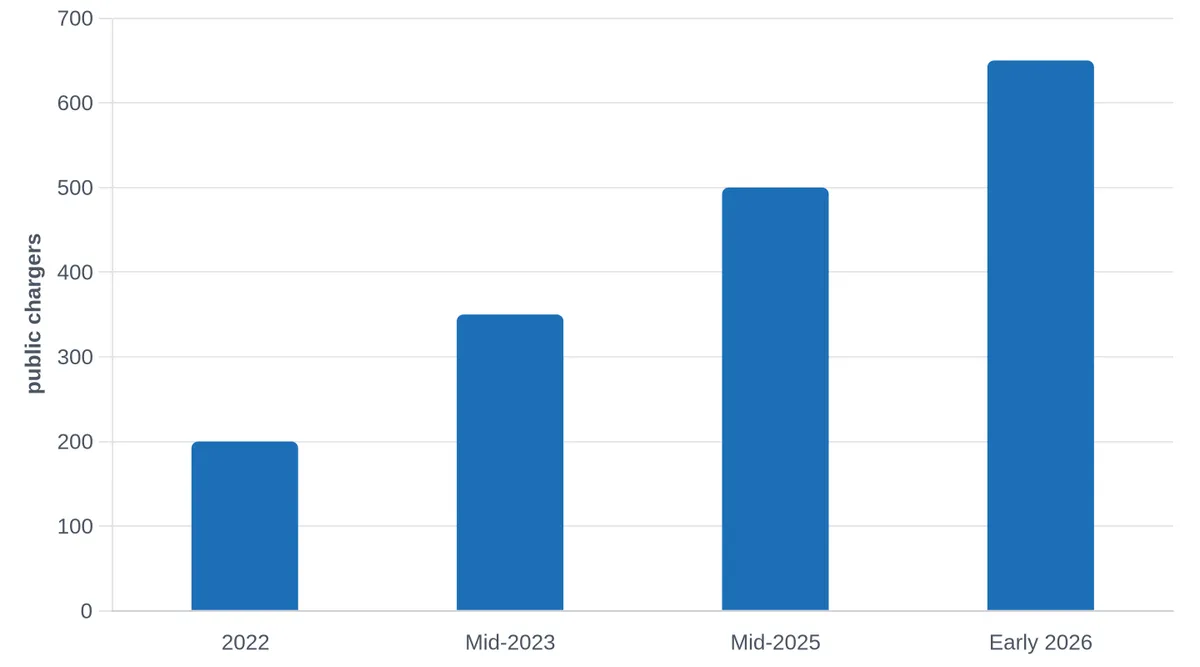
South Africa’s public charging network has grown from approximately 350 stations in mid-2023 to 500+ by mid-2025, reaching approximately 650 chargers across 445 sites with 1,200+ connectors by early 2026 (ChargePoint SA). The EV-to-charger ratio is roughly 1:7, better than the global 1:10 benchmark (ChargePoint SA, citing Rubicon 2025 annual report).
However, 78% of all public charging points are concentrated in the Western Cape and Gauteng (ChargePoint SA). GridCars operates approximately 60% of the country’s total public charge points. A MyBroadband survey found that 46% of GridCars users reported unresolved problems, 31% experienced problems that were subsequently fixed, and only 23% reported consistently smooth experiences (ChargePoint SA). A widespread GridCars network glitch in early May 2026 affected multiple platforms simultaneously, and sites at Alzu near Emalahleni and Mooirivier Mall in Potchefstroom were confirmed as long-term offline.
The conclusion for fleet operators is unambiguous: South Africa’s public charging network does not meet the reliability standard that commercial operations require (Engineering News). Any fleet business case that relies on public fast charging as the primary energy source is building on an unreliable foundation.
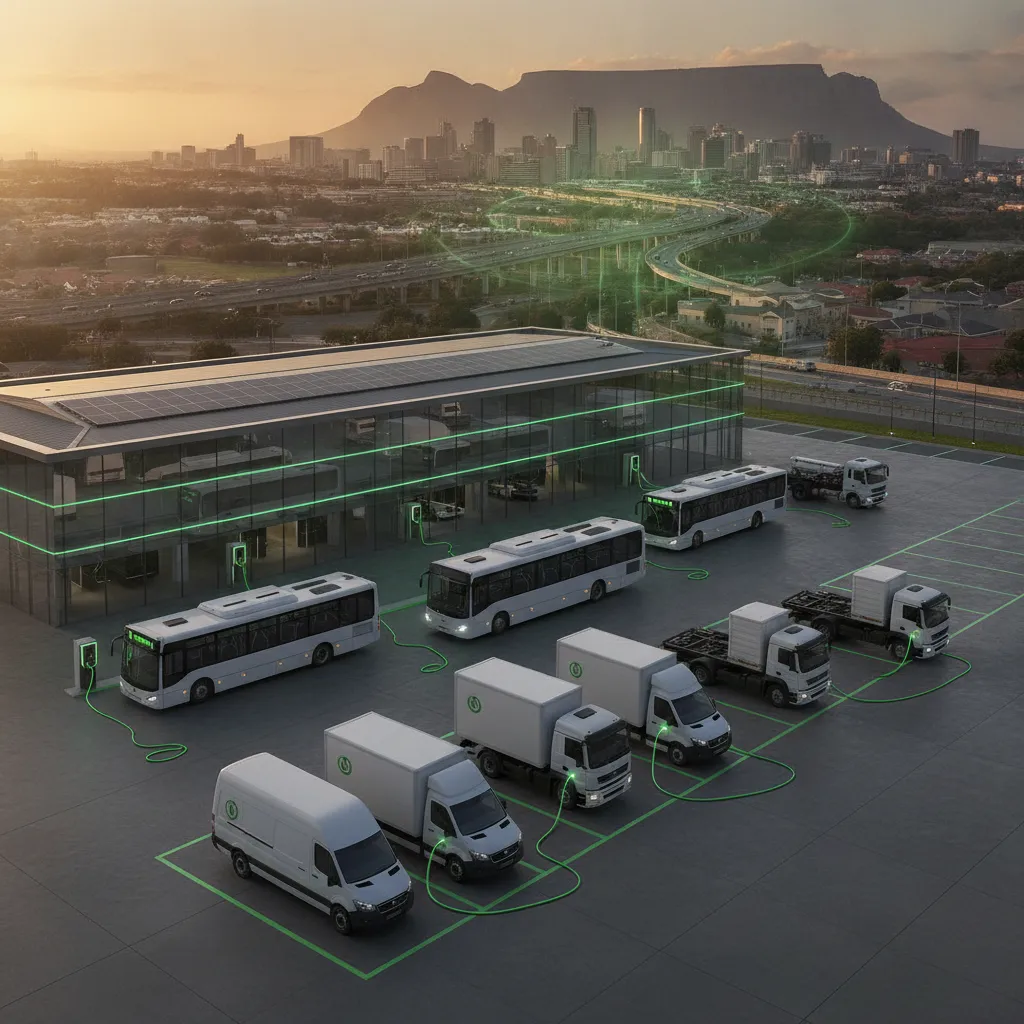
The emerging alternative is dedicated fleet charging infrastructure. WattSpot, South Africa’s first dedicated fleet charging network, recorded 18,884 charging sessions across three Gauteng sites between December 2025 and February 2026, dispensing 205,845 kWh, with above 98.5% uptime since launch (Engineering News). The network plans to expand to more than 200 charge points nationally by 2027.
“As we expand the Uber Go Electric category, the need for reliable, accessible charging infrastructure becomes essential. WattSpot enables us to significantly reduce vehicle downtime, improve driver earnings, and deliver a seamless, high-performance experience for our fleet. Together, we are building the backbone of electric mobility infrastructure in Gauteng and in the Western Cape by Q3, with a long-term vision to scale this model nationally and across Africa.”
Valternative Energy’s Uber Go Electric programme had reached 240 vehicles by February 2026 and covered more than 2 million kilometres since its November 2025 launch (Engineering News), demonstrating that purpose-built fleet charging infrastructure enables scale that the public network cannot yet support.
For corridor operations, CHARGE has launched off-grid solar stations along the N3, with each site capable of charging up to 8 EVs simultaneously (3 DC chargers with 6 dispensers and 2 AC chargers). The Wolmaransstad pilot has recorded 99% uptime since November 2024. CHARGE’s model charges 10% to 80% in approximately 25 minutes. The DBSA has committed US$6.2 million in equity funding with a condition to build off-grid infrastructure every 150 km along major national roads, and the network is targeting 60+ sites nationally along the N1 and N3 corridors (Engineering News).
“By building off-grid EV charging infrastructure along key transport corridors like the N3, we are reducing dependence on volatile fuel prices while creating greater energy and transport cost stability over the long term.”
Depot charging infrastructure: costs and the Eskom demand charge reality

A complete depot charging setup, charger unit, installation, and Certificate of Compliance, costs R25,000-R45,000 per AC charging point (Cartrack ZA). For fleets requiring faster turnaround, a dual-gun 60 kW DC fast charger installed at a depot costs approximately R650,000 all-in, with ongoing Eskom Megaflex demand charges of R26.53/kVA/month in the low-demand season and R52.65/kVA/month in the high-demand season (Eskom 2026/27 tariff schedule). These demand charges are billed whether or not any vehicle is charging, they represent a fixed monthly cost that must be built into fleet charging economics from day one.
For a fleet depot with a 60 kW DC charger, the Megaflex demand charge alone can add R1,500-R3,000 per month to operating costs depending on season. This is manageable when the charger is running at high utilisation across a full fleet, and problematic when a single or small number of vehicles are using a large installed charger. Infrastructure sizing matters as much as the vehicle economics.
The Eskom Homeflex time-of-use tariff structure is relevant for overnight depot charging: peak rates apply 06:00-08:00 and 17:00-20:00, while off-peak rates apply outside these windows. Overnight depot charging scheduled between 21:00 and 05:00 falls entirely in the off-peak band (Sensor Networks, citing Eskom Homeflex tariff), allowing operators to lock in the lowest possible energy cost per kilometre by charging at night rather than during the day.
Eskom has submitted a residential time-of-use EV charging tariff to NERSA specifically designed to incentivise off-peak charging (ESI-Africa), which would further improve the economics of overnight depot charging when approved.
The right depot charging hardware for commercial fleets
For fleet operators setting up dedicated depot charging, equipment selection depends on the vehicle mix, daily range requirements, and charging window available.
For overnight AC depot charging of light delivery vehicles (4-8 hours available): the ChargePoint SA Caro Pro (CP-AC22) delivers 22 kW three-phase with dynamic load balancing, OCPP connectivity for fleet management integration, and IP65/IK10 protection for depot environments. At up to 3 times the speed of a 7 kW charger, it can fully replenish most light commercial EVs within a standard overnight window. Indicative pricing from approximately R13,900 per unit, with installation quoted per site depending on DB board capacity, cable run, and civils.
For fleets needing billing-grade metering with per-vehicle transaction records (a requirement for accurate cost allocation across a mixed fleet): the ChargePoint SA CP-AC22-N adds an Eichrecht-conformant smart meter with 1% accuracy, OCPP 2.0.1J compliance, and ISO 15118 Plug and Charge support. Every charging session is recorded with a verifiable energy transaction, critical for fleet cost management and potential internal chargebacks.
For depots requiring fast turnaround of high-utilisation vehicles (multi-shift operations, large delivery fleets): the ChargePoint SA CP-DC60 delivers 60-120 kW DC fast charging with dual CCS2 outlets, OCPP integration, and smart-grid load management. At 60 kW, most light commercial EVs reach 80% charge within approximately 30 minutes. From approximately R430,000 installed for the 60 kW configuration (indicative, installation varies with site conditions).
ChargePoint SA supplies and installs its full charger range under a single accountable contract, with SANS 10142-1 wiring compliance, electrical CoC, and ECSA-registered installers. The Commercial EV Charging Programme covers managed billing, RFID and app-based access control, load balancing, and remote monitoring, with managed services from approximately R350 per charger per month. A white-label option allows the chargers and app to be branded as the operator’s own.
Financing models: EV-as-a-Service and the capital question
The largest single barrier to fleet electrification in South Africa is upfront capital. A comparable diesel light commercial vehicle at, say, R700,000 versus an EV equivalent at R850,000 represents a R150,000 per-vehicle premium that must be recovered through running cost savings before the EV becomes cheaper on a total cost basis.
EV-as-a-Service (EVaaS) models address this by converting the capital requirement into a monthly fee that includes the vehicle, charging infrastructure, maintenance, insurance, and telematics. The fleet operator pays a fixed monthly amount per vehicle with no large upfront capital commitment, and the service provider assumes the residual value risk (Everlectric). Under this model, the monthly EVaaS fee competes directly against the monthly all-in cost of running a diesel vehicle, and the comparison becomes straightforward at scale.
There is no direct consumer or fleet purchase rebate in South Africa. The government’s 150% tax deduction on EV and hydrogen production investment applies to manufacturers from March 2026 (ChargePoint SA / Department of Transport), not fleet buyers. The financial business case therefore stands entirely on operating cost differentials, not purchase incentives.
Risks fleet managers must plan for, not dismiss
Honest fleet electrification planning requires acknowledging the genuine risks alongside the cost advantages:
Accident repair costs and downtime. EV battery and high-voltage system repairs require specialist technicians. Where qualified technicians are not available locally, downtime can extend significantly beyond the equivalent diesel repair. This is a material risk for fleets operating outside Gauteng and the Western Cape. Spare parts availability for newer Chinese EV models is improving but remains thinner than for established diesel platforms (Cartrack ZA).
Depreciation and residual value. South Africa’s used EV market is still shallow. EVs currently depreciate faster than established ICE models due to limited secondary market demand and buyer uncertainty about battery health (Cars.co.za). Fleet operators planning 3-5 year ownership cycles need to model residual value conservatively. The BYD Atto 3 is projected to retain 65-70% of value at 3 years, comparable to a Toyota Hilux (ChargePoint SA), but these projections are based on limited local resale data.
Load-shedding and grid reliability. Grid-connected chargers are vulnerable to power outages. Traditional Eskom-connected depot chargers without battery backup will not charge during load-shedding. Fleets that schedule overnight charging need to account for the possibility of interrupted sessions and implement backup protocols, whether UPS, solar plus battery, or staggered charging windows that provide a buffer against outages.
Range and payload sensitivity. Real-world range in South African conditions averages approximately 400 km (AutoTrader), but AC use in summer heat adds 5-15% to energy consumption (AutoTrader), and highway driving at 120 km/h delivers approximately 70% of WLTP-rated range (MyBroadband). Fleet route planning must use conservative real-world estimates, not manufacturer WLTP figures.
“There is no single diesel price where electrification suddenly works for every fleet. The economics depend on mileage, route predictability, payload, charging access, and vehicle utilisation. But as diesel moves higher, the case becomes harder to ignore for last-mile and urban delivery operations that are already well suited to EVs.”
What government and institutional fleet programmes signal about the direction of travel
Eskom has committed to full electrification of its Distribution Division fleet of approximately 10,000-13,000 vehicles by 2035-2040 (Eskom official press releases). The utility launched its EV charging infrastructure pilot in August 2024 at the Eskom Academy of Learning in Midrand, installing 60 kW DC fast chargers and 22 kW dual AC chargers at five sites nationwide, with a formal 20-vehicle fleet pilot launched in September 2025.
The scale implication is significant: replacing just 10% of Eskom’s fleet in a single year (approximately 1,200 vehicles) would exceed the entire 2025 national BEV sales volume of 1,088 units (CleanTechnica). Institutional fleet transitions at scale will reshape the supply chain, the used market, and the charging infrastructure economics of the entire country.
BYD plans to roll out 200-300 Flash Charging stations across South Africa by 2026 (ChargePoint SA). Eskom plans 55 public EV charging stations within two years of September 2025 (Eskom official press release). The infrastructure trajectory is clearly upward, even if current public network reliability is inconsistent.
The Department of Transport’s 2018-2050 strategy targets 750,000 EVs on South African roads by 2030 (ChargePoint SA / Department of Transport). Whether that target is achievable is debatable, but the direction of policy, infrastructure investment, and commercial adoption is not.
AutoTrader recorded a 220% increase in EV searches between March 2025 and March 2026 (Business Day). BYD became South Africa’s number one selling EV brand by Q4 2025, with the BYD Dolphin recording 239 units in its first reported sales month of March 2026 (ChargePoint SA). The secondary market for EVs is forming. The question for fleet managers is not whether electrification is coming, it is which vehicle classes and operational profiles are financially ready right now.
A documented real-world savings case

One of the most useful real-world data points available for South African fleet managers is a documented individual operator case: R47,307 saved over 28,744 km and two years against a petrol equivalent at R22.40 per litre fuel prices. At the current R27.50 per litre diesel price (GlobalPetrolPrices.com), the same mileage over the same period would produce savings exceeding R57,000 (CleanTechnica / Everlectric research).
Scale that to a 50-vehicle last-mile delivery fleet at similar utilisation, and the aggregate three-year saving approaches R8.5 million, before accounting for reduced maintenance costs, extended service intervals, and the avoided cost of diesel price spikes.
The honest summary for fleet managers making decisions today
The business case for fleet electrification in South Africa is real, verified, and improving. It is also conditional. The 27% TCO advantage applies to operations that meet specific criteria: daily distances within vehicle range, depot-based overnight charging at R4.50/kWh or below, routes that return to a home base, and vehicle classes with available EV equivalents in the South African market.
For operations that meet those criteria, the question is no longer whether to electrify, it is how quickly to move and which vehicles to prioritise. For operations that do not currently meet those criteria, the question is what operational changes would be needed to get there, and whether those changes are feasible in the next 12-36 months as the charging network, vehicle range, and service infrastructure all continue to develop.
The risk of waiting is not neutral. Every month a qualifying fleet remains on diesel at R27.50 per litre, with the memory of R33.89 per litre still recent, is a month of avoidable margin compression. The operators who moved earliest have two and three years of cost advantage already banked.
Ready to plan your fleet’s charging infrastructure? Plan your site free with our Commercial Site Builder and get a clear picture of what depot charging would cost and deliver for your specific operation.
Plan depot charging for your fleet’s real TCO payback
Free site builder; no obligation. Model your break-even against diesel costs.
Plan my fleet charging →WhatsApp us
CoC-certified installers, nationwide
Illustration: chargepointsa.co.za