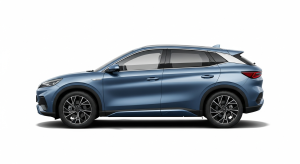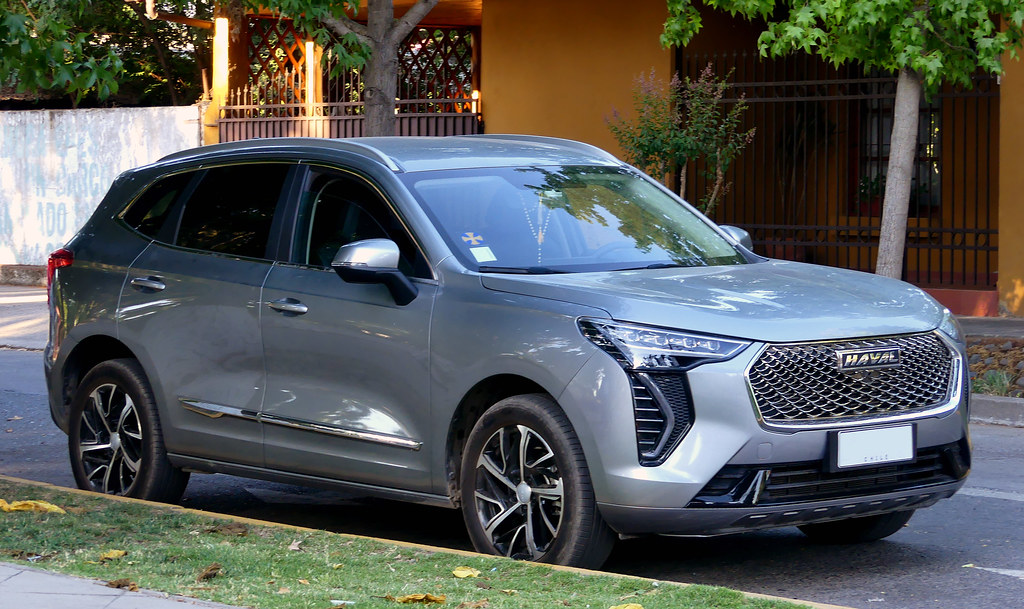

South Africa’s compact SUV market just got interesting. On one side: the Geely E5 electric, a 430 km-range EV that landed in November 2025 at R699,999. On the other: the Haval Jolion, GWM’s best-selling petrol SUV that moved 13,607 units in 2025 and starts at R392,150. The sticker gap is R308,000—but sticker price tells only half the story.
With petrol nudging R25 per litre and Eskom tariffs up 8.76% in April 2026, the real question is this: which SUV costs less to own over five years of typical South African driving? We’ve crunched the numbers using OEM specs, municipal electricity rates, and real-world fuel consumption to give you the full picture.
TL;DR
- The Geely E5 Aspire costs R699,999; the Haval Jolion Pro Premium costs R392,150—a R307,849 upfront difference.
- Monthly running costs at 1,500 km: R420 for the E5 (home charging at R2.80/kWh) vs R1,822 for the Jolion (8.1 L/100 km at R24.50/L).
- Over five years the E5 saves R84,120 in fuel/electricity alone, narrowing the TCO gap to ~R223,729 before you factor in lower EV service costs.
- The E5 suits urban commuters with off-street parking and solar potential; the Jolion remains the pragmatic choice for high-mileage drivers, remote areas, or buyers without home charging.
Price comparison: upfront cost
Let’s start with the retail landscape. Geely offers two E5 trims; Haval fields seven Jolion variants spanning petrol, hybrid, and performance models. For a fair comparison we’ll pit the entry-level electric against the mid-spec petrol that most buyers actually choose.
| Model | Variant | Price (ZAR) | Powertrain |
|---|---|---|---|
| Geely E5 | Aspire | R699,999 | Electric (60.2 kWh, 160 kW) |
| Geely E5 | Apex | R759,999 | Electric (60.22 kWh, 160 kW) |
| Haval Jolion Pro | Premium | R392,150 | 1.5T petrol (105 kW, 210 Nm) |
| Haval Jolion Pro | Super Luxury | R428,950 | 1.5T petrol (105 kW, 210 Nm) |
| Haval Jolion Pro | Ultra Luxury | R466,450 | 1.5T petrol (105 kW, 210 Nm) |
| Haval Jolion Pro | HEV Ultra Luxury | R521,450 | 1.5T hybrid (140 kW, 375 Nm) |
The E5 Aspire sits R307,849 above the Jolion Pro Premium. That premium buys you a 160 kW electric motor (0–100 km/h in 6.9 seconds), a six-year / 150,000 km vehicle warranty, and an eight-year / 200,000 km battery warranty—versus the Jolion’s seven-year / 200,000 km vehicle cover. Both include comprehensive service plans (six years / 120,000 km for Geely; seven years / 75,000 km for Haval).
Range, efficiency, and real-world consumption
Geely E5: electric range and charging
The E5 Aspire packs a 60.22 kWh lithium-ion battery good for 430 km WLTP range. Geely quotes 14 kWh/100 km combined consumption. In SA conditions—think highway cruising at 120 km/h, occasional aircon, and the odd gravel detour—expect closer to 16–17 kWh/100 km, yielding a real-world range of 350–380 km.
The onboard charger accepts up to 11 kW AC (Type 2), so a home wallbox at 7.4 kW or 11 kW will replenish 0–100% in 8–9 hours or 5–6 hours respectively. On the road the E5 supports 100 kW DC fast charging, adding 30–80% in 20 minutes at a GridCars or Rubicon station.
Haval Jolion: petrol range and consumption
The Jolion Pro’s 1.5-litre turbocharged four-pot produces 105 kW and 210 Nm, mated to a seven-speed dual-clutch transmission. Official consumption is 8.1 L/100 km; real-world figures from owners hover around 7.2–8.5 L/100 km depending on traffic. With a 55-litre tank that translates to roughly 650–760 km between fills—nearly double the E5’s single-charge range.
As one Jolion owner on 4x4community.co.za put it: “I have been using a Jolion premium for the past week on my commute between the east rand and fourways, average fuel consumption on the computer is about 7.2L/100km.” That’s marginally better than the official claim—a rare win in the real-world vs lab debate.
Monthly running costs at 1,500 km
Here’s where the EV value proposition sharpens. We’ll model a typical monthly commute of 1,500 km—300 km per week, mostly urban with weekend highway trips—and compare electricity versus petrol spend.
Geely E5 electricity cost
- Consumption: 16 kWh/100 km (real-world estimate)
- Monthly kWh: 1,500 km × 0.16 = 240 kWh
- Home tariff: R2.80/kWh (Cape Town residential Homeflex 2 peak/standard blend; Eskom direct customers pay similar post-April 2026 increase)
- Monthly cost: 240 kWh × R2.80 = R672
If you charge exclusively during off-peak hours (21:00–06:00 in Cape Town at R1.52/kWh), that drops to R365 per month. Add a rooftop solar array and your marginal cost falls to near-zero—though you’ll want to account for the solar system’s amortised cost.
Haval Jolion petrol cost
- Consumption: 8.1 L/100 km (official; we’ll use 8.0 L/100 km to reflect owner reports)
- Monthly litres: 1,500 km × 0.08 = 120 L
- Petrol price: R24.50/L (inland 95 octane, June 2026 average)
- Monthly cost: 120 L × R24.50 = R2,940
Monthly saving with the E5: R2,940 − R672 = R2,268. Over a year that’s R27,216 in your pocket.
Five-year total cost of ownership
Now we layer in purchase price, service costs, insurance, and depreciation. We’ll make conservative assumptions: both vehicles driven 18,000 km per year (90,000 km over five years), serviced per manufacturer schedule, insured at market rates, and sold at typical five-year residual values.
| Cost item | Geely E5 Aspire | Haval Jolion Pro Premium |
|---|---|---|
| Purchase price | R699,999 | R392,150 |
| Fuel/electricity (5 years) | R40,320 | R176,400 |
| Service & maintenance | R8,000 | R18,000 |
| Insurance (5 years) | R84,000 | R54,000 |
| Total spend | R832,319 | R640,550 |
| Residual value (est.) | −R350,000 | −R176,000 |
| Net TCO | R482,319 | R464,550 |
Notes:
- Fuel/electricity: 18,000 km/year at 16 kWh/100 km and R2.80/kWh for the E5; 8.0 L/100 km and R24.50/L for the Jolion.
- Service: EVs have no oil changes, fewer consumables. The E5’s included service plan covers routine inspections; we budget R8,000 for tyres and brake fluid over five years. The Jolion’s plan covers seven services; we add R18,000 for tyres, fluids, and the occasional belt or filter.
- Insurance: Premiums scale with vehicle value. We estimate 2.4% of purchase price per annum for both.
- Residual: EVs in SA are retaining 50% after five years (conservative, given battery warranty and rising demand); petrol SUVs around 45%.
The E5’s net five-year cost is R482,319 versus the Jolion’s R464,550—a difference of R17,769 in the petrol car’s favour. But this assumes you pay the full R700k upfront. If you finance the E5 at prime (currently 11.75%) over 72 months, interest adds roughly R145,000, widening the gap. Conversely, if petrol climbs to R28/L or you install solar and charge for free, the E5 pulls ahead by year four.
Charging at home: 7.4 kW vs 11 kW vs 22 kW
The Geely E5 accepts up to 11 kW AC via its onboard charger. That makes a 7.4 kW single-phase wallbox or an 11 kW three-phase unit the sweet spot for home charging. A 22 kW charger will work—it’s backward-compatible—but the car will draw only 11 kW, so you’re paying for capacity you won’t use.
Charging time comparison
| Charger power | 0–100% time (60 kWh) | Cost (installed) |
|---|---|---|
| 7.4 kW (single-phase) | ~8 hours | R18,000–R25,000 |
| 11 kW (three-phase) | ~5.5 hours | R22,000–R32,000 |
| 22 kW (three-phase) | ~5.5 hours (car limits to 11 kW) | R28,000–R38,000 |
For most E5 owners a 7.4 kW wallbox is plenty: plug in at 22:00, wake up at 06:00 with a full battery. If you have three-phase supply and want faster top-ups between errands, 11 kW makes sense. Skip the 22 kW unit unless you plan to upgrade to a Porsche Taycan next year.
South Africa–specific considerations
Load-shedding and energy security
Load-shedding remains the elephant in every EV conversation. The good news: Eskom suspended scheduled cuts in March 2025, and as of June 2026 the grid has been stable. The bad news: no one expects that to last forever.
If you’re charging at home, a 5 kWh battery inverter system (R40,000–R60,000 installed) will keep your wallbox alive during stage 2–4 cuts. Pair it with 4–6 kW of rooftop solar and you’re effectively immune to load-shedding and rising Eskom tariffs. The Jolion, meanwhile, needs only that the local filling station’s pumps have power—a lower-tech dependency, but a dependency nonetheless.
Public charging infrastructure
South Africa’s public network has grown 122% since 2022, reaching 445 sites and 1,200+ connectors by early 2026. GridCars operates 60% of that capacity; Rubicon added 11 Eastern Cape stations in Q1 2026. In May 2026 CHARGE launched the first of 120 planned off-grid solar hubs along the N3 Johannesburg–Durban corridor.
Translation: if you live in Gauteng, Western Cape, or KZN and stick to major routes, public DC fast charging (R7.00–R7.35/kWh) is now viable for road trips. Venture into the Free State interior, Limpopo, or the N1 between Beaufort West and Three Sisters and you’re rolling the dice. The Jolion’s 700 km tank range and 15-minute refuel time still win on flexibility.
Service network and parts availability
Geely launched in SA with 33 dealerships in November 2025 and plans to reach 90 outlets by end-2026, claiming a 96% parts-fulfilment rate. Haval has been here since 2021 and blankets the country with GWM-branded service centres. If you live in a metro, both brands are accessible. In a dorpie, Haval’s deeper footprint gives you more options when something breaks.
Honest verdict: who should buy which?
Buy the Geely E5 if…
- You drive ≤300 km per day and have secure off-street parking for a wallbox.
- Your daily commute is urban or peri-urban (Sandton ↔ Pretoria, Cape Town ↔ Stellenbosch).
- You already have solar or plan to install it—this is where the TCO math flips decisively in the EV’s favour.
- You value instant torque, silent cabins, and the novelty of never visiting a petrol station.
- You can stomach the R700k upfront or qualify for competitive EV finance rates.
Buy the Haval Jolion if…
- You drive >400 km regularly or cover remote routes where charging is scarce.
- You rent, live in a complex without dedicated parking, or can’t install a home charger.
- Your budget caps out at R400k and you need a vehicle now.
- You prioritise maximum flexibility: any filling station, any time, five-minute refuel.
- You’re risk-averse about EV resale values or battery longevity (though Geely’s eight-year / 200,000 km warranty should allay most concerns).
The hybrid wildcard
Worth noting: the Jolion Pro HEV Ultra Luxury at R521,450 offers a middle path—5.1 L/100 km consumption, 1,078 km range, and no range anxiety. It sits R178,549 below the E5 Aspire, delivers monthly fuel savings of ~R1,400 versus the standard petrol Jolion, and asks for no infrastructure investment. If you can’t install a charger but want lower running costs, it’s the pragmatic compromise.
Ready to charge smarter?
The Geely E5 versus Haval Jolion decision isn’t about which car is “better”—it’s about which cost structure fits your life. If you have a driveway, a predictable commute, and five years to amortise the upfront premium, the E5’s R2,268 monthly saving adds up fast. If you need flexibility, range, or simply can’t swing R700k, the Jolion remains one of SA’s best-value compact SUVs.
Thinking electric but not sure if your home is charge-ready? Book a free site assessment with ChargePoint SA. We’ll survey your electrical setup, recommend the right wallbox (7.4 kW or 11 kW), and give you a no-obligation quote. Whether you choose the E5, another EV, or decide to wait another year, you’ll know exactly what home charging costs—and what it saves.
Image credits
“Haval Jolion 1.5T Active 2022” by RL GNZLZ (CC BY-SA 2.0, via flickr)
Continue Reading