- Trustees have no legal grounds to issue a blanket refusal to a properly documented, CoC-backed EV charger application under the STSMA.
- A charger on common property requires an ordinary resolution (more than 50% of votes); amending conduct rules to create an EV policy requires a special resolution (75%).
- Every compliant EV charger installation must meet SANS 10142-1:2024 Edition 3.2 (specifically Annex N), use SANS 62196-2 or 62196-3 connectors, and be issued a Certificate of Compliance by a registered electrician (ETSP, IE or MIE).
- The CoC shifts professional liability to the registered electrician, not the body corporate, this is the most misunderstood fact in every trustee objection.
- Sub-metered installations mean non-EV owners pay nothing extra: the EV owner’s municipal account absorbs 100% of consumption.
- Without a written EV charging policy, inconsistent trustee decisions are fertile ground for a CSOS referral or High Court review.
- A shared charging hub can be funded via a once-off special levy and recovered per-kWh via app billing, a proven model already operating in South African complexes.
Why trustees are blocking the wrong thing
South Africa has an estimated 1.9 million sectional title properties (Statistics SA, cited by ChargePoint SA). As EV adoption grows, the number of residents arriving at trustee meetings with charger applications is rising faster than the governance frameworks to handle them. The result: reflexive refusals that expose the body corporate to exactly the liability trustees were trying to avoid.
“Every trustee in this country should have an EV charging policy on the agenda of their next meeting. If it isn’t on yours, ask why.”
Johlene Wasserman, Director of Community Schemes and Compliance, VDM Incorporated (BusinessTech, April 2026)Thinking about a home charger?Get a fixed-price installation quote — a few quick questions and we’ll send your cost, with no surprises on the day.Get my fixed-price quote →
The fear is understandable. EV chargers draw 32 A continuously on a single-phase 7.4 kW circuit, far more than any household appliance. They connect to the DB board. They may route cables across common property. But the answer to that complexity is a structured approval process, not a refusal. The law is explicit on this, and the tools to manage it correctly already exist.
“The first ruling on EV charging in a scheme is coming, and no trustee wants their scheme to be the test case.”
Johlene Wasserman, VDM Incorporated (BusinessTech, April 2026)
The legal framework trustees must understand
STSMA, what you actually control
The Sectional Titles Schemes Management Act 8 of 2011 (STSMA), together with the Sectional Titles Schemes Management Regulations 2016 (effective 7 October 2016), governs everything from levy collection to what trustees may and may not do with applications from owners. Johlene Wasserman of VDM Incorporated has been explicit: Section 5(1)(b) of the STSMA requires trustees to act in the best interests of the body corporate, and that duty includes protecting communal infrastructure and finances, not refusing applications that would not harm either.
Under the STSMA, the body corporate legitimately controls:
- Where the charger is mounted.
- Which qualified electrician carries out the work.
- How cables are routed (they may not damage common property).
- Whether the complex has sufficient electrical capacity (confirmed by a professional load report).
What the body corporate does not have legal grounds to do is refuse outright a properly documented, CoC-backed application without a specific, documented technical or legal reason.
“Vague refusals, ‘we don’t allow it,’ ‘it sets a precedent,’ ‘the committee isn’t comfortable’, are not valid technical or legal grounds. Push back, politely, in writing.”
ChargePoint SA, 2026 Body Corporate EV Charger Guide
The correct voting thresholds
Trustees consistently misapply the voting thresholds, either demanding a special resolution when none is required, or approving informally when a resolution is needed. The correct position:
| Decision required | Vote threshold | Authority |
|---|---|---|
| Owner installs charger on exclusive-use area or section (own DB, own bay) | Trustee resolution under Section 5 STSMA, no general meeting vote required | STSMA s5; ChargePoint SA 2026 |
| Body corporate installs shared charger on common property | Ordinary resolution: more than 50% of votes in favour | STSMA (STSMA s27 for real EUA rights) |
| Amend conduct rules to include an EV charging policy | Special resolution: 75% in number and value of members present, or 75% of all owners by round robin | STSMA s10(2)(b); Paddocks 2024 |
| Conduct rules amendment notifying owners of common property changes | All owners informed per PMR 29(2): 30 days written notice | Prescribed Management Rule 29(2) |
Exclusive-use area rights matter here. A parking bay registered as a real EUA under STSMA Section 27 gives the owner a property right over that bay. A personal-use right under STSMA Sections 10(7) and 10(8) is a conduct-rules entitlement only. Trustees should verify which applies before deciding where a charger may be permanently fixed.
Trustee fiduciary duty and personal liability
STSMA Section 8(1) places each trustee in a fiduciary relationship with the body corporate. Section 8(2) requires that trustees act honestly and in good faith, exercise their powers in the interest of the body corporate, and avoid material conflicts of interest. Section 8(3) is the part most trustees have not read: a trustee who breaches their fiduciary duty is liable in their personal capacity for any loss suffered, or any economic benefit improperly received. This liability may arise regardless of intention, including through negligent conduct or omission.
“Many buyers don’t realise they can be held personally liable for certain failures regarding the management of the complex. It’s important to understand this before taking on the role.”
Adrian Goslett, Regional Director and CEO, RE/MAX of Southern Africa (Property24)
The statutory indemnity in PMR 8(4) protects trustees only when they act in good faith within their fiduciary mandate. If a trustee’s refusal of a compliant EV charger application is later found to be negligent, outside their mandate, or without documentable technical or legal grounds, that indemnity does not apply. Indemnity clauses that purport to exempt trustees from negligence are void. The CSOS recorded 16,791 new dispute applications in the 2024/25 financial year, up 7.7% from the year before. Governance failures, not technical ones, dominate the case load.
“Good governance is not only about managing property, it is about managing power, risk and responsibility with integrity. While courts will probably be slow to penalise inadvertent error, they are unlikely to tolerate negligence, conflict of interest, or self-dealing.”
Paddocks, South Africa’s leading sectional title law specialists
The compliance framework: SANS 10142-1, CoC and who bears liability
Why the wiring code matters more than trustees realise
SANS 10142-1:2024 Edition 3.2, released on 12 August 2024 (confirmed by the Electrical Contractors Association of South Africa), is South Africa’s governing wiring code for low-voltage electrical installations. It is a legal requirement, not a recommendation. The Occupational Health and Safety Act, 1993 (Act No. 85 of 1993), administered by the Department of Labour’s Chief Inspector, mandates that all electrical installations comply with SANS 10142-1 and that a registered person issue a Certificate of Compliance.
“Without adherence to SANS 10142-1, no installation can be certified as compliant, making it crucial for both safety and legal operation.”
TDMI Training (EWSETA-recognised, Department of Employment and Labour compliant)
The 2024 edition is the second amendment to Edition 3 and explicitly incorporates requirements for EV charging socket-and-plug systems based on SANS 61851-1, SANS 62196-2 (AC connectors), SANS 62196-3 (DC connectors) and SANS 61851-23. EV charging was first addressed in Edition 2 (March 2017) and has been progressively strengthened. The 2024 revision aligns South Africa more closely with IEC international standards.
What Annex N requires, the technical checklist trustees should insist on
SANS 10142-1 Annex N specifically covers EV charging infrastructure and sets requirements beyond those for ordinary socket outlets. Every application submitted to a body corporate should demonstrate compliance with all of the following:
- A dedicated circuit, not a shared circuit with other loads.
- A Type A or Type B residual-current device (RCD) rated for DC fault currents. A standard household earth-leakage unit is not compliant for EV charging. This is the single most common non-compliance in informal installations.
- An MCB (miniature circuit breaker) sized to the charger’s maximum load: a 7.4 kW single-phase charger draws approximately 32 A.
- A minimum 6 mm squared copper cable for 32 A single-phase runs under 25 m, with thicker cable required for longer runs or three-phase circuits.
- Earthing that meets the 1-ohm resistance threshold (or lower, depending on soil conditions).
- IP54-rated enclosures or better if the charger is mounted outdoors.
- A surge protection device (SPD) on the dedicated circuit. Annex N strongly recommends this; insurers increasingly require it.
“Installing a surge arrester at your distribution board can save your pricey charger from voltage spikes, especially when power comes back after a blackout.”
Electricians Johannesburg, quoted in TopAuto (2026)
Before issuing a CoC, the registered electrician must test insulation resistance, earth-loop impedance and RCD trip time, and produce a test report including wiring diagrams, photos and test sheets. Without this documented process, the CoC is not valid.
The Certificate of Compliance: what it actually says about liability
The CoC is a uniquely numbered, traceable legal document issued under Government Notice R242 (Electrical Installation Regulations, effective 1 May 2009). It must carry the employee name, name of the registered person, the electrical contractor’s registration number, registration date and registration expiry.
“The COC confirms that the installation was, at the moment of inspection, reasonably safe and compliant, and that the responsible registered electrician accepts legal liability for that statement.”
TDMI Training, explaining the CoC’s legal function
This is the fact trustees most often misunderstand. The body corporate does not accept liability for the installation by approving it. The registered electrician, not the property owner and not the body corporate, bears professional liability for the declaration of compliance. Clause 2 of the Electrical Installation Regulations 2009 places responsibility for the safety of an electrical installation on the user or lessor, and requires that user or lessor to hold and produce a valid CoC on request. An approved, CoC-backed installation therefore reduces the body corporate’s exposure, it does not increase it.
Only three categories of registered person may issue a CoC: an Electrical Tester for Single Phase (ETSP) for single-phase work only; an Installation Electrician (IE) for single or three-phase; or a Master Installation Electrician (MIE) for any installation including specialised work. All licences are issued by the Department of Employment and Labour and must be renewed annually. Trustees should require the installer’s licence category and registration number as part of every application. For work on common property, the body corporate must also put in place a Section 37(2) Health and Safety Agreement under the OHS Act, which is a legally binding contract specifying the terms under which the contractor will work on-site.
Insurance consequences trustees are not told about
The South African Insurance Association (SAIA) stated in November 2025 that informal home EV charging arrangements, particularly where loads are drawn through extension leads or non-dedicated circuits, increase fire and electrical risk in residential areas. The STSMA prescribes a minimum public liability limit of R10 million per claim for body corporate insurance. If a fire caused by a non-compliant EV charger installation results in a claim and the body corporate cannot demonstrate that it required CoC compliance, the insurer’s position becomes complicated for everyone in the scheme.
“Trustee mismanagement can have serious consequences, including lapses in maintenance planning, poor oversight of service providers and, critically, inadequate building insurance or underinsurance, leaving body corporates, and individual owners, financially exposed when they need to claim.”
Ryno de Kock, Head of Distribution, PSG Insure (FA News)
Without a valid CoC, home insurance can reject claims for electrical fires and the property cannot be legally transferred. The two-year rule under Regulation 7(5) applies only to property transfers: a CoC does not automatically expire for an owner who has made no alterations. But installing an EV charger is an addition or alteration, which invalidates the existing CoC and requires a new supplemental CoC. No supplemental CoC can be issued if the whole property does not already have a valid initial CoC.
“Failure to comply with these laws will not only nullify your policy, but is a criminal offence that may lead to prosecution.”
GRIB, South African property and risk advisory firm
The cost and cost-recovery picture
What a compliant installation actually costs
Trustees are entitled to know what they are approving. Here is a cost breakdown based on verified 2025/2026 market data from ChargePoint SA:
| Cost component | Typical range | Notes |
|---|---|---|
| Budget charger hardware (3.7 kW) | R8,000-R12,000 | Not recommended as primary option |
| Mid-range hardware (7.4 kW) | R12,000-R18,000 | Sweet spot for most residential owners |
| Premium smart/app-enabled hardware | R18,000-R25,000 | RFID, scheduling, longer warranty |
| Installation labour (dedicated sub-circuit, DB upgrade where needed) | R5,000-R15,000 | Varies by cable run length and DB condition |
| Certificate of Compliance (CoC) | R500-R1,500 | Issued by registered electrician |
| Engineering load report (body corporate requirement) | R3,000-R6,000 | Sets capacity precedent for entire complex |
| Conduit trenching (if cables must go underground) | R2,000-R5,000 per 10 m | Long runs add up quickly |
| Managing agent admin fee (complex-dependent) | R500-R2,000 | Charged by some bodies corporate for processing |
| Sub-metered installation (7 kW wallbox + sub-meter + cable run up to 30 m) | R12,000-R22,000 all-in | Most JHB and Cape Town complexes land R16,000-R20,000 |
| Shared hub: 2 chargers | R65,000 | Hardware, installation, commissioning |
| Shared hub: 5 chargers | R140,000 | Hardware, installation, commissioning |
| Shared hub: 10+ chargers | R240,000+ | Hardware, installation, commissioning |
A 50-metre cable run costs approximately R8,000 in cable alone before labour or hardware (ChargePoint SA). This is why parking bay distance from the unit’s DB board is the most important variable in any body corporate application, and why the shared-hub model exists.
Cost-of-ownership comparison: sub-metered home charger versus public charging
The electricity tariff context (all figures from ChargePoint SA, 2025, and Eskom 2026/27 schedule):
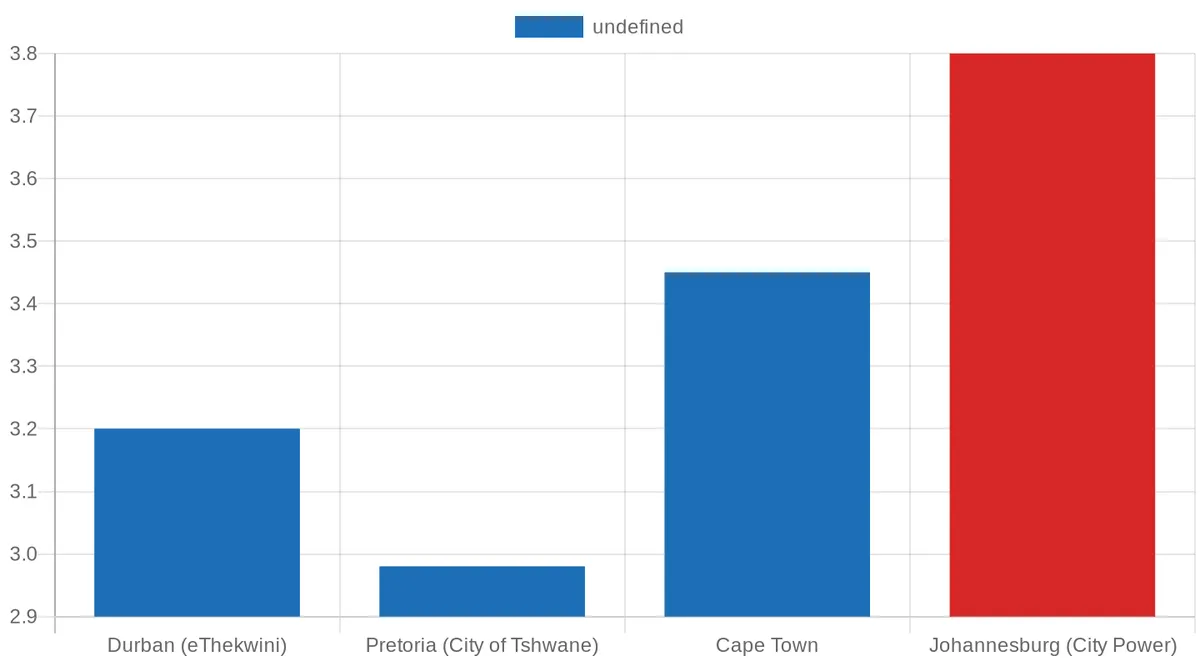
- City Power Johannesburg: approximately R3.80/kWh (flat rate, no TOU for domestic customers yet).
- City of Cape Town: approximately R3.45/kWh basic; Home Power Plus TOU off-peak approximately R2.10/kWh.
- eThekwini (Durban): approximately R3.20/kWh, lowest of the three major metros.
- City of Tshwane (Pretoria) prepaid Block 1: R2.98/kWh, working out at approximately R0.66/km for overnight EV charging.
- Eskom Homeflex TOU off-peak (launched April 2025): R1.45-R2.25/kWh (22:00-06:00 and 10:00-18:00 weekdays); peak climbs to R3.40+ per kWh (07:00-10:00 and 18:00-22:00).
- Public AC charging (GridCars / Rubicon networks, August 2025 rates): R5.88/kWh. Note: GridCars announced an approximately 15% increase from 1 December 2025, treat these August 2025 public rates as a floor, not a current 2026 figure.
- Public DC fast charging (August 2025): R7.00/kWh (Rubicon eMSP) or R7.35/kWh (GridCars eMSP).
A resident who charges a 60 kWh battery at home in Johannesburg at R3.80/kWh pays R228 per full charge. The same charge at a public AC charger (August 2025 rate) costs R352.80, a difference of R124.80 per charge, or roughly R1,500 per month for a typical commuter. ChargePoint SA’s own ROI calculation notes a R22,000 home charger installation typically pays for itself in approximately 10 months, with cumulative savings above R180,000 over a seven-year ownership period, before residual value differences.
Why non-EV owners must be protected through proper metering
“Without dedicated metering systems, communal electricity costs can rise rapidly, effectively forcing non-EV owners to subsidise EV users through their monthly levies.”
Estate Living magazine
This is the single most sensitive cost-recovery issue in community schemes, and the reason trustees should insist on one of two metering models for every installation:
- Sub-metered from the owner’s own DB board: the owner pays 100% of EV consumption via their own municipal account. Zero impact on levies. Zero admin for the body corporate.
- Sub-meter tapping the common supply (where the cable run from the unit DB is economically unfeasible): the body corporate bills the owner directly based on sub-meter readings. ChargePoint SA notes trustees typically dislike this because it creates monthly invoicing admin, but it is legitimate and approvable for awkward parking configurations.
“Sub-metered installation means you pay 100% of your electricity usage via your own municipal bill. Zero impact on complex levies. Zero admin burden. The body corporate does not touch a cent.”
ChargePoint SA, 2026 Body Corporate EV Charger Guide
The lesson from real disputes is that failure to define the billing model from the start escalates. Marina Constas of BBM Law has documented High Court matters where body corporate electricity billing disputes resulted in owners owing more than R100,000. A clearly documented per-kWh recovery rate, set from the first installation, prevents that outcome.
The shared charging hub: a proven cost-recovery model
“Parking bay was 45 metres from the unit, a cable run that would have cost more than the charger itself. Owner negotiated a different solution: a shared charging hub in two visitor bays, funded jointly by the body corporate (R30,000 upfront, recovered via a once-off R150 per-unit special levy). Eight EV owners now share the system, paying per kWh via app. The body corporate carries the infrastructure; residents pay for usage.”
ChargePoint SA, documented real-world case study (2026 Body Corporate Guide)
This model is already running in South African urban complexes. The body corporate’s upfront cost was recovered through a once-off R150 special levy across the complex. Ongoing electricity costs are borne entirely by users, billed per kWh through an app. The body corporate is not in the electricity retail business; it is simply the infrastructure host.
For larger estates considering a multi-charger hub, financing over 60 months can bring the monthly cost to R2,000-R6,000 for a 2-10 charger installation. Investor-funded models (where a third party owns and operates the chargers, paying the estate a hosting fee or revenue share) are also available, though Winstone Jordaan of GridCars noted at Enlit Africa 2025 that South Africa needs approximately 100,000 EVs on the road before public-facing charging revenue is reliably profitable, estates should not depend on revenue-share income as a near-term primary return from a low-traffic hub.
Understand cost recovery and metering for body corporate residents
Writing the EV charging policy: what it must contain
“Without a policy, these decisions are made inconsistently, which is the single biggest risk, because inconsistent treatment of owners is fertile ground for a CSOS referral or a High Court review.”
Johlene Wasserman, VDM Incorporated (BusinessTech, April 2026)
A written EV charging policy, adopted by special resolution (75% threshold for conduct rules) and served on all owners with 30 days notice under PMR 29(2), is the document that makes every future application administratively simple and legally defensible. It should cover:
- Application requirements: who must apply, what documentation is required (load report, installer registration number, proposed cable route, metering plan).
- Technical standards: explicit reference to SANS 10142-1:2024 Annex N; SANS 62196-2 (AC connectors); SANS 62196-3 (DC connectors); Type A or Type B RCD requirement; CoC requirement on completion; ECSA-registered installer requirement.
- Metering: which model applies (direct sub-meter from unit DB, or common-supply sub-meter with billing by body corporate), how the per-kWh recovery rate is set, and how often it may be reviewed.
- Cable routing: conduit specifications, approved routing paths, prohibition of surface extension leads across common property.
- Parking bay status: whether the bay is a registered EUA (STSMA s27) or a personal use right (s10(7)/s10(8)), and what permanent fixings are permissible in each case.
- Section 37(2) OHS Act agreement: mandatory for any contractor working on common property.
- Common-property works: confirmation that any shared infrastructure on common property requires an ordinary resolution of owners before trustee approval is granted.
- Appeals process: what happens if an application is declined and on what grounds a refusal is documentable.
“The schemes that will pay the most are the ones that approved installations informally three years ago and now can’t undo them. The schemes that will pay the least are the ones that write the rules before their first application arrives. There is no third option.”
Johlene Wasserman, VDM Incorporated (BusinessTech, April 2026)
Recommended chargers for body corporate applications
Where an EV-owning resident submits an application, the charger model matters to trustees as much as the wiring plan. The hardware must be IP-rated for outdoor mounting, app or RFID controllable (so usage is auditable), and compatible with SANS 62196-2 Type 2 connectors. We install a wide range of quality chargers across South Africa. The two we recommend most for body corporate applications:
- ChargePoint SA Caro Plus (CP-AC7) — 7 kW home wallbox — from ~R8,900 per unit + installation quoted per site. Single-phase, tethered Type 2 (5–7 m cable), plug/RFID/app start; OCPP 1.6/2.0.1, Wi-Fi/Bluetooth; optional dynamic load balancing and PV solar charging; IP65 weatherproof, Type A + 6 mA DC earth-leakage built in; SANS 10142-1 install + CoC. The entry-level home charger that maps directly to Annex N requirements — gives trustees a verified spec sheet and full charges overnight (~8 h). Get a quote.
- ChargePoint SA Caro Pro (CP-AC22) — 22 kW AC wallbox — from ~R13,900 per unit + installation quoted per site. Three-phase, tethered 7 m Type 2; up to ~3× faster than a 7 kW charger (if the vehicle accepts it); dynamic load balancing, Wi-Fi/Ethernet/4G/BT, OCPP, PV solar charging; IP65 · IK10. Turns a bay over in a couple of hours — the best everyday AC choice for homes, estates and workplaces where three-phase supply is available. Get a quote.
We can also supply and install other chargers from our range on request, including the CP-DUO-44 twin 2×22 kW wallbox for schemes needing two bays from a single unit, depending on the scheme’s specific load management, solar integration or three-phase requirements. Installation cost is quoted per property because DB board condition, cable run distance and whether conduit trenching is needed all affect the scope. The charger unit price above is the hardware cost only, installation is a separate quoted item, which is the correct way to price it honestly.
The approval timeline trustees should communicate to applicants
Trustees who set realistic expectations reduce disputes before they start. The standard timeline:
- Application submission to trustee decision: 2-6 weeks, depending on meeting schedules and application completeness.
- Quote acceptance to installation complete: 4-8 hours on-site for single-phase; one full day for three-phase.
- CoC issuance: within 7-14 days of installation completion once all tests are documented.
- Total from first submission to charging: 3-8 weeks for a straightforward application.
Incomplete applications are the primary cause of delays. The single item trustees most commonly cite when sending applications back is the absence of a professional load calculation. Without that document, expect the application to be returned (ChargePoint SA, 2026 Body Corporate Guide). An application that includes a load report, a proposed cable route, the installer’s registration category and number, the charger’s IP rating and spec sheet, and a metering plan has everything a trustee needs to make a documented decision in one meeting.
“After months of trying to get body corporate approval, ChargePoint SA stepped in. They prepared professional documentation, attended the trustee meeting, answered all technical questions, and got approval in one meeting. The general contractor I was working with before couldn’t even tell me what documentation was needed.”
Anonymous sectional title owner, ChargePoint SA website (2025)
Property value: the argument that moves hesitant trustees
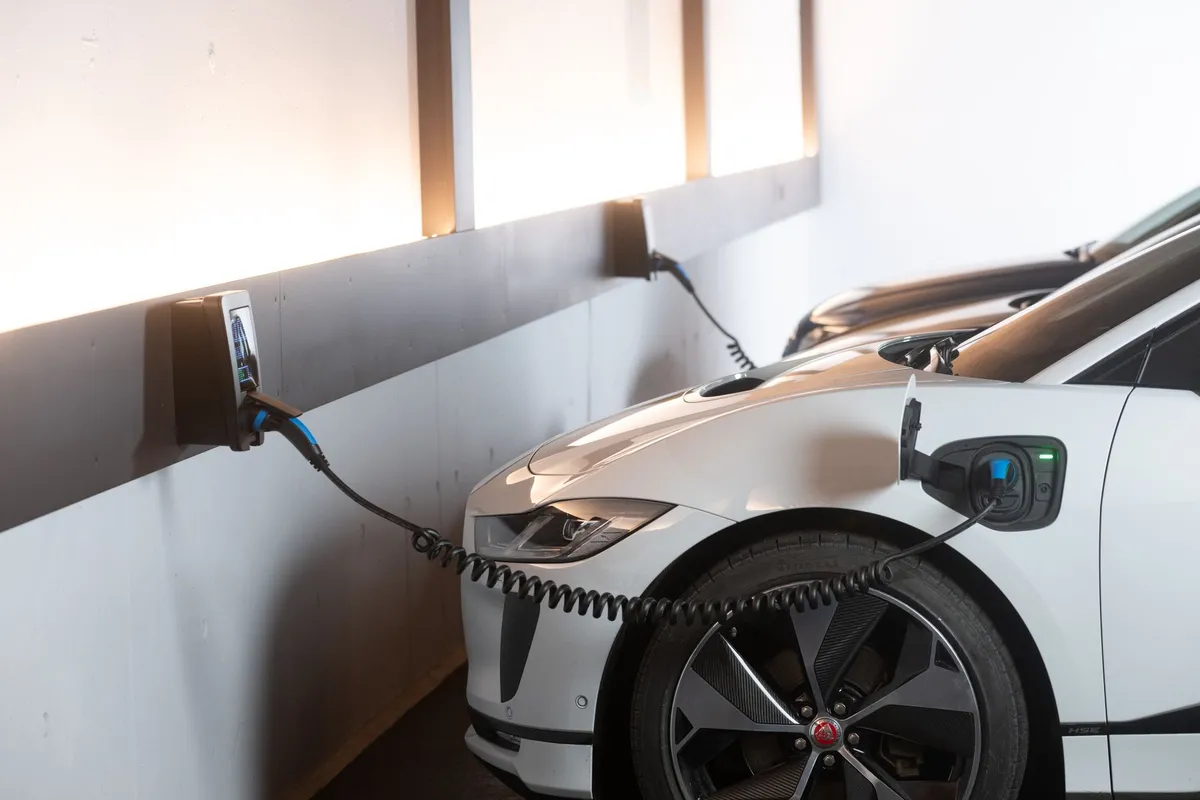
“Premium estates without EV charging are starting to look dated. Century City apartments with charging infrastructure command a premium. Waterfall estate agents are already listing ‘EV charger ready’ as a selling feature. Trustees understand property value, use that language.”
ChargePoint SA, 2026 Body Corporate EV Charger Guide
Property value is not a compliance argument, but it is often the argument that tips a hesitant trustee board. Trustees who act in the best interests of the body corporate (their statutory duty under STSMA s8(2)) must weigh the evidence: in at least two South African urban precincts, charging infrastructure is already a listed selling feature. A trustee board that resists a compliant installation for no documented technical reason is making a decision that arguably works against the interests of all owners in the scheme, not just the applicant.
Frequently asked questions
Can a body corporate legally refuse all EV charger applications outright?
No. A blanket refusal without a specific, documented technical or legal reason is not defensible under the STSMA. The law does not prohibit EV charger installations in sectional title schemes; it regulates the process. The body corporate may control where the charger is mounted, who carries out the work, and how cables are routed, but it cannot refuse a properly documented, CoC-backed application without a legitimate technical or legal ground. An owner who receives a vague refusal can raise the matter with the CSOS, which has the authority to enforce rulings (ChargePoint SA, 2026 Body Corporate Guide).
Who is legally liable if an EV charger installation causes a fire or electrical fault?
The registered electrician who issued the Certificate of Compliance bears professional liability for the declaration that the installation was, at the time of inspection, reasonably safe and compliant. The body corporate is not the declaring party. However, if the body corporate approved an installation by an unregistered or unlicensed contractor, or failed to require a Section 37(2) OHS Act agreement for common-property work, the body corporate may face exposure under the OHS Act, which does not exempt trustees from on-site accident liability (SafetyWallet; TDMI Training).
Does installing an EV charger require SSEG registration with the municipality?
No. A dedicated EV charger on its own does not export electricity to the grid and therefore does not require Small-Scale Embedded Generation registration with the municipality. It does, however, require a Certificate of Compliance under SANS 10142-1, issued by a registered electrician after completing insulation resistance, earth-loop impedance and RCD trip-time testing. If the charger is integrated with a solar-plus-battery system that does export, the solar installation’s SSEG registration requirements apply separately (Synergy Energy Solutions).
What vote threshold is needed for the body corporate to install shared chargers on common property?
An ordinary resolution, meaning more than 50% of total votes in favour, is sufficient for the body corporate to install shared chargers on common property. Amending the conduct rules to incorporate a written EV charging policy requires a special resolution: 75% in number and value of members present or represented at a general meeting, or 75% of all owners by round robin, under STSMA Section 10(2)(b). All owners must be informed of proposed changes to common property under Prescribed Management Rule 29(2), with 30 days written notice (Paddocks; ChargePoint SA 2026).
How does the body corporate prevent non-EV owners from subsidising EV charging costs?
Through metering. A sub-metered installation connected to the owner’s own DB board means 100% of EV electricity consumption appears on the owner’s municipal account and has no effect on levies. Where the cable run from the unit’s DB board to the parking bay is too long to be practical or economical (the cable for a 50-metre run costs approximately R8,000 before labour, per ChargePoint SA), a sub-meter on the common supply with direct billing by the body corporate is an alternative. The billing rate should be documented in the EV charging policy and reviewed at the same time as annual levy adjustments to prevent disputes (Estate Living; ChargePoint SA 2026 Body Corporate Guide).
What happens if a trustee approves an EV charger installation informally, without a written policy?
Inconsistent, undocumented trustee decisions are the highest-risk outcome for a body corporate. If one owner’s informal approval is granted and a later application is refused, or if the approved installation later causes damage, the body corporate has no written standard against which to measure either decision. Johlene Wasserman of VDM Incorporated has been explicit: inconsistent treatment of owners is fertile ground for a CSOS referral or a High Court review. The SCA ruling that community scheme disputes can go directly to the High Court means the litigation pathway is faster and more expensive than many trustees assume. The solution is a written policy adopted before the first application arrives (BusinessTech, April 2026).
If your scheme is ready to move from ad hoc decisions to a defensible, compliant EV charging programme, ChargePoint SA’s Commercial EV Charging Programme provides a single accountable contract covering charger supply, ECSA-registered installation, SANS 10142-1 wiring compliance, electrical CoC, and four ownership models matched to your scheme’s risk appetite. Request a B2B proposal and get a fixed-scope, site-assessed quote that gives your trustees exactly the documentation they need to make a decision with confidence.
Guide your trustees through body corporate EV charging approval
Covers STSMA rules, SANS 10142-1 compliance, and cost recovery—no obligation.
Explore trustee roadmap →WhatsApp us
CoC-certified installers, nationwide