
Key points
- The BYD Dolphin Surf Comfort starts at R339,900, less than a base Toyota Corolla Cross at R360,400, making it one of the most affordable EVs in South Africa.
- V2L output on the Dolphin Surf is rated at 3 kW, enough for a fridge, Wi-Fi router, TV and phone charging simultaneously, but not an electric geyser or air conditioner.
- Eskom declared the end of load-shedding in February 2026, but localised outages continue, so backup power capability retains real-world value for SA buyers.
- Home charging costs R3.00 to R4.00 per kWh versus petrol at roughly R210 per 100 km at current inland 95-octane prices of around R26.50 per litre, a dramatic running-cost difference.
- BYD’s 8-year/200,000 km battery warranty and 6-year/150,000 km free-servicing package materially reduce ownership risk.
- All home charger installations must comply with SANS 10142-1 and include an electrical Certificate of Compliance, unlicensed work voids your home insurance.
South Africa’s EV market has spent years waiting for a genuine mass-market entry point. The BYD Dolphin Surf at R339,900 is the closest thing to one that has arrived so far. It costs less than a base Toyota Corolla Cross, comes from the brand that became the number-one EV seller in South Africa by Q4 2025, and carries a feature that resonates powerfully with South African buyers: the ability to power household appliances directly from the car’s battery during an outage.
But the marketing language around “backup power” deserves scrutiny. This article examines what V2L (Vehicle-to-Load) actually delivers in a South African home, what the Dolphin Surf genuinely costs to own over five years, how it compares to its closest rival, and whether the numbers justify the switch from a comparable petrol alternative.
What V2L Actually Does During an Outage
Vehicle-to-Load technology allows the car’s high-voltage battery to power standard household appliances through a socket, either built into the car’s body or via a cable that plugs into the charging port. On the BYD Dolphin Surf, V2L output is rated at 3 kW. On the BYD Shark 6 PHEV bakkie, it steps up to 6.6 kW.
To put 3 kW in context: a typical South African household fridge draws 100 to 200 W, a LED television 80 to 150 W, a Wi-Fi router around 15 W, and phone chargers under 30 W combined. Running all of those simultaneously uses well under 500 W. A 3 kW output handles them with headroom to spare. What it cannot do is run an electric geyser (typically 3 to 4 kW alone), a tumble dryer, or any air conditioner above a small portable unit.
There is an important practical consideration for hardwired V2L integration. According to South African electricians, the ecosystem for wiring V2L into a DB board via a manual transfer switch is not yet standardised locally, most owners currently run appliances directly from the car via extension leads. That works fine for essentials, but it is worth knowing before you budget for a whole-house transfer switch installation.
On the question of battery longevity: conservative V2L usage, never discharging the battery below 20 to 30%, is the recommended approach to minimising degradation. BYD’s thermal management and battery management software are designed with discharge cycles in mind, but regularly draining the pack to zero as a generator substitute will accelerate wear over time.
Dolphin Surf Specs and Variants
The Dolphin Surf launched in September 2025 as South Africa’s most affordable electric car at the time. Two variants are available.
| Variant | Price | Battery | WLTP Range | DC Fast Charging |
|---|---|---|---|---|
| Comfort | R339,900 | 30 kWh | 232 km | 30 kW max |
| Dynamic | R389,900 | 38.8 kWh | 295 km | 40 kW max (30-80% in ~30 min) |
The Comfort’s 232 km WLTP range comfortably covers the average South African daily travel distance of around 55 km, roughly four days of typical commuting on a single charge. The Dynamic’s 295 km range adds a meaningful buffer for longer day trips or for drivers who want to rely on public charging less frequently.
By April 2026, the Dolphin Surf had become South Africa’s top-selling EV in that month with 302 sales recorded, clear evidence that the market had been waiting for this price point.
BYD Dolphin Surf vs Geely E2: The Affordable EV Head-to-Head
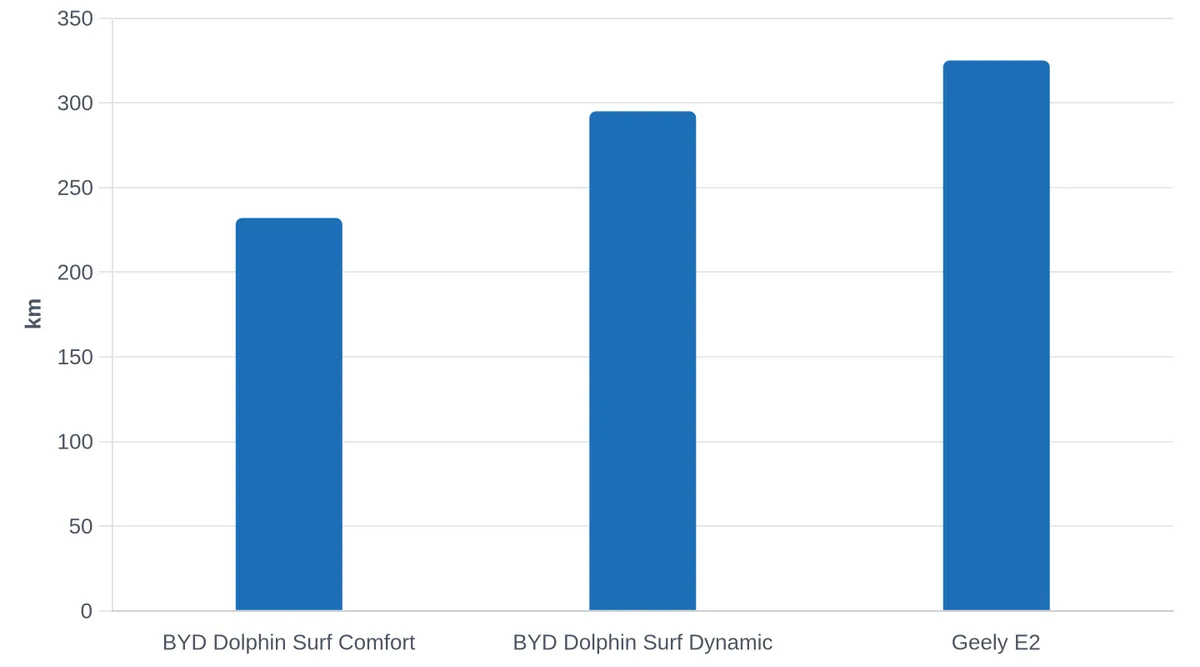
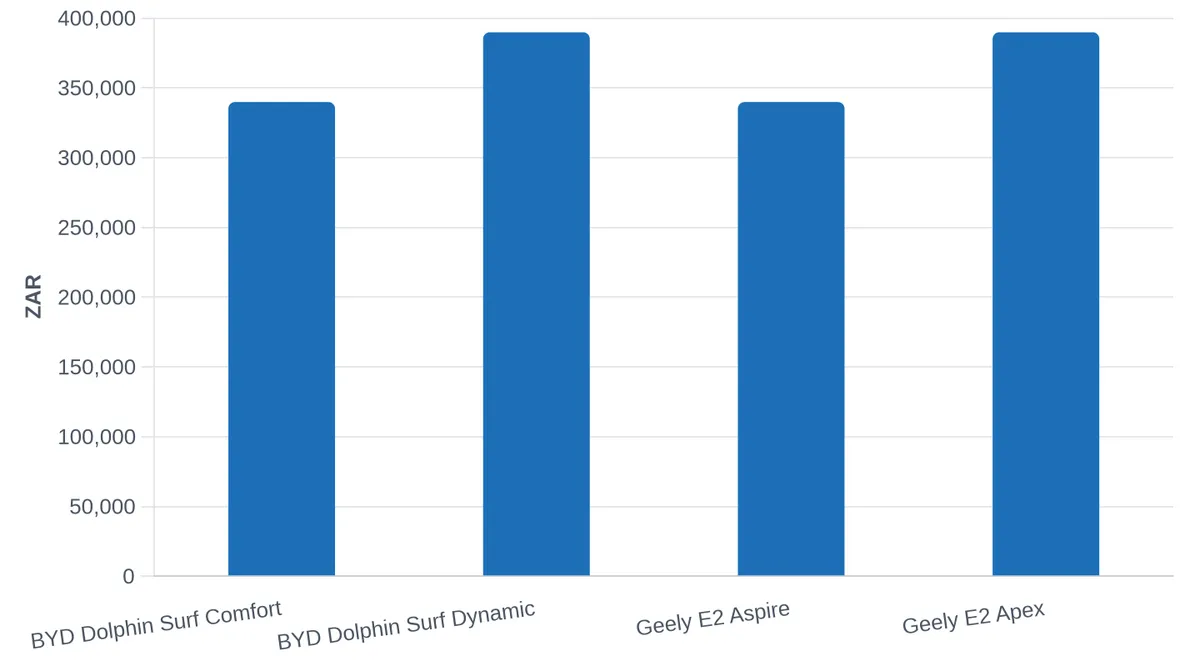
The Dolphin Surf does not sit alone at the R339,900 entry price for long. The Geely E2 Aspire launched in April 2026 at exactly the same price, with the Apex variant also matching the Dolphin Surf Dynamic at R389,900. Both cars target the same buyer. Here is how the key numbers compare.
| Spec | BYD Dolphin Surf Comfort | Geely E2 Aspire |
|---|---|---|
| Price | R339,900 | R339,900 |
| Battery capacity | 30 kWh | 39.4 kWh |
| WLTP range | 232 km | 325 km |
| V2L output | 3 kW | 3.3 kW |
| DC fast charging | 30 kW max | 70 kW max |
| 30-80% DC charge time | Not specified | ~25 minutes |
On paper, the Geely E2 Aspire has a significant battery and fast-charging advantage at the same price. Its 39.4 kWh battery versus the Dolphin Surf Comfort’s 30 kWh, combined with 70 kW DC charging versus 30 kW, means the E2 replenishes faster on the public network and goes further between charges. For buyers who are nervous about South Africa’s still-developing public charging infrastructure, that larger battery and faster DC top-up is a meaningful differentiator.
The Dolphin Surf’s advantage lies in BYD’s established local footprint. BYD became the number-one EV brand in South Africa by Q4 2025, with a dealer network, parts supply chain, and service history that a newer entrant like Geely E2 is still building.
What It Truly Costs to Charge
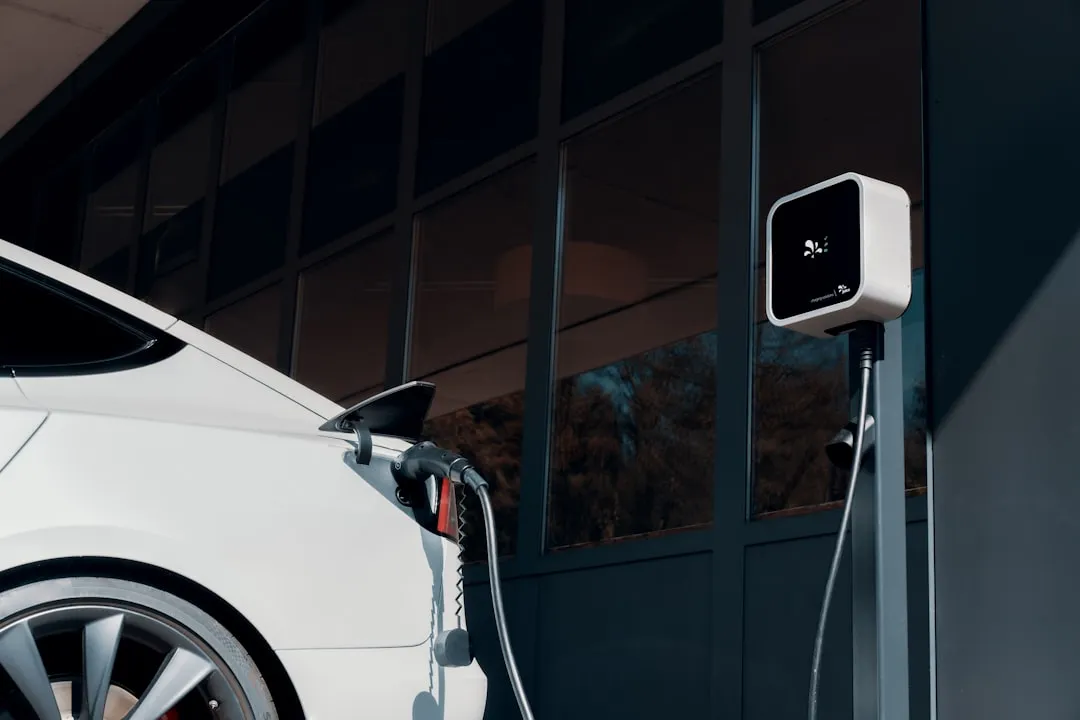
The Dolphin Surf’s running costs are where the ownership argument gets compelling. Home charging in South Africa costs between R3.00 and R4.00 per kWh. At that rate, filling the Comfort’s 30 kWh battery from empty costs roughly R90 to R120, and delivers 232 km of WLTP range. Compare that to a petrol hatchback consuming 7 to 8 litres per 100 km at around R26.50 per litre inland (mid-2026 pricing), which works out to approximately R185 to R212 per 100 km.
Public DC fast charging costs more, between R7.00 and R7.50 per kWh as of August 2025, according to our public charging network analysis. A full charge from empty on a public fast charger for the Comfort model would cost roughly R210 to R225. That is still competitive with petrol on a per-kilometre basis, but the home-charging advantage is clearly superior for daily commuters.
South Africa now has approximately 650 public EV chargers across 445 charging sites, with most concentrated in Gauteng, the Western Cape, and KwaZulu-Natal. For a Dolphin Surf owner in a major metro who charges at home overnight, the public network is largely a top-up convenience rather than a necessity.
Calculate your real Dolphin Surf charging costs
Home Charger Installation: What You Need and What It Costs
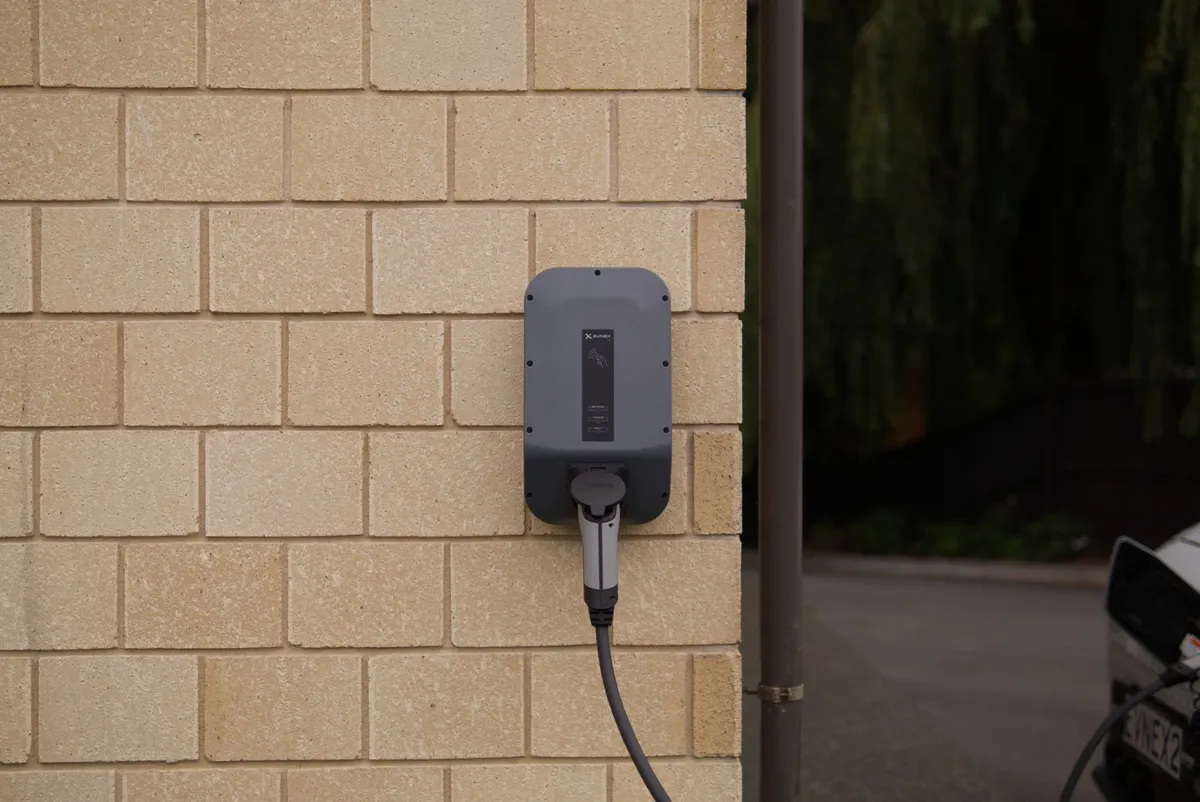
The Dolphin Surf supports AC charging via a standard Type 2 connector. A 7 kW single-phase wallbox is the practical home charging solution for most South African households, as most homes are wired single-phase and can support a 7.4 kW wallbox without a major infrastructure upgrade.
A fully installed, SANS 10142-1 compliant 7 kW wallbox with electrical Certificate of Compliance costs R13,000 to R15,000 all-in from a certified installer. That is not optional, all EV charger installations in South Africa must comply with SANS 10142-1 and carry an electrical CoC. An unlicensed installation voids your home insurance and exposes you to personal liability.
Smart EV chargers that can be scheduled to charge during off-peak hours deliver annual savings of R1,500 to R3,000 compared to unmanaged daytime charging. Over five years, that scheduling discipline alone can offset a significant portion of the charger installation cost.
If you want to understand the right charger spec for your home and get a certified installer quote, the fastest route is to use the free tool below.
Five-Year Total Cost of Ownership vs a Petrol Alternative
The Dolphin Surf’s purchase price of R339,900 sits R20,500 below a base Toyota Corolla Cross at R360,400. But the more meaningful comparison is what you spend over five years of ownership.
A directly comparable five-year TCO analysis for the BYD Atto 3 versus the Toyota Corolla Cross, both positioned in the same segment, shows the BYD delivering R143,935 in total savings, driven by lower fuel costs, approximately R33,000 less in maintenance over five years, and zero scheduled servicing costs under BYD’s included service plan. EV insurance runs approximately 10 to 15% higher than a comparable petrol vehicle, which is a real offset, but it does not come close to erasing the fuel and maintenance advantage.
BYD’s warranty package further de-risks the ownership equation. The battery carries an 8-year/200,000 km warranty, with coverage triggered if the battery falls below 70% of its original capacity. The complete vehicle warranty runs 6 years/150,000 km with free servicing included. BYD Atto 3 owners with over 100,000 km on the clock are reporting 96 to 98% battery health retention, a reassuring real-world data point for prospective Dolphin Surf buyers considering BYD’s battery technology.
Modern EV batteries typically lose 5 to 10% of their capacity in the first five years under normal use, and the average annual degradation rate across the industry sits at approximately 2.3% per year. At that rate, a 30 kWh Dolphin Surf Comfort battery would retain around 27 kWh of effective capacity after five years, still delivering comfortably over 200 km of real-world range for most daily use cases.
Load-Shedding, the Grid, and the Backup Power Reality Check
Eskom declared the end of load-shedding in February 2026, and over a year without structured outages has eased adoption anxiety among prospective EV buyers. However, localised municipal outages continue, and the muscle memory of backup-power planning remains deeply embedded in South African households. That is why the Dolphin Surf’s V2L capability still resonates as a genuine purchase consideration rather than mere marketing.
Public chargers are grid-dependent and stop working during outages. Home chargers can be integrated with solar inverter systems to charge during the day using solar generation, or to draw from a battery backup during the evening charging window. A hybrid solar and battery system allows you to time-shift solar energy to evening use and maintain charging availability through localised outages, as detailed by Synergy Energy Solutions in their solar EV charging guide.
The BYD Atto 3 and Dolphin are also confirmed as V2H (Vehicle-to-Home) capable via the Sigenergy SigenStor bi-directional DC charger, which is rolling out through 2026. V2H goes a step further than V2L by integrating the car’s battery with the home’s electrical circuits, but V2H regulatory approval for South Africa has not yet been confirmed, and the bi-directional meter cost responsibility remains a contested policy question locally.
For most Dolphin Surf owners today, V2L via extension leads for essential appliances is the practical reality. It works, it is useful, and it costs nothing extra beyond the car itself.
The Bigger Picture: SA’s EV Market Momentum
The Dolphin Surf arrived at a pivotal moment. BEV sales surged 97.1% in Q1 2026 compared to Q1 2025, with 544 BEVs sold and March 2026 recording 389 BEV sales, the highest monthly figure in South African history. The government’s 150% tax deduction for EV production investments took effect on 1 March 2026, signalling manufacturer commitment and lifting demand for new energy vehicles.
BYD is also planning to deploy 200 to 300 ultra-fast 1 MW Flash charging stations across South Africa by year-end 2026, starting from April 2026, some incorporating solar panels to reduce grid reliance. Zero Carbon Charge launched South Africa’s first off-grid, solar-powered EV charging network on the N3 corridor, backed by a R100 million DBSA investment, with plans for 120 stations nationwide. The infrastructure picture is improving meaningfully and rapidly.
Chinese manufacturers have triggered a genuine price war in the affordable EV segment. The entry barrier has dropped by over R400,000 in two years, and the Chery Q EV is expected to launch in Q3 2026 targeting sub-R340,000 pricing to compete directly with the Dolphin Surf and Geely E2. Competition is healthy for the buyer.
Frequently Asked Questions
Can the BYD Dolphin Surf power my home during an outage?
It can power essential appliances, a fridge, TV, router, phone chargers and lights, through its 3 kW V2L output. It cannot run an electric geyser, air conditioner, or tumble dryer. Think of it as a generator for essentials, not a whole-home backup system.
How much does it cost to charge the Dolphin Surf at home?
At South Africa’s typical home tariff of R3.00 to R4.00 per kWh, a full charge of the Comfort’s 30 kWh battery costs approximately R90 to R120. That delivers up to 232 km of WLTP range.
Do I need a special charger installed at home?
Yes. A certified 7 kW wallbox installation, compliant with SANS 10142-1 and with an electrical CoC, costs R13,000 to R15,000 all-in from a registered installer. Using an unlicensed installer voids your home insurance.
How does the Dolphin Surf compare to the Geely E2 at the same price?
At R339,900, the Geely E2 Aspire offers a larger 39.4 kWh battery (vs 30 kWh), longer 325 km WLTP range (vs 232 km), and faster 70 kW DC charging (vs 30 kW). The Dolphin Surf benefits from BYD’s more established SA dealer and service network.
What is the battery warranty on the Dolphin Surf?
BYD provides an 8-year/200,000 km battery warranty, with coverage triggered if capacity drops below 70% of the original figure. The complete vehicle warranty runs 6 years/150,000 km with free servicing included.
Is load-shedding still a risk for EV owners?
Eskom declared the end of load-shedding in February 2026. Localised municipal outages continue in some areas. Home charging paired with a solar inverter and battery backup provides meaningful resilience. Public chargers remain grid-dependent and go offline during outages.
Compare the Dolphin Surf to other affordable EVs
See specs, pricing, and total cost of ownership side-by-side.
Compare EV models →WhatsApp us
CoC-certified installers, nationwide