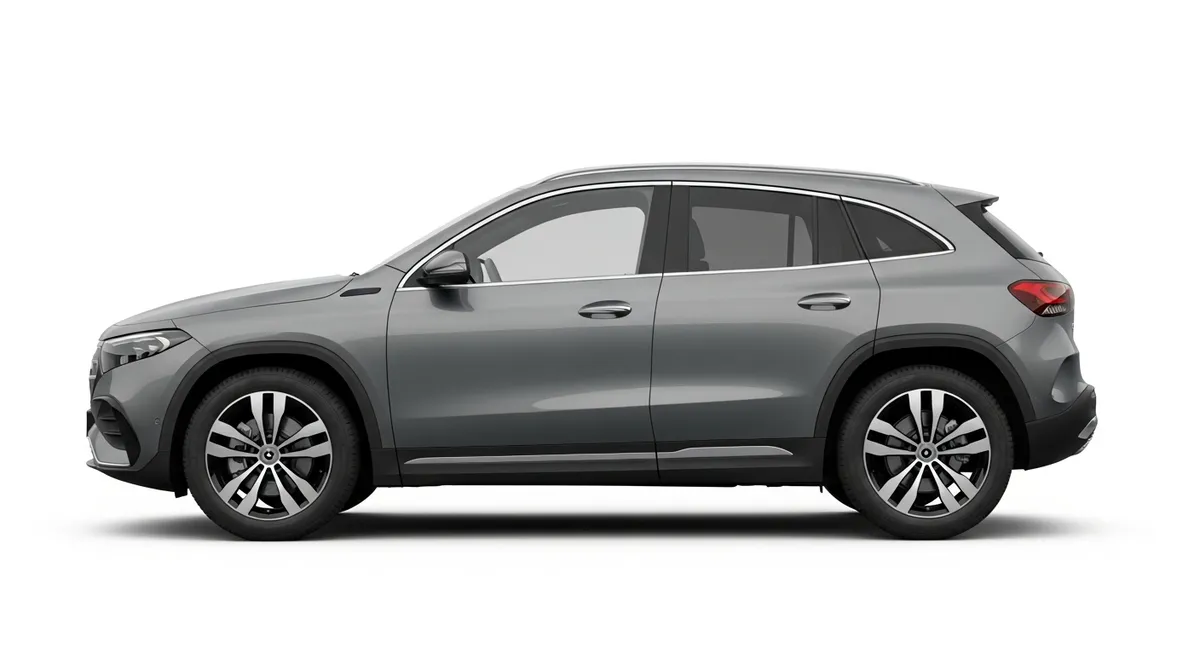

A Mercedes EQA 250 owner in South Africa discovered their charge port door jammed shut mid-week — u/Gasoline420 documented the saga on r/electricvehicles, trying every unlock trick before admitting defeat and booking a dealer visit. It’s the kind of friction that doesn’t appear in the R1.18 million brochure, but it matters when you’re weighing the EQA against its R972,000 petrol sibling, the GLA 200. That R208,000 gap buys you an electric drivetrain, 490 km of WLTP range, and a charging infrastructure dependency the GLA simply doesn’t have.
The Mercedes-Benz EQA 250 vs Mercedes-Benz GLA 200 comparison cuts to the heart of South Africa’s EV transition in 2026. These models share a platform, a badge, and a showroom. They diverge on powertrain — and on the R208,000 price gap that separates them. This analysis uses real-world data to answer the question every buyer asks: does the electric version pay for itself, or are you paying a premium for novelty?
Price comparison: what you pay at the dealership
Mercedes-Benz South Africa positions the EQA and GLA as siblings, not rivals — but the price gap is real. The EQA 250 Progressive starts at R1,179,400 (2022 pricing, still current for base model), while the AMG Line variant retails at R1,232,400 as of January 2026. The GLA 200 Night Edition — the most recent comparable trim — lists at R972,387 (January 2026). Spec-for-spec, you’re looking at a R207,013–R260,013 premium for the electric drivetrain — a significant investment that demands careful analysis of running costs and ownership experience.
| Model | Price (ZAR) | Power (kW) | Torque (Nm) | Service Plan |
|---|---|---|---|---|
| Mercedes-Benz EQA 250 Progressive | R1,179,400 | 140 kW | 375 Nm | Included (5yr/100,000km) |
| Mercedes-Benz GLA 200 Night Edition | R972,387 | 120 kW | 270 Nm | Included (5yr/100,000km) |
Both models include Mercedes-Benz’s Premium Drive Comfort Care service plan, so maintenance is a wash for the first five years. The EQA delivers 20 kW more power and 105 Nm more torque — electric motors always win the spec-sheet drag race — but the GLA 200’s turbocharged four-cylinder is no slouch in real-world overtaking.
Range, efficiency, and the real cost per kilometre
EQA 250: battery size and real-world range
The EQA 250 packs a 66.5 kWh usable battery and delivers 490 km WLTP range according to Mercedes-Benz South Africa’s official specifications (consistent across both Progressive and AMG Line variants, 2022–2026). The official consumption figure is 17.5 kWh/100 km, which aligns mathematically with the battery capacity. Translate that to South African highway driving — 110–120 km/h on the N1 or N3 — and you’re looking at 390–440 km in warm weather, less in winter or with the air-con cranked. Real-world owners report 18–20 kWh/100 km depending on driving style.
One EQA 250+ owner on Reddit documented a 20% charging loss when AC charging at home — 30 kWh drawn from the wall meter to add 23.3 kWh to the battery. That’s a real cost you need to factor in: for every 100 kWh you pay Eskom for, only 80 kWh reaches the battery. DC fast charging is more efficient (5–10% loss), but you’ll pay R7.00–R7.35 per kWh at Rubicon or GridCars stations versus R2.80–R3.50 at home on tier-1 metro tariffs.
GLA 200: fuel consumption and tank range
The GLA 200’s turbocharged 1.3-litre petrol engine claims a combined consumption of 6.8 litres/100 km (figures vary by source — consult Mercedes-Benz for the latest WLTP data). With a 50-litre tank, you’re looking at 700+ km of range on paper, but real-world highway driving at 120 km/h typically pushes consumption to 7.5–8.5 l/100 km, giving you 580–650 km between fills.
At R24 per litre (January 2026 inland petrol price), every 100 km costs you R163–R204 depending on your right foot. The EQA, charged at home on Eskom’s Homepower tariff (R2.80–R3.50/kWh in tier-1 metros after the April 2026 8.76% increase), costs R53–R67 per 100 km including charging losses. That’s a 67–69% saving per kilometre — if you can charge at home.
Monthly running costs: 1,500 km scenario
A typical Johannesburg commuter covers 1,500 km per month, split 70% city / 30% highway. We’ll use conservative real-world figures and January 2026 pricing.
| Cost Item | EQA 250 (Electric) | GLA 200 (Petrol) |
|---|---|---|
| Energy consumption | 19 kWh/100 km (real-world) | 7.8 l/100 km (real-world) |
| Monthly energy use | 285 kWh (÷ 0.8 efficiency = 356 kWh from wall) | 117 litres |
| Energy cost | 356 kWh × R2.80 = R997 | 117 L × R24 = R2,808 |
| Service/maintenance | R0 (plan included, minimal brake wear) | R0 (plan included for 5yr/100k km) |
| Total monthly | R997 | R2,808 |
| Monthly saving (EV) | R1,811 | |
That’s R21,732 per year in your pocket if you drive the EQA. But remember: this assumes 100% home charging at R2.80/kWh (lower end of the tier-1 metro range post-April 2026 tariff hike). If you rely on public DC fast chargers at R7.00/kWh, your monthly cost jumps to R2,492 — still cheaper than petrol, but the margin shrinks to R316/month.
Five-year total cost of ownership
Over five years (90,000 km total — 18,000 km/year, slightly above the 1,500 km/month scenario to account for holiday road trips), the numbers look like this:
| Cost Category | EQA 250 | GLA 200 |
|---|---|---|
| Purchase price | R1,179,400 | R972,387 |
| Fuel/electricity (5yr, 90k km) | R59,850 (home charging @ R2.80/kWh) | R168,480 (petrol @ R24/L) |
| Service & maintenance | R0 (plan included) | R0 (plan included) |
| Insurance (estimated) | R78,000 (R1,300/mo × 60) | R66,000 (R1,100/mo × 60) |
| Tyres (1 set) | R12,000 | R10,000 |
| Total 5-year cost | R1,329,250 | R1,216,867 |
| Difference | EQA costs R112,383 more over 5 years | |
The EQA saves you R108,630 in fuel over five years, but higher insurance (premiums track purchase price) and the upfront premium mean you’re still R112,383 behind at the 90,000 km mark. Push the timeline to eight years or add rooftop solar (cutting your electricity cost to near-zero), and the EQA pulls ahead. If petrol climbs to R28/litre — not unrealistic given NERSA’s 8.76% tariff hikes and global oil volatility — the crossover happens sooner.
Charging at home: 7.4 kW vs 11 kW vs 22 kW
The EQA 250 accepts 11 kW AC charging as standard. That means:
- 7.4 kW charger: 0–100% in ~9 hours (66.5 kWh ÷ 7.4 kW). Fine for overnight charging, but you’ll need a full night if you arrive home near-empty.
- 11 kW charger: 0–100% in ~6 hours. This is the sweet spot — matches the car’s onboard charger, gives you flexibility for late-night top-ups.
- 22 kW charger: Wasted on the EQA. The car will still draw only 11 kW, so you’re paying for hardware you can’t use unless you plan to upgrade to a higher-spec EV later.
Most South African homes have single-phase supply, which caps you at 7.4 kW unless you upgrade to three-phase (common in newer estates, rare in older suburbs). If you’re on single-phase, a 7.4 kW ChargePoint-installed unit will do the job — just plan your charging overnight. If you have three-phase, spec the 11 kW unit and you’ll never wait.
On the road, the EQA supports 100 kW DC fast charging, taking the battery from 10% to 80% in roughly 30 minutes at a compatible station. GridCars operates over 450 public charging sites across South Africa as of January 2026, and CHARGE’s new solar-powered stations on the N3 (launched May 2026) mean you can tackle Johannesburg–Durban without range anxiety.
South Africa-specific considerations
Load-shedding and energy security
Eskom’s Energy Availability Factor hit 65.85% year-to-date in early 2026, per the utility’s own reporting, reducing load-shedding frequency. But the grid remains fragile. If you’re charging an EQA at home, you need either:
- A battery backup system (8–10 kWh Pylontech or similar) to bridge 2–4 hour load-shedding windows, or
- Rooftop solar + battery (10 kW array + 15 kWh storage) to charge the car during the day and ride out evening blackouts.
The GLA 200 doesn’t care about load-shedding — petrol stations have generators. That’s a real-world convenience the EQA can’t match unless you invest in energy independence. Budget R150,000–R250,000 for a solar + storage system that can charge your EV and run your home.
Service network and parts availability
Mercedes-Benz has 50+ dealerships in South Africa, and all are trained to service the EQA — but u/Gasoline420’s stuck charge-port saga highlights a risk: EV-specific faults (charge-port actuators, high-voltage contactors, battery management modules) require specialist diagnostics and parts that may take weeks to ship from Germany. The GLA 200’s drivetrain is proven, global, and shares components with millions of other Mercedes engines — parts are in-country, and any competent indie can fix it after the warranty expires.
Resale value and market maturity
South Africa’s EV market hit a record 389 sales in March 2026, driven by sub-R400k Chinese models like the BYD Dolphin Surf at R341,900. But the premium segment remains thin — there’s no deep used-EV market yet, so your EQA’s residual value in 2031 is a guess. The GLA 200 will depreciate predictably (50–55% over five years), and you’ll find buyers. The EQA might hold value better if EVs go mainstream, or crater if battery tech leaps ahead and 66.5 kWh feels tiny in 2030.
The honest verdict: who should buy which
Buy the EQA 250 if you:
- Have off-street parking and can install a home charger (essential — public charging as your primary source will drive you mad).
- Drive predictable daily routes under 350 km with reliable home charging overnight.
- Already have or plan to install solar + battery storage to insulate yourself from Eskom’s tariff hikes and load-shedding.
- Value the instant torque and silence of electric drive — the EQA is genuinely more relaxing in traffic than the GLA.
- Can afford to treat the R207k premium as the cost of early adoption and environmental leadership, not a pure financial play.
Stick with the GLA 200 if you:
- Park on the street or in a complex without charging infrastructure (and no appetite to fight a body corporate).
- Regularly drive 500+ km days — Johannesburg to Durban, Cape Town to George — where refuelling in 5 minutes beats hunting for a DC charger.
- Need maximum flexibility and don’t want to plan trips around charging stops.
- Want the lower upfront cost and proven resale market of a conventional premium SUV.
- Live in a region with patchy public charging (anything outside Gauteng, Western Cape, and the N3 corridor).
As u/FinancialLiving1530 noted on r/electriccars: “I like the exterior of the Mercedes [EQA 250+] the most but also read a lot of criticism about the electrical performance.” That’s the tension in a nutshell — the EQA looks the part and wears the three-pointed star, but it’s not the most efficient EV per rand spent, and it demands infrastructure the GLA 200 doesn’t.
Ready to charge smarter?
If you’ve decided the EQA 250 fits your life — off-street parking, daily commute under 350 km, and appetite for the electric future — the next step is a home charging solution that works with South Africa’s grid realities. ChargePoint SA installs 7.4 kW and 11 kW AC chargers nationwide, with optional solar integration and battery backup to keep you charging through load-shedding.
Book a free site assessment and we’ll design a system that matches your EQA’s 11 kW onboard charger, your home’s electrical supply, and your budget. Whether you’re in Johannesburg, Cape Town, or Durban, we’ll get you charging overnight — so you wake up to a full battery every morning, no petrol station detours required.
Image credits
All vehicle images courtesy of Wikimedia Commons under Creative Commons licensing.