
Key points
- The Audi e-tron 55 quattro carries a 95 kWh battery with up to 417 km WLTP range; real-world SA mixed driving delivers 350 to 400 km (CFAO Mobility).
- SA heat above 35°C cuts EV range by roughly 8 to 18% (AAA Research); highway speeds above 130 km/h add another 20 to 28% penalty (Geotab).
- Used e-tron prices on AutoTrader run from R829,950 to R1,450,000 as of July 2026; the Q6 e-tron arrives at R1,236,805 to R1,404,005 (Autogiz.za); the RS e-tron GT Performance produces 680 kW and covers 0-100 km/h in 2.5 seconds, making it the most powerful production car Audi has built.
- Home charging costs roughly R0.93 per km versus R2.40 per km for petrol, a 61% saving (ChargePoint SA). Over five years at 20,000 km per year, EV electricity costs roughly R60,000 versus R210,000 for petrol.
- South Africa levies a 25% import duty on fully built EVs versus 18% on combustion vehicles, that gap is baked directly into the sticker price.
- The e-tron carries a 5-year/100,000 km vehicle warranty and an 8-year/160,000 km battery warranty (Audi South Africa).
- Nationally there are now approximately 445 public charging sites with 650 individual chargers and over 1,200 connectors (ChargePoint SA, 2026).
The Audi EV line-up in South Africa today
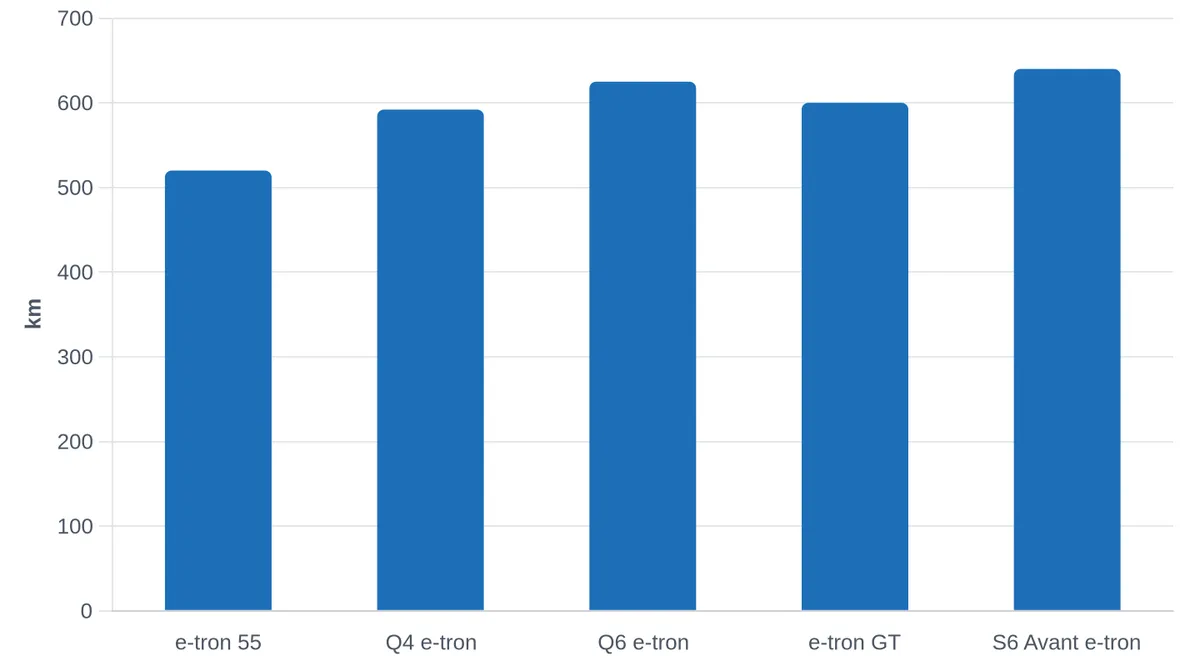
Audi sells three distinct electric model families in South Africa: the original e-tron SUV (now marketed as the Q8 e-tron in some markets), the sporty e-tron GT grand tourer, and the incoming Q6 e-tron on Volkswagen Group’s new PPE platform. Each targets a different pocket and use case, and the pricing spread is wide enough that they barely compete with each other.
South Africa remains a low-volume EV market. Business Day reports that BEVs still represent only 0.2% of new vehicle sales, but the trajectory is shifting fast. BEV sales jumped 193% year-on-year in the first five months of 2026 (Sunday Times data cited by The South African), so there are now meaningful numbers of these cars on SA roads and a genuine used market to shop from. Battery electric vehicle sales reached 544 units in Q1 2026 alone, more than double the 265 units recorded in Q1 2025, according to IOL Motoring.
Audi e-tron 55 quattro and Sportback: the core model
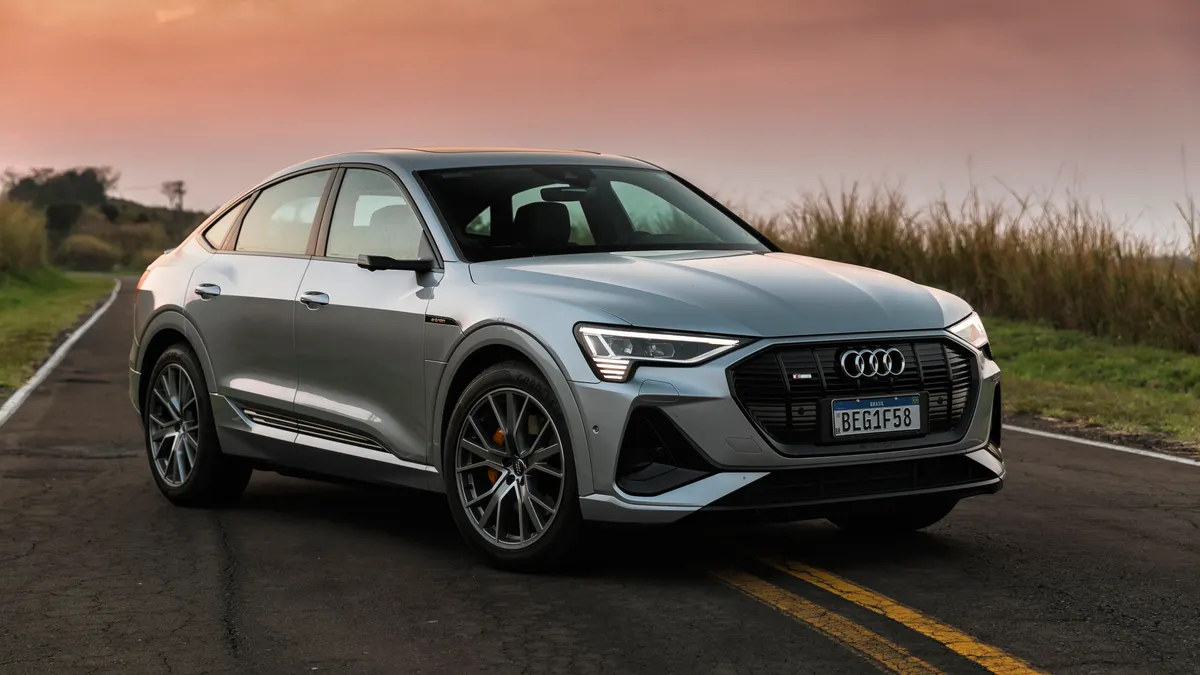
The e-tron 55 quattro is where most buyers start. Audi South Africa quotes up to 417 km WLTP for the standard body and up to 446 km for the Sportback. The 95 kWh battery drives dual motors producing 300 kW and 664 Nm, with a 0 to 100 km/h time of 5.7 seconds (Recharged.co.za). The e-tron 50 quattro Advanced steps down to a 336 km WLTP range, according to Audi South Africa’s official FAQ. When the SA electricity tariff of R2.80-R3.20/kWh is applied, a full charge costs well under R300 from a home wallbox, versus roughly R420 to fill a comparable petrol SUV at the April 2026 inland price of R23.36/L.
Boot capacity is around 660 litres, expandable, and the cabin seats five comfortably with ample rear legroom. Dual electric motors provide quattro all-wheel drive, and the air suspension adjusts ride height for light off-road use (CFAO Mobility South Africa). The standard onboard AC charger is 11 kW, with a 22 kW option; DC fast charging peaks at 150 kW for a verified 0 to 80% in approximately 30 minutes (Audi USA FAQ / Audi Press).
The e-tron launched in South Africa at R1,990,000 for the 55 Advanced variant in November 2021. Every purchase included a R5,000 industrial socket installation subsidy, and the warranty package covers the vehicle for 5 years or 100,000 km and the battery for 8 years or 160,000 km. Used examples on AutoTrader now range from R829,950 to R1,450,000, making the e-tron accessible to a wider pool of buyers. One caution: internationally, around 70,000 e-tron owners were advised to limit charging to 80% following a battery defect investigation, SA buyers should confirm with their dealer whether their specific vehicle is affected and whether a software resolution has been issued.
Real-world range in South African conditions
WLTP figures overstate real-world range by roughly 15 to 25% under typical conditions. Overlay SA-specific factors and the gap widens further: temperatures above 35°C reduce range by 8 to 18% (AAA Research), and sustained highway speeds above 130 km/h add another 20 to 28% penalty (Geotab). Climate control, air conditioning in a Johannesburg summer, can consume up to 30% of driving range on its own (Audi Middle East). For practical planning, CFAO Mobility South Africa puts the e-tron 55’s real-world SA range at 350 to 400 km under moderate conditions. That is sufficient for Johannesburg to Pretoria commuting for weeks without a public charge, and more than adequate for the Johannesburg to Bloemfontein leg of a Cape trip if you stop at a DC fast charger en route.
Audi Q6 e-tron: the next generation arrives
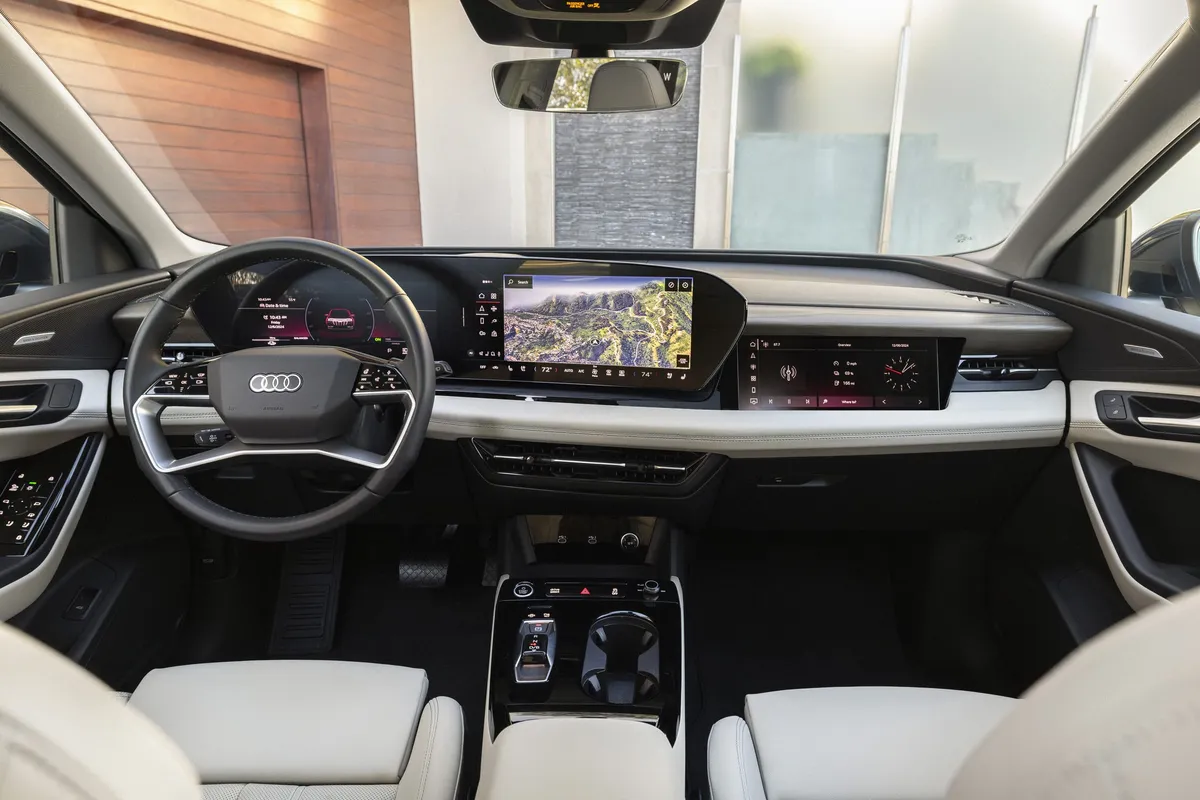
Built on the PPE (Premium Platform Electric) architecture shared with the Porsche Macan EV, the Q6 e-tron is a meaningful step forward. Audi quotes a WLTP range of well over 625 km for the Q6 e-tron quattro, with DC fast charging at up to 270 kW, meaning 10 minutes on a high-power charger adds 255 km of range, and 10 to 80% takes just 21 minutes. That changes the maths on long-distance SA travel considerably. SA pricing (2026) is estimated at R1,236,805 to R1,404,005 depending on variant (Autogiz.za), positioning the Q6 e-tron between the used e-tron market and the e-tron GT.
Audi South Africa has also secured approval for the A6 e-tron Avant and Q6 e-tron SUV among eight confirmed 2027 models, signalling that the PPE platform will underpin Audi’s local EV expansion for years to come.
Audi e-tron GT and RS e-tron GT Performance: the performance flagship
The e-tron GT quattro produces 370 kW in standard mode and 430 kW with Launch Control active, with a quoted WLTP range of more than 600 km. DC fast charging peaks at up to 320 kW, adding roughly 285 km in 10 minutes. The standard onboard AC charger is 11 kW with a 22 kW option; verified real-world DC fast charging time from 5 to 80% is 22.5 minutes at a 270 kW charger. Audi South Africa originally launched the e-tron GT at R2,715,000.
Above that sits the RS e-tron GT Performance, which Audi South Africa confirmed as the brand’s most powerful production car ever. It produces 550 kW continuously and 680 kW (925 hp) in Launch Control, sprinting from 0 to 100 km/h in 2.5 seconds. The 105 kWh battery supports DC fast charging at up to 320 kW with a 0 to 80% time of 18 minutes (The Citizen / Audi South Africa). Audi includes wall-mount chargers and a Mode 3 public cable with the vehicle. No confirmed SA retail price is available from Audi at time of publication, contact your nearest Audi dealer for a formal quote. The Citizen confirmed its local launch in July 2026.
| Model | WLTP range | Peak DC charge | 10-80% charge time |
|---|---|---|---|
| e-tron 55 quattro | Up to 417 km | 150 kW | ~30 min (0-80%) |
| e-tron 55 Sportback | Up to 446 km | 150 kW | ~30 min (0-80%) |
| e-tron 50 quattro | Up to 336 km | 150 kW | ~30 min (0-80%) |
| Q4 e-tron | Up to 592 km | Up to 185 kW | ~28 min (10-80%) |
| Q6 e-tron quattro | Well over 625 km | 270 kW | 21 min (10-80%) |
| e-tron GT quattro | More than 600 km | Up to 320 kW | ~22.5 min (5-80%) |
| RS e-tron GT Performance | Up to 320 kW | ~18 min (0-80%) |
Calculate your Audi EV home charging costs in SA
The import duty problem and what it means for pricing
Every Audi EV sold in South Africa arrives as a fully built import. SA currently levies a 25% import duty on fully built EVs versus 18% on combustion engine vehicles, a reverse incentive that inflates the sticker price of every electric car before a single rand of dealer margin or VAT is added. Until that tariff structure changes, Audi EVs will carry a meaningful premium over equivalent petrol models, and buyers should factor this into total-cost-of-ownership calculations rather than comparing purchase prices in isolation.
The running-cost advantage helps offset the premium. At home charging rates of R2.80 to R3.20/kWh, driving 20,000 km per year in an Audi e-tron costs roughly R60,000 in electricity over five years, versus approximately R210,000 in petrol for a comparable SUV doing 9 L/100 km at the April 2026 inland price. That is a five-year fuel saving of over R150,000, which goes a long way toward bridging the purchase-price gap created by the import duty differential.
Charging an Audi EV in South Africa: home, public and load-shedding
Home charging: the foundation
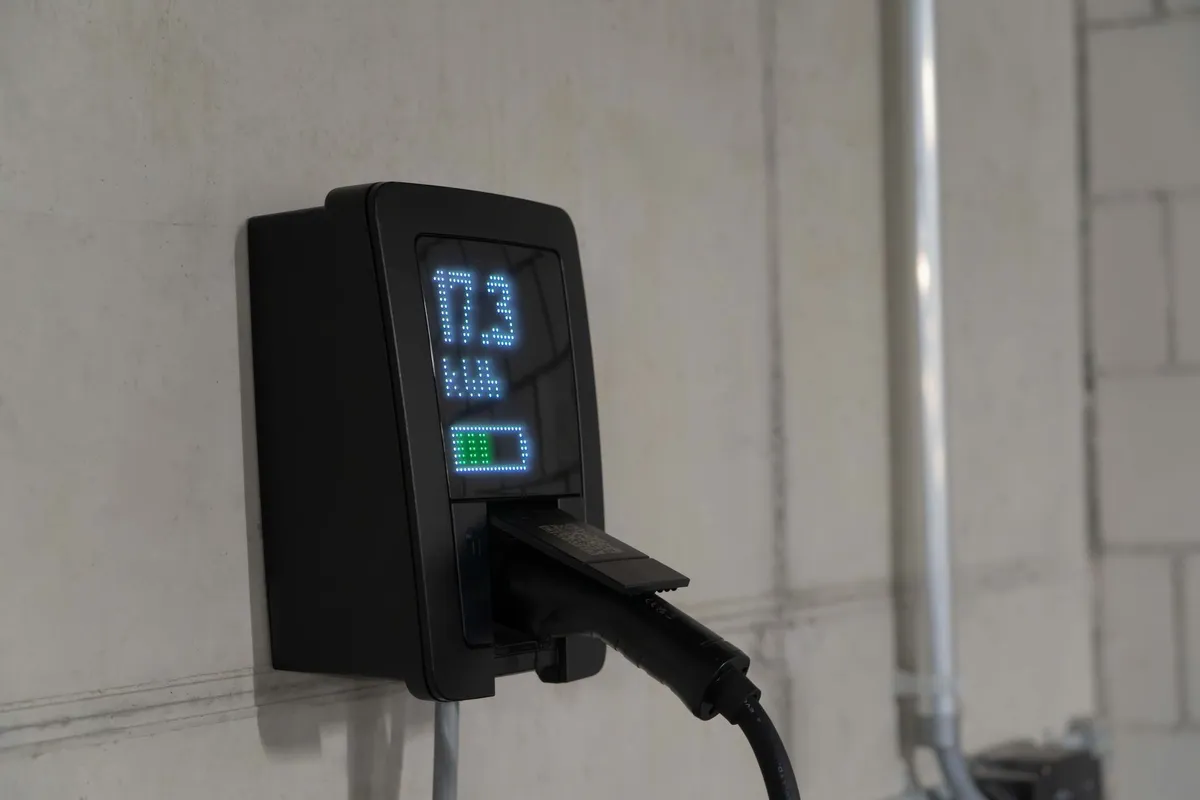
Audi South Africa notes that over 80% of electric charging takes place at home, and the numbers support that approach strongly. A standard 11 kW AC home wallbox charges the e-tron 55 from flat in roughly 13 hours; an 8-hour overnight session adds approximately 256 km of range. For the average SA driver, whose daily distance is typically no more than 30 km (Hippo.co.za), that means a full charge every few nights, costing well under R150 at current municipal tariffs.
Installing a home wallbox in South Africa costs R14,000 to R26,000 all-in for a 7 kW single-phase unit, or R18,000 to R40,000 for a three-phase 22 kW installation, depending on the property and distance from the DB board. Every installation requires a Certificate of Compliance (CoC) issued by an ECSA-registered electrician under SANS 10142-1. If you are buying a new Audi EV, the purchase included a R5,000 industrial socket subsidy at launch, confirm with your dealer whether this still applies on current stock.
Load-shedding is a genuine consideration but not a dealbreaker. A 60 kWh battery charges fully in 8 to 10 hours on a home wallbox, which means even Stage 4 schedules can be worked around with overnight or mid-morning charging windows. The Eskom Homeflex off-peak tariff (22:00 to 06:00) runs at approximately R1.45 to R2.25/kWh, the cheapest electricity you can buy in SA, making a disciplined overnight charging habit both grid-friendly and cost-optimal.
Public charging network
South Africa’s public charging network has grown substantially. ChargePoint SA’s 2026 network map counts approximately 445 public charging sites with around 650 individual chargers and over 1,200 connectors nationally, up from roughly 200 stations in 2022. GridCars operates approximately 60% of the network’s capacity, with Rubicon, CHARGE and Zero Carbon Charge accounting for most of the balance. Audi advertises access to over 300 charging connectors, most of which support DC fast charging, via its GridCars and Rubicon partnerships.
Public DC fast charging costs R6.00 to R8.50/kWh at most networked stations, compared with R2.80 to R3.20/kWh at home, roughly 2 to 3 times the home rate. For corridor travel, CHARGE launched South Africa’s first off-grid EV charging stations on the N3 in May 2026, backed by a R100 million Development Bank of Southern Africa investment, with plans to deploy 120 solar-powered stations nationwide. The N1 Johannesburg to Cape Town route is served by DC fast-charger stops including Huguenot Toll, Touws River, Three Sisters, Richmond, Hanover, Colesberg, Trompsburg and Springfontein, most operated by GridCars or Charge Forward.
All Audi e-tron vehicles use Type 2 AC connectors and CCS (Combined Charging System) for DC fast charging, both of which are the dominant standards in South Africa under SANS 62196-2 (AC) and SANS 62196-3 (DC). Compatibility with virtually every public charger on the national network is not an issue.
Planning your home charger installation
If you are buying an Audi EV and need a home charger installed, get a free installation quote from a SANS 10142-1 certified installer who can assess your DB board, confirm single-phase or three-phase capacity, and issue the required CoC. A professional installation takes 4 to 8 hours on-site and 7 to 14 days from quote to certificate.
How Audi compares with its premium rivals
| Model | SA price (2026) | WLTP range | Real-world SA range |
|---|---|---|---|
| Audi e-tron 55 quattro (used) | R829,950-R1,450,000 | Up to 417 km | 350-400 km |
| Audi Q6 e-tron (est.) | R1,236,805-R1,404,005 | 625+ km | |
| BMW iX xDrive40 | R1,735,000 | 400-460 km (WLTP) | 350-420 km |
| BMW iX xDrive50 | R2,350,000 | 400-460 km (WLTP) | 350-420 km |
| Mercedes-Benz EQE 350 4MATIC | R1,529,900 | Up to 645 km | 400+ km |
| Tesla Model Y Long Range AWD | R1,250,000 | 533 km (WLTP-equiv.) | 450-500+ km (highway) |
At the used e-tron price point of under R1 million, the Audi represents strong value in a segment where the BMW iX starts at R1,735,000 new. The Q6 e-tron’s combination of 625+ km WLTP range and 21-minute 10 to 80% charging makes it technically superior to the current e-tron platform, and its estimated pricing places it directly against the Mercedes-Benz EQE 350 4MATIC. The Tesla Model Y Long Range remains a formidable value proposition at R1,250,000 with real-world highway range of 450 to 500+ km.
What is coming: Audi’s EV pipeline for SA
Audi’s local product plans are unusually transparent. Three additional new models were confirmed for 2026, including the RS e-tron GT Performance already covered above. Looking further ahead, eight models have been approved for 2027, including the A6 e-tron Avant and Q6 e-tron SUV, both on the PPE platform. The Audi A2 e-tron is set for a world premiere in autumn 2026 as the brand’s entry-level electric model in the compact segment, though no SA launch date has been confirmed. The S6 Avant e-tron offers 370 kW (405 kW with Launch Control) and over 640 km of WLTP range, a potential future addition to the local range.
The pattern is clear: Audi is shifting its SA product strategy firmly toward electrification, with PPE-platform models offering materially longer range and faster charging than the first-generation e-tron. Buyers who wait for the Q6 e-tron or A6 e-tron Avant will get significantly better technology; buyers who want a premium EV now can access the original e-tron at used-car prices that represent good value relative to new alternatives.
Battery health, warranty and depreciation
The e-tron’s 8-year/160,000 km battery warranty is among the stronger offerings in SA’s premium EV segment. Battery degradation under normal home-dominant charging tracks around 1 to 2% capacity loss per year (Recharged.com), meaning an e-tron used primarily as a home-charged daily driver should retain around 80 to 85% of its original range after a decade. Frequent DC fast charging accelerates degradation to around 3% annually, acceptable if used occasionally, but not ideal as a primary charging strategy.
On depreciation, the e-tron 55 loses approximately 68.7% of its value over five years according to iSeeCars, steeper than equivalent petrol luxury SUVs, which typically depreciate 55 to 60% over the same period. The used-market pricing on AutoTrader confirms this trajectory. The counterbalance is the running-cost advantage: five-year fuel savings of R150,000+ and reduced maintenance (services every 30,000 km or 2 years, with no oil changes, timing belt or exhaust system to budget for) partially offset the steeper depreciation curve.
Frequently asked questions
Can I charge an Audi e-tron at a standard South African wall socket?
Technically yes, but it is impractical. A standard 15-amp socket charges the e-tron at roughly 3 kW, a full charge would take over 30 hours. The minimum practical home setup is a 32-amp industrial socket (rated for ~7 kW), which Audi subsidised at R5,000 on launch. For daily convenience, a dedicated wallbox at 11 kW or 22 kW is strongly recommended.
What connector does an Audi e-tron use in South Africa?
Type 2 (IEC 62196) for AC home and public charging; CCS2 (Combined Charging System) for DC fast charging. Both are the dominant standards in South Africa and compatible with all major public networks including GridCars and Rubicon.
How does load-shedding affect Audi EV ownership?
Stage 4 load-shedding creates roughly 4-hour outage windows. An 11 kW wallbox adds around 44 km of range per hour, so a two-hour morning window between outages adds 88 km, more than triple the average SA daily driving distance of 30 km. A solar inverter with battery backup makes you substantially grid-independent for home charging purposes.
Is the 25% import duty on EVs going to change?
No confirmed timeline for a reduction exists as of mid-2026. The 25% duty versus 18% for combustion vehicles is a structural cost that currently inflates every imported EV’s sticker price, including all Audi models sold here.
Which Audi EV should I buy in South Africa right now?
Budget under R1.1 million: a well-specced used e-tron 55 quattro from AutoTrader. Budget R1.2 million to R1.4 million: the incoming Q6 e-tron offers significantly longer range and faster charging on the new PPE platform. Above R2.5 million and want the performance flagship: the RS e-tron GT Performance, contact an Audi dealer for current pricing and availability.
Whatever model you choose, sorting your home charging setup before delivery makes the transition seamless. Get a free installation quote and our ECSA-registered team will assess your DB board, recommend the right charger for your property, and handle the CoC, typically within two weeks from enquiry to energised wallbox.
Find the right Audi EV for your South African budget
Compare range, pricing, and real-world performance across the current line-up.
Explore Audi models →WhatsApp us
CoC-certified installers, nationwide
Illustration: chargepointsa.co.za